Why spend forty hours a week building someone else's empire when the professional networking market is projected to explode from $65.64 billion in 2026 to over $201 billion by 2031? You've likely reached the ceiling of the corporate grind and realized that legacy networking organizations are built on rigid, transactional models that fail to respect your executive expertise. This inefficiency is why owning a networking business company has become the premier choice for professionals seeking high-ROI autonomy. You deserve a model that values measurable results over mandatory attendance.
This guide shows you how to stop participating in broken systems and start owning a tech-enabled enterprise that generates high-margin recurring revenue. You'll learn how to transition from a burnt-out professional to a visionary community leader by leveraging disruptive, proprietary technology. You'll discover the strategic path to securing time freedom and lifestyle scalability through a business model that prioritizes professional credibility. Networking evolved. It's time to stop making connections for others and start owning the infrastructure that makes them possible.
Key Takeaways
- Identify the strategic differences between transactional referral groups and a professional networking business company that focuses on high-level B2B connections.
- Discover how proprietary technology replaces manual tracking to ensure consistent ROI for members while maximizing your operational efficiency.
- Reject the forced referrals and rigid schedules typical of legacy networking organizations in favor of a curated, high-quality membership model.
- Evaluate the franchise opportunity through a strategic lens, focusing on territory availability and the potential for scalable recurring revenue.
- Build lasting professional credibility by positioning yourself as the visionary architect of your city's most influential business community.
What is a Professional Networking Business Company?
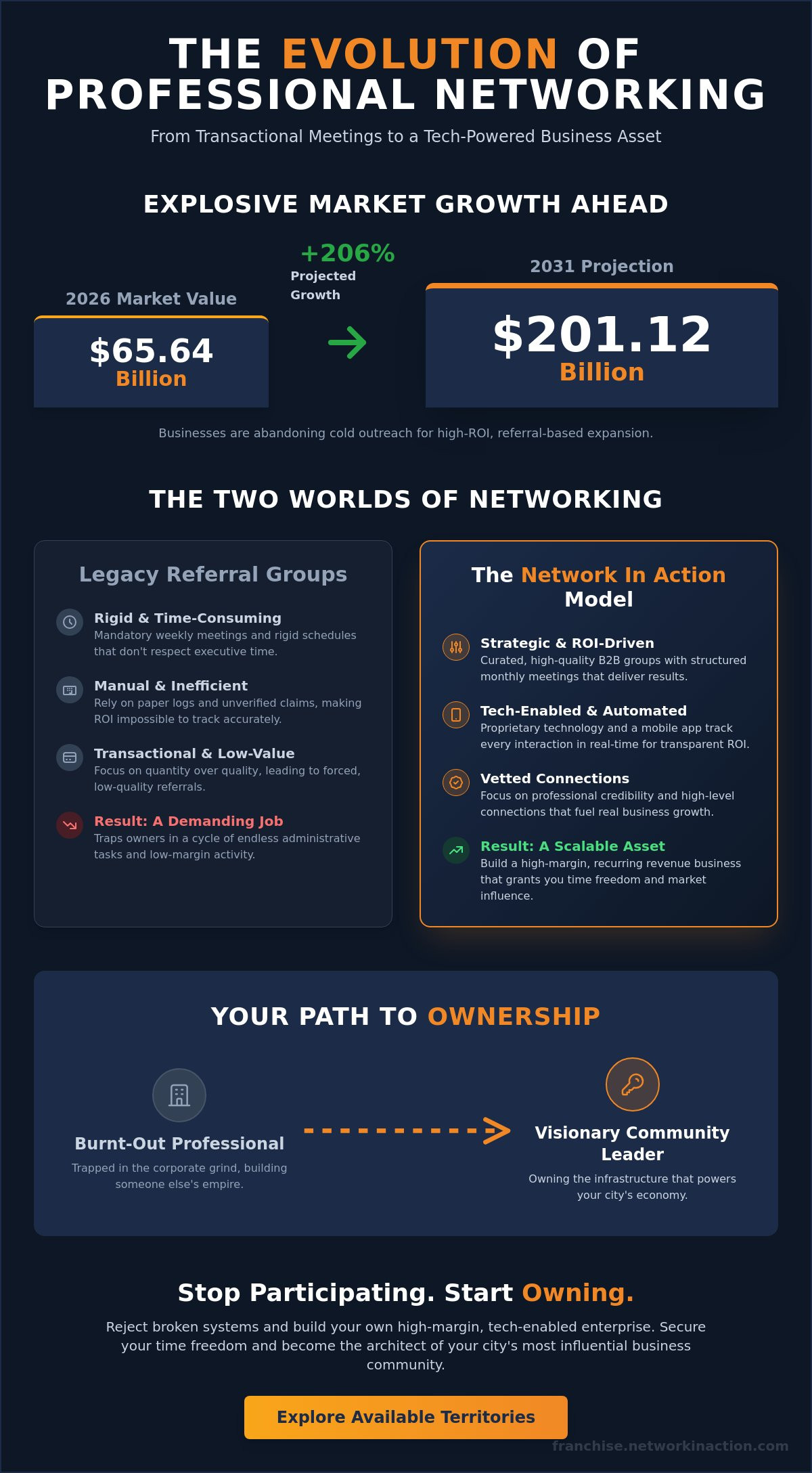
A professional networking business company is a strategic enterprise that facilitates high-level B2B referrals through curated, structured groups. It isn't a social club; it's a sophisticated infrastructure for professional growth. As an owner, you move beyond the role of a participant. You become the community architect who curates local talent and manages the ecosystem where business happens. By May 2026, the professional networking market is valued at approximately $65.64 billion, and it's projected to reach $201.12 billion by 2031. This massive growth is driven by businesses abandoning cold outreach in favor of referral-based expansion. Professionals are tired of the noise. They want a vetted environment where every handshake has a high probability of ROI.
Professional Networking vs. Network Marketing
It's vital to distinguish this model from network marketing or MLM. Professional networking is about referral exchange, not product reselling. You aren't recruiting people to sell consumer goods or building a "downline" for commissions. Instead, your revenue comes from a scalable franchise model built on professional service delivery. You're engaging with business owners and C-suite executives who value their time and demand measurable results. While MLM targets the general consumer, a What is a Professional Networking Business model targets high-earning professionals who need quality connections to scale. This isn't about selling vitamins; it's about building the infrastructure that powers a city's economy.
The Evolution of Referral-Based Business Models
Networking has evolved from casual social gatherings into high-stakes, ROI-driven business meetings. Legacy networking organizations often rely on "old-school" manual tracking and rigid, transactional rules that frustrate modern leaders. These outdated networking models prioritize quantity over quality, forcing referrals that often lead nowhere. Modern professionals want informed disruption. They want technology-enabled platforms that respect their schedules and deliver verified social capital. They're looking for efficiency, structure, and a clear path to growth without the fluff of traditional networking. A professional networking franchise serves as a turnkey solution for executive leaders ready to dominate their local market. If you're ready to see where you can lead, check for available territories to start your transition from executive to owner.
The Mechanics of a High-ROI Networking Business
Owning a networking business company isn't about hosting coffee chats. It's about operating a precision-engineered engine of recurring revenue. Traditional networking models rely on antiquated, manual systems that drain time without proving value. In contrast, a modern approach uses a business referral platform to automate the heavy lifting. This shift allows you to focus on high-level strategy rather than administrative minutiae. You aren't just selling a service. You're building a scalable asset that delivers predictable income month after month. The math is simple: lower overhead and higher efficiency lead to a superior return on investment.
Scalability is the hallmark of a well-oiled machine. Because the infrastructure is built on technology and structured monthly meetings, you can manage multiple groups without the risk of burnout. Legacy networking organizations often trap owners in a cycle of endless weekly meetings. That isn't a business; it's a demanding job. A high-ROI model allows you to expand from a single local group to a multi-territory empire by leveraging the same proprietary systems. This is how you transition from a high-level professional to a community leader with significant market influence.
Leveraging Technology for Modern Connections
Proprietary technology is the ultimate differentiator in 2026. While outdated networking models struggle with paper logs and unverified claims, a tech-forward model uses data to track every interaction in real time. This transparency ensures member retention. When professionals can see their exact ROI through a mobile app, they don't just stay; they become advocates. This goes far beyond Professional Networking 101. It's about using a digital ecosystem to keep your community connected between meetings. This turns a once-a-month event into a 24/7 referral machine that operates even when you aren't in the room.
Maximizing Time Freedom and Lifestyle Autonomy
Efficiency is the only metric that matters to the "Visionary Architect." Legacy networking organizations demand weekly attendance, which is a non-starter for busy executives who value their time. By switching to a monthly meeting structure, you achieve higher impact with 75% less time commitment. You stop hustling for individual leads and start managing a high-value asset that supports your lifestyle. This autonomy is the ultimate reward for those who choose a modernized path. You've spent years building someone else's dream. Now, you can download the franchise kit to see how this model provides the freedom you've earned while maintaining the professional sophistication you expect.
Why Traditional Networking Models Fail Modern Executives
Legacy networking organizations are operating on a 1980s playbook in a 2026 economy. They rely on volume, noise, and rigid attendance policies that treat high-level executives like hourly employees. When you evaluate the landscape of a networking business company, the contrast between "the leading brand" and a modern, tech-enabled model is stark. Traditional groups prioritize filling seats over fostering elite connections. They demand a level of micromanagement that drives away the very professionals you want in your inner circle. This misalignment is why the "old-school" approach is failing to retain top-tier talent.
Success in modern business requires a sophisticated understanding of market dynamics. Outdated networking models often ignore the "burnout factor" that comes with mandatory, weekly breakfast meetings. These sessions are frequently transactional and lack the depth required for complex B2B referrals. High-performing leaders don't want to be forced into a box. They want a streamlined system that respects their schedule and amplifies their influence. If your goal is to lead a community of movers and shakers, you can't use a clunky, manual system that feels like a chore.
Transactional vs. Relationship-Driven Growth
The "forced referral" culture is perhaps the most significant flaw in legacy systems. It pressures members to provide leads regardless of quality, which inevitably erodes trust. High-level professionals prefer an organic, trust-based referral marketing strategy where connections happen naturally. They value relationships that are built on mutual respect and verified expertise. By removing the pressure of weekly quotas, a modern networking business company creates an environment where high-value opportunities can actually flourish. Quality always beats quantity in the executive world.
The Hidden Costs of Inefficient Networking
Consider the math behind a traditional weekly meeting model. Attending 52 meetings a year, each lasting roughly 90 minutes, consumes 78 hours of prime business time annually. When you factor in travel and preparation, that number often doubles. For a professional whose time is valued at $250 per hour, the opportunity cost exceeds $39,000 every year. This inefficiency is a massive drain on resources. Modern networking solves this by moving to a monthly structure, delivering better results while reclaiming over 50 hours of your schedule annually. It's about working smarter, not harder, to build your professional legacy.
Evaluating a Networking Franchise Opportunity
Due diligence is the hallmark of a sophisticated executive. Transitioning into the ownership of a networking business company requires a cold, analytical look at the underlying systems and market demand. You aren't just buying a brand; you're investing in a methodology that must outperform outdated networking models in every metric. Start by analyzing the Franchise Disclosure Document (FDD). This document reveals the financial health and operational requirements of the system. For instance, verified 2026 data shows an initial franchise fee of $35,000 for a modern, tech-enabled model. This is a strategic entry point for a business built on recurring revenue and high-margin professional services.
Your success depends on the strength of the turnkey solution provided. A premium opportunity should offer more than just a name. It must include proprietary technology, proven marketing scripts, and a structured onboarding process that accelerates your path to profitability. You need to know exactly how to transition from the C-suite to a community authority without wasting months on trial and error. Before signing any agreement, use a franchise roi calculator to project your earnings based on group size and territory density. This ensures your move is grounded in practical business logic rather than emotional excitement.
Territory and Market Potential
Market saturation is the enemy of growth. Legacy networking organizations often over-saturate markets, leading to diluted value and internal competition. You must identify available territories that boast high B2B activity and a dense population of professional service providers. Protected territories are non-negotiable. They ensure that as you build your empire, your local influence remains unchallenged. Assess the local competition by looking for gaps left by inefficient, traditional groups. Where they offer rigid rules, you offer results-oriented flexibility.
Support Systems and Training
The most critical phase of your new venture is the initial ninety days. A high-tier franchisor provides intensive training that covers everything from member curation to leveraging the referral platform. You shouldn't have to invent the wheel. The value of the franchise lies in its "Visionary Architect" framework, which allows you to lead while the technology manages the tracking. Beyond initial training, a peer network of fellow owners provides a sounding board for scaling your business. This community of elite leaders ensures you're never operating in a vacuum. If you're ready to see how these systems align with your goals, request the free book to explore the full scope of the opportunity.
The Path to Ownership: Becoming a Community Leader
Owning the infrastructure of professional connection is the ultimate strategic move for a seasoned executive. Most professionals spend their careers joining groups, but the real power lies in owning the networking business company itself. This transition allows you to stop trading time for a salary and start building a high-value asset that enhances your personal brand. By curating the city’s top talent, you position yourself as the premier authority in your local market. You aren't just a participant in the economy; you become the architect of it. This isn't about attending another meeting. It's about owning the platform where the most important business in your city happens.
The ROI of owning the network far outweighs the benefits of simply joining one. While members seek referrals, you manage the flow of social capital. This unique position provides a level of professional credibility that a corporate title cannot match. You're seen as the individual who has solved the inherent flaws of outdated networking models, replacing them with a modern, tech-enabled alternative. Your influence grows as your groups scale, creating a compound effect on your reputation and your revenue. It's a path that offers both financial reward and the status of a visionary leader.
From Employee to Entrepreneur
The shift from the corporate C-suite to business ownership often involves significant psychological hurdles. Leaving the perceived safety of a 9-to-5 grind can feel daunting. However, the skills you've honed in leadership, management, and strategic planning are exactly what's required to run a successful networking business company. You already know how to manage people and drive results. Now, you can apply those skills to an asset you own. There is a profound satisfaction in building a business that creates real community impact. You're no longer just hitting quarterly targets for a distant board of directors. You're facilitating the growth of local businesses and creating a legacy of success that you control.
Next Steps for Strategic Professionals
The discovery process shouldn't feel like a high-pressure sales pitch. It's an exploration of alignment between your goals and a proven system. You're a smart professional making a strategic move, and the right opportunity should stand on its own logic. To begin, you should request the free book to gain deeper insights into the NIA philosophy. This resource outlines the informed disruption required to succeed where legacy networking organizations have stalled. Once you've reviewed the data and understand the proprietary technology behind the model, invite a discovery call to see if your ambitions match this modern approach. It's time to stop joining groups and start owning the future of networking in your market.
Secure Your Position as a Market Architect
The transition from corporate executive to visionary owner is a strategic move toward lifestyle autonomy and measurable impact. Legacy networking organizations continue to fail top-tier professionals by prioritizing rigid attendance over actual ROI. By contrast, owning a modern networking business company allows you to leverage a proprietary technology platform included in the model to curate an elite community that values efficiency. Redefining the industry since 2015, this system has already expanded to over 150 locations worldwide. It provides a turnkey infrastructure that replaces "old-school" manual tracking with a high-margin, scalable enterprise.
You've spent years building value for others; it's time to build a high-value asset for yourself. The market for professional connection is projected to reach $201.12 billion by 2031, and the demand for quality over quantity has never been higher. Take the first step toward reclaiming your time and establishing your professional legacy. Download the NIA Franchise Kit and start your discovery journey today. The future of networking is waiting for a leader like you.
Frequently Asked Questions
How much does it cost to start a networking business franchise?
The initial franchise fee is $35,000 as of May 2026. Your total initial investment typically ranges from $37,710 to $42,700 according to verified industry data. This investment covers the turnkey systems and proprietary technology required to launch your territory. It's a low-overhead model designed for high-level professionals seeking a streamlined entry into business ownership.
What is the typical ROI for a professional networking business owner?
ROI is driven by a scalable recurring revenue model and minimal operational overhead. Unlike outdated networking models that rely on manual labor, this system uses technology to maximize your profit margins. Success depends on your ability to curate high-quality groups and leverage the provided tools. You're building a high-margin asset that values your time as much as your income.
Do I need a background in sales to own a networking group?
No, you need a background in leadership and executive management. While communication skills are vital, the franchise provides a complete library of marketing materials and proven scripts. You aren't cold prospecting; you're curating an elite community of business leaders. Your role is that of a "Visionary Architect" who manages relationships rather than a high-pressure salesperson.
How much time per week does it take to manage a networking group?
Managing a single group requires approximately 10 to 15 hours per month. The monthly meeting structure is 75% more efficient than legacy networking organizations that demand weekly attendance. This efficiency allows you to scale to multiple territories without the risk of corporate burnout. It's a business model built specifically for those who prioritize time freedom and lifestyle autonomy.
Is a networking business recession-proof?
Yes, because professional referrals are the most cost-effective growth strategy during economic shifts. When traditional marketing budgets are cut, businesses prioritize the high-ROI connections found within a networking business company. In 2026, referral-based growth is the primary driver of B2B success. Your business provides the essential infrastructure that local economies need to stay resilient regardless of market volatility.
What makes a networking franchise different from a traditional business club?
A networking franchise is a results-oriented enterprise powered by technology, not a casual social club. Traditional business clubs often lack structure and fail to track measurable outcomes for their participants. This modernized model uses proprietary systems to ensure every handshake has a high probability of success. You're offering a sophisticated alternative to the stagnant, "old-school" methods that frustrate modern executives.
Can I run a networking business while keeping my current job?
Yes, many owners begin their journey while still holding a corporate position. The monthly meeting model provides the flexibility to manage your groups around an existing schedule. It's a strategic path that allows for a gradual transition from the C-suite to full-time entrepreneurship. You can build your community and your recurring revenue stream without sacrificing your current financial security.
What kind of technology do I need to run a modern networking company?
You need a proprietary technology platform that automates referral tracking and member engagement. Running a modern networking business company requires moving beyond the paper logs and manual processes used by legacy systems. A dedicated mobile app keeps your community connected 24/7, ensuring the network delivers value even when you aren't present. This tech-forward approach is what separates a scalable asset from a demanding job.