Most executives are wasting 100 hours a year in legacy networking organizations that offer zero measurable return. It's a harsh reality, but the traditional model of rigid, weekly meetings is officially obsolete. You've likely felt the exhaustion of cold prospecting and the frustration of sitting through transactional sessions that fail to move the needle on your bottom line. It's time to stop being a participant in a broken system and start being the architect of a superior one.
By launching a modern networking business, you can transition from a seeker of leads to a leader of a high-level community. This guide reveals how to leverage proprietary technology and AI-driven network management to create a scalable, recurring revenue stream. Discover how to replace the clunky methods of the past with a sophisticated, ROI-driven platform that prioritizes executive efficiency. You'll see how to capitalize on the momentum of 123 million annual hybrid events and why owning the connection is the ultimate strategic move for your professional freedom in 2026.
Key Takeaways
- Transition from a passive participant to a strategic leader by managing social capital within a structured, referral-based organization.
- Leverage proprietary technology to automate tracking and deliver measurable ROI, eliminating the manual processes found in legacy networking organizations.
- Discover how owning a modernized networking business replaces the "time tax" of weekly meetings with high-impact sessions designed for executive efficiency.
- Analyze the financial potential of a scalable franchise model that generates recurring revenue through curated, high-quality professional memberships.
- Establish yourself as a visionary leader in your local market while gaining lifestyle autonomy through a proven, tech-enabled business platform.
Defining the Networking Business in a Modern Economy
Stop viewing connections as a byproduct of professional life. In 2026, those connections are the business itself. A modern networking business isn't a social club; it's a high-performance engine for referral generation. While Business networking has historically been viewed as a casual activity, the global economy has shifted toward strategic social capital management. This is the definitive transition from "who you know" to "how you leverage who you know" for measurable, predictable growth.
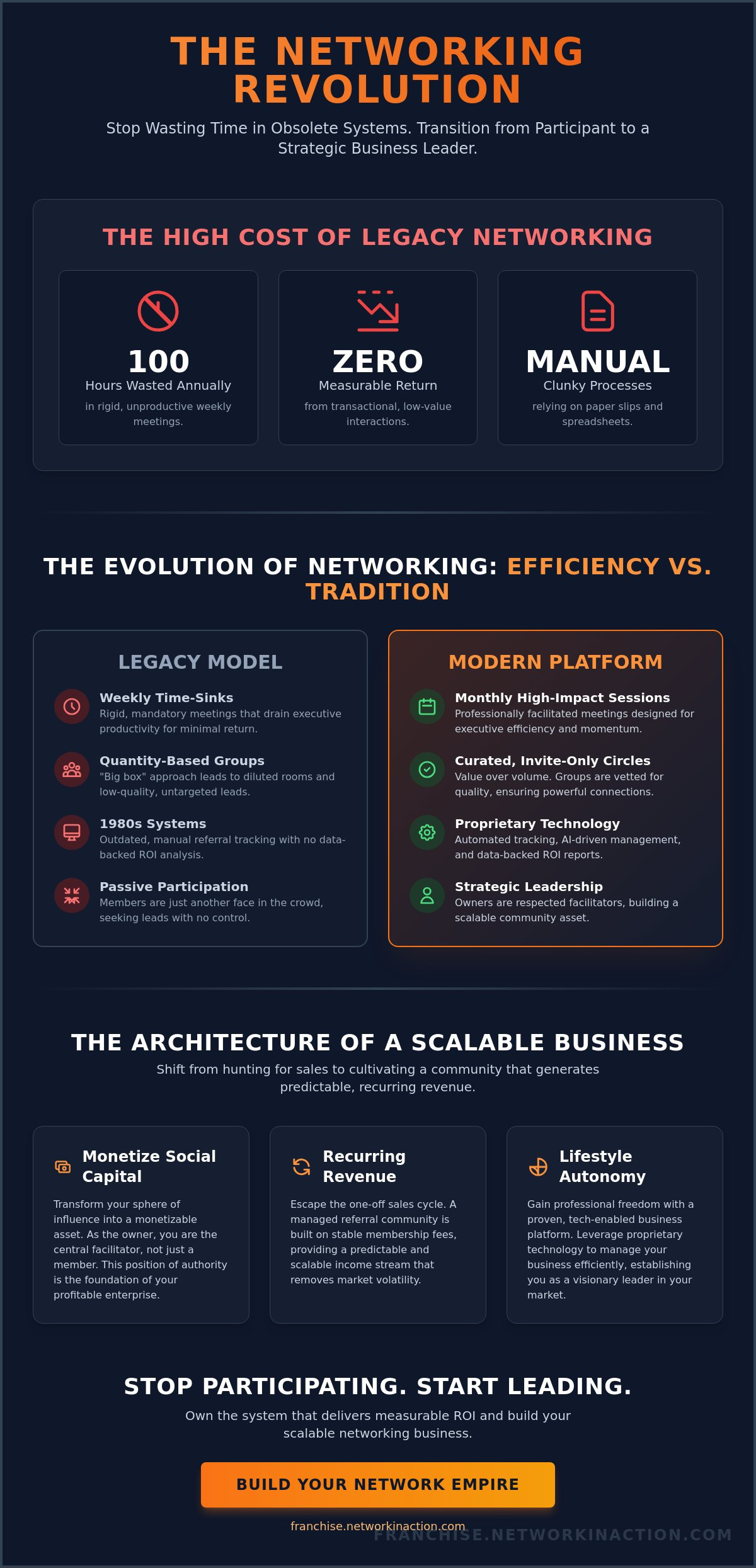
Legacy networking organizations often focus on mass membership, prioritizing volume over value. This "big box" approach leads to diluted rooms and low-quality leads. Modern professionals demand "Networking Evolved." This means moving away from transactional exchanges and toward long-term ROI within curated, executive-level groups. The shift in 2026 is clear:
- From quantity-based "open" groups to curated, invite-only circles.
- From manual referral tracking to data-backed ROI reports.
- From weekly time-sinks to monthly high-impact sessions.
Social Capital as a Scalable Asset
Social capital is now a scalable asset that functions as a monetizable business entity. Leading a network provides you with instant authority that membership alone cannot match. You aren't just one of many; you are the facilitator. This shift has opened doors for executive business opportunities that allow high-level professionals to monetize their existing spheres of influence. Instead of cold prospecting, you build a community where your reputation is the foundation for a profitable, service-oriented enterprise.
The Economics of Professional Connections
The economics of this model are simple and compelling. Unlike one-off sales models that require constant hunting, a managed referral community relies on recurring revenue. You build the infrastructure once, and the membership fees provide stability and scalability. It's about creating a predictable environment where business owners pay for access to vetted peers and proven results. This removes the volatility of the service sector and replaces it with a structured, growth-oriented mindset. A professional networking business is a turnkey system for community leadership and profit.
The Architecture of a High-ROI Referral Platform
Traditional networking is built on a foundation of manual labor. Members are often forced to act as unpaid administrative assistants, filling out paper referral slips and attending grueling weekly meetings. A modern networking business flips this script. It uses technology to handle the heavy lifting, allowing the owner and the members to focus on high-level strategy and relationship building. In 2026, the architecture of your platform determines the success of your members.
Legacy networking organizations still rely on systems designed in the 1980s. This is unacceptable for the modern executive. Automated tracking systems now replace the clunky manual processes that once defined the industry. This shift ensures that every referral is documented, every introduction is tracked, and every dollar of ROI is accounted for. It transforms networking from a "hope-based" activity into a data-backed business strategy.
Executive time is the most valuable commodity in any market. Weekly meetings are a relic of the past that drain productivity without guaranteed returns. A high-ROI platform utilizes monthly, high-impact sessions instead. This preserves the schedule of the busy professional while maintaining the momentum of the group. It's about working smarter, not harder, to achieve superior results.
Leveraging Proprietary Technology for Growth
A sophisticated business referral platform ensures that professional connections don't stop when the meeting ends. It facilitates 24/7 interaction through mobile apps and web portals, creating a digital ecosystem where members can pass leads and schedule coffee chats in seconds. This data-driven approach allows you, as the owner, to monitor group health instantly. You can see which members are engaging and which need support, all without the administrative burden of manual spreadsheets. This efficiency is why many are moving toward owning a system rather than just participating in one.
Quality Over Quantity: The Curated Membership Model
Ownership gives you the power to curate. While outdated networking models focus on filling seats with anyone who has a checkbook, a modern platform prioritizes a rigorous vetting process. You aren't building a crowd; you're building a brain trust. By removing forced referral quotas, you actually increase the quality of business leads. Trust becomes the primary driver of growth. While many sources offer general professional networking tips regarding how to talk to strangers, a curated model focuses on building an empire of trusted advisors. This approach guarantees that every referral passed is a high-value opportunity, not just a box checked to satisfy a rigid rule. If you're ready to move beyond participation, it's time to explore available territories for your own high-impact community.
Disruption of Legacy Networking Models: Efficiency vs. Tradition
The networking industry is currently split between those clinging to the past and those building the future. For decades, legacy networking organizations have forced professionals into a rigid, one-size-fits-all box. These outdated networking models rely on high-frequency, low-impact meetings that prioritize attendance over actual business growth. In 2026, the C-suite has no interest in performing for the sake of tradition. Executives are looking for a modernized networking business that respects their schedule and delivers a clear return on investment.
The "Time Tax" of traditional networking is a primary point of failure. Weekly meetings require a commitment of at least 50 hours per year, not including travel or follow-up time. In contrast, the NIA approach utilizes monthly high-impact sessions, reducing that commitment to just 12 hours annually while increasing the quality of the interactions. This 76% reduction in time commitment is a massive differentiator for busy professionals. It's the difference between a transactional chore and a strategic advantage. As highlighted in recent discussions on modern networking strategies for entrepreneurs, the shift toward streamlined, high-value structures is essential for maintaining a competitive edge in a fast-paced market.
The Failure of Forced Referrals
Legacy networking organizations often prioritize quota-filling over genuine business value. This creates a "clunky" environment where members feel pressured to pass low-quality leads just to satisfy a rigid rule. The psychological shift when you remove forced referrals is profound. When referrals are organic and based on professional credibility, trust grows naturally. NIA positions itself as the "Visionary Architect" by replacing forced transactions with a technology-led platform that facilitates real connections. This sleek alternative ensures that every referral passed is a high-value opportunity, not a box checked on a manual slip.
Lifestyle Autonomy for the Business Owner
Ownership in a traditional model is often just as labor-intensive as membership. Managing manual reports, tracking attendance, and enforcing rigid rules can feel like a second full-time job. A modern networking business through NIA is designed for executive efficiency. The proprietary technology handles the administrative heavy lifting, giving the franchise owner the freedom and flexibility to focus on community leadership and high-level strategy. This lifestyle-friendly model offers a path to recurring revenue without the burnout associated with old-school management. You can download a franchise kit to see exactly how the operational systems differ from the labor-intensive legacy brands. The goal is to build a professional empire that serves your life, rather than one that consumes it.
- Monthly meetings preserve executive time while maintaining group momentum.
- No forced referrals ensures higher quality business leads and stronger trust.
- Proprietary tech reduces the administrative burden for the business owner.
- C-suite professionals prefer curated, high-level groups over mass-membership models.
Strategic Criteria for Evaluating a Networking Franchise Opportunity
Investing in a networking business is a high-level strategic move that requires rigorous due diligence. You aren't just buying a brand; you're acquiring a system for social capital management. A modern franchise license fee must cover more than just the right to use a logo. It should include comprehensive training, a clearly defined territory, and a robust onboarding process that prepares you for immediate community leadership. In 2026, the difference between a successful owner and a struggling one often comes down to the quality of the initial support and the scalability of the underlying model.
Recurring revenue is the heartbeat of this industry. While legacy networking organizations often focus on one-time transactional fees, a modernized model prioritizes monthly membership dues. This creates a predictable financial baseline that allows for long-term planning and growth. You must evaluate the royalty structure to ensure it supports your profitability while providing the corporate infrastructure needed for high-level operations. Verify that the franchisor offers ongoing innovation in technology and marketing to keep your local groups competitive and relevant.
Due Diligence for Executive Owners
The Franchise Disclosure Document (FDD) is the most powerful tool for transparency. It allows you to examine the financial health of the franchisor and the success rates of existing owners. Look for red flags common in outdated networking models, such as high member turnover or a lack of proprietary tools. These issues indicate a system that fails to provide value to its members. To quantify potential success, use a franchise ROI calculator to model various membership scenarios. This ensures the decision is based on hard data rather than emotional appeal.
Scalability and Growth Potential
A visionary leader looks toward the horizon. The best networking business opportunities offer the ability to own multiple territories, allowing for the creation of a regional empire of professional connections. This scalability is what transforms a simple business into a lifestyle-friendly asset that produces recurring revenue without requiring 60-hour work weeks. Before signing any agreement, check available territories to confirm that the desired market isn't already saturated. Exclusivity is non-negotiable; you need the freedom to dominate a local market without internal competition. If the numbers align with your professional goals, evaluate the franchise potential to see if the vision matches the modern NIA approach to networking.
Cultivating Community Leadership and Recurring Revenue
Owning a networking business places you at the epicenter of your local economy. You aren't just another professional in the room; you're the architect who built it. This position naturally cultivates thought leadership. People look to the person who facilitates high-level connections for strategic guidance and market insight. In 2026, influence is the most valuable currency, and owning the platform that generates that influence is the ultimate power move.
There's a profound psychological benefit in facilitating growth for others. When your members hit their ROI targets, your professional credibility scales automatically. This isn't the surface-level "assistance" found in generic career advice. It's a high-stakes leadership role that transforms you from an executive into a community pillar. You're no longer just working in a market; you're shaping it. Helping other business owners navigate challenges and secure wins provides a level of fulfillment that a traditional corporate role rarely offers.
The transition from a "9-to-5" mindset to a "Visionary Architect" mindset is the ultimate professional evolution. You stop trading your hours for a paycheck and start leveraging a system that produces recurring revenue. This shift provides the lifestyle autonomy that high-level leaders crave. It allows you to focus on high-impact decisions rather than the administrative minutiae that plagues legacy networking organizations. You're building an asset that grows in value as your community strengthens.
Beyond Cold Prospecting: Leveraging Your Network
Leading a group is the ultimate form of professional credibility. You grow your franchise by practicing exactly what you preach. By implementing a sophisticated referral marketing strategy, you turn your existing connections into a scalable business asset. NIA provides a clear roadmap to launch your first group within 90 days, ensuring you move from executive to owner with speed and precision. This approach replaces the exhaustion of cold prospecting with the efficiency of relationship-driven growth.
Next Steps: From Executive to Owner
This guide isn't a hard sell. It's an invitation to explore a more sophisticated way of doing business. If outdated networking models have left you frustrated with their inefficiency, the next step is discovery. You can dive deeper into the NIA philosophy by reading the free book. It outlines how to reclaim your time while building a legacy of impact. Your transition from participant to owner is a strategic move toward freedom and influence. Align your vision with a model that values ROI as much as you do and take control of your professional future.
Lead the Evolution of Your Local Market
The era of passive participation in rigid, inefficient circles is officially over. You've seen how a technology-driven networking business replaces the "time tax" of legacy networking organizations with a high-ROI monthly model. By prioritizing curated relationships over forced quotas, you position yourself as a community leader while securing a scalable, recurring revenue stream. This is the definitive shift from being a member to being the architect of professional connection.
Network In Action has already proven this modernized approach with over 150 locations worldwide. The system leverages a proprietary technology platform to eliminate administrative friction and maximize member results. It's a turnkey solution for executives who value time, impact, and measurable growth. If you're ready to move from the sidelines to the center of your local economy, the path is clear. It's time to align your professional influence with a model designed for 2026 and beyond. Take the first step toward ownership and strategic autonomy today.
Explore Available Territories and Start Your Networking Journey
Frequently Asked Questions
How does a networking business generate recurring revenue?
A networking business generates recurring revenue primarily through monthly or annual membership dues paid by its participants. These fees provide members with access to curated professional circles, proprietary technology, and facilitated monthly meetings. Unlike transactional sales models that require constant prospecting, this subscription-based approach creates a stable financial foundation. It allows the owner to focus on group quality and member retention rather than high-volume, one-off sales.
What is the difference between NIA and traditional networking organizations?
The primary difference lies in efficiency and technology. Legacy networking organizations often rely on rigid, weekly meetings and manual referral tracking that drain executive time. NIA replaces this outdated approach with high-impact monthly sessions and a proprietary tech platform. By eliminating forced referrals and prioritizing professional vetting, the model ensures higher quality connections and a measurable ROI that traditional networking models simply cannot match.
Do I need prior experience in franchising to own a networking business?
You don't need prior franchising experience to lead a successful networking business. The NIA model is specifically designed for high-level executives and entrepreneurs who already possess strong leadership and relationship-building skills. Comprehensive training covers every operational detail, from member recruitment to technology management. This allows you to leverage your existing professional expertise while following a proven, turnkey system for community leadership.
How much time does it take to manage a modern networking group?
Managing a modern group typically requires only a few hours of active work per month. Because meetings occur monthly rather than weekly, the administrative burden is 76% lower than in traditional networking models. Proprietary technology automates referral tracking and member communication, which allows you to maintain a lifestyle-friendly business. You can lead multiple groups while still enjoying the freedom and flexibility of a modern service-based franchise.
What kind of technology platform does a networking franchise provide?
A modern networking franchise provides a proprietary digital ecosystem that keeps members connected 24/7. This includes mobile applications and web portals where members track their ROI, pass referrals, and schedule introductions instantly. The technology removes the need for manual paperwork and provides the owner with real-time data on group engagement. It transforms the networking experience from a clunky, manual process into a sleek, data-driven business strategy.
Is a networking business scalable across multiple locations?
Yes, the model is highly scalable through multi-unit ownership and territory expansion. Owners can manage several groups within a single territory or acquire multiple territories to build a regional empire of professional connections. The tech-enabled infrastructure ensures that as you scale, your administrative workload doesn't grow at the same rate. This allows for significant growth in recurring revenue while maintaining your role as a visionary architect rather than a daily manager.
How do I know if a territory is available for a networking franchise?
You can verify territory availability by consulting the interactive map on the NIA franchise website. This tool provides real-time data on which markets are currently open for acquisition and which are already occupied by existing owners. Ensuring territory exclusivity is a critical step in your due diligence. It protects your market share and ensures you have the freedom to dominate your local area without internal competition.
What is the typical ROI for a professional networking business owner?
The ROI for a professional networking business owner depends on membership volume and retention rates within their curated groups. By utilizing a franchise ROI calculator, you can model potential earnings based on membership targets and low operational overhead. The combination of recurring revenue and minimal physical infrastructure typically leads to a more favorable financial outcome than labor-intensive service businesses or traditional retail models.