What if your exit from the C-suite didn't mean trading high-stress corporate roles for the manual grind of a traditional business? You've felt the weight of the golden handcuffs while realizing that professional transitions often fail because they lack a scalable, system-driven foundation. You understand that professional relationships are the ultimate currency, but you've seen how legacy networking organizations fail to deliver measurable results. It's time to demand more from franchise networks than just a weekly breakfast meeting and a stack of paper business cards.
The professional landscape in 2026 has shifted toward efficiency and data-driven connection. You'll learn how to transition into a high-ROI, tech-enabled model that disrupts outdated networking models through proprietary systems. This guide explores the strategic path to recurring revenue and community leadership, proving that you can own your time while maintaining your status as a visionary architect of professional growth. Discover how to leverage technology to turn social capital into a high-performance asset.
Key Takeaways
- Learn how to transition from time-consuming legacy networking organizations to a strategic, tech-enabled engine designed for high-impact relationship commerce.
- Discover the structural secrets of modern franchise networks that prioritize curated memberships and proprietary technology over rigid, outdated attendance rules.
- Identify the specific revenue drivers and scalability strategies that allow executive owners to build recurring wealth through multi-territory expansion.
- Analyze the flaws of traditional models to understand why a results-oriented, monthly meeting structure delivers superior ROI for high-level professionals.
- Master the mindset shift required to move from the corporate grind to becoming a visionary community architect with full lifestyle autonomy.
The Evolution of Franchise Networks: From Directories to Strategic Engines
Modern franchise networks have transcended the limitations of static business directories. They're now sophisticated professional ecosystems engineered for high-velocity referral generation and sustainable business growth. By 2026, the marketplace has undergone a fundamental shift. Cold prospecting has lost its pulse. Relationship-driven commerce has taken center stage. For the modern executive, this evolution represents a pivot from corporate dependency to community leadership.
The distinction between "buying a job" and "owning a community engine" is critical. Traditional franchise models often require the owner to perform manual labor or manage high-turnover staff. In contrast, a strategic networking franchise allows an owner to leverage their existing professional capital. It's a move toward the franchising business model that prioritizes intellectual property and social equity over physical inventory. You aren't just purchasing a brand; you're building a high-leverage asset that scales through connection rather than cold calls.
The Shift Toward Relationship-Based Business Models
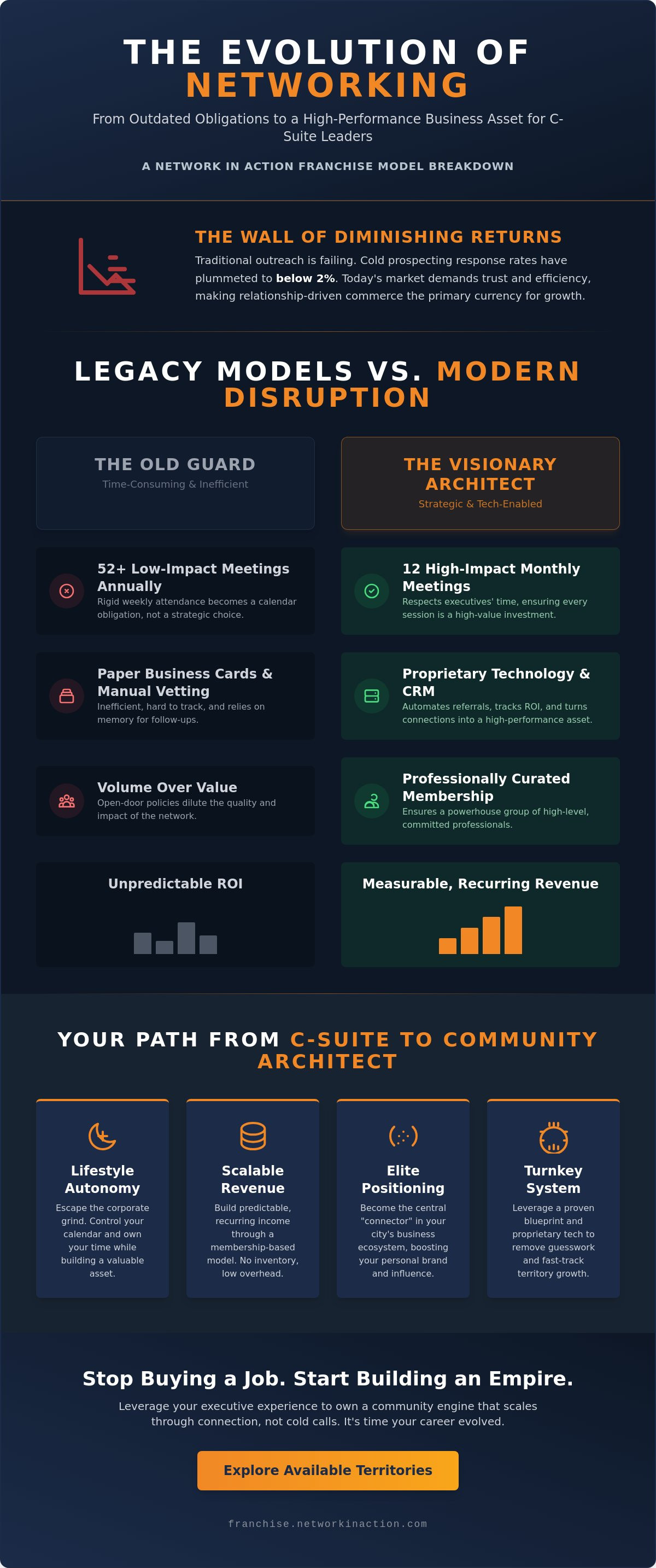
Traditional digital advertising has hit a wall of diminishing returns. Recent data from 2024 showed that cold outreach response rates plummeted below 2%, a trend that has only accelerated into 2026. Buyers are exhausted by automated sequences and impersonal ads. Trust-based referrals have become the primary currency for mid-sized business owners. This is the era of Informed Disruption. It’s a methodology that replaces the "throw everything at the wall" approach of legacy networking organizations with a structured, technology-backed system. High-level professionals now demand efficiency. They want a platform where every interaction translates into a measurable ROI.
Why Executives are Choosing Networking Franchises in 2026
Former C-suite leaders are migrating to network ownership for three primary reasons. First, the overhead is remarkably low. There’s no need for expensive storefronts or complex supply chains. Second, it offers true lifestyle autonomy. You control your calendar while maintaining a high-level influence within your local business community. Third, it provides a platform for leadership. Instead of managing corporate silos, you're curating a powerhouse group of business owners.
- Zero Inventory: No physical products to spoil or store.
- Scalable Recurring Revenue: Membership models provide predictable monthly income.
- Elite Positioning: Owners are seen as the "connectors" in their city, boosting their personal brand.
This model appeals to those who are done with the corporate grind but aren't ready to retire. It’s for the professional who wants to lead, influence, and grow. If you're ready to see where these opportunities exist, you can explore available territories to find your place in this evolving market. Networking evolved. It’s time your career did the same.
The Anatomy of a High-Performance Networking Franchise
Traditional networking models are failing the modern executive. They demand weekly attendance and prioritize volume over value. A high-performance networking franchise disrupts this cycle by focusing on three core pillars: curated membership, proprietary technology, and a strict ROI-driven structure. Instead of 52 low-impact weekly meetings, these modern franchise networks utilize monthly high-impact sessions that respect the schedules of busy business owners. This shift from quantity to quality ensures that participation is a strategic investment rather than a calendar obligation.
The role of the franchisee is equally transformed. You don't act as a mere social coordinator or event planner. You serve as a Visionary Architect. This position requires someone who can build and lead a community of high-level professionals using a turnkey system designed for rapid territory scaling. Success depends on following a proven blueprint that removes the guesswork from operations. When evaluating these opportunities, consult the Consumer's Guide to Buying a Franchise to ensure you understand the legal and financial framework of a professional investment.
Proprietary Technology as a Growth Multiplier
Legacy networking organizations often rely on manual spreadsheets and paper-based referral slips. Modern franchise networks leverage a dedicated platform to keep members connected 24/7. This technology provides real-time referral tracking and precise ROI measurement for every member. It transforms social capital into hard data. Proprietary software automates the administrative burden, allowing the focus to remain on strategic relationship building. This automation is what allows a single owner to scale multiple groups without increasing overhead.
The Power of Curated Membership
Quality over quantity is the non-negotiable mantra of elite groups. A rigorous vetting process ensures that only established small to mid-sized business owners gain entry. This prevents the "sales pitch" environment common in entry-level groups.
- Exclusive Seats: Only one professional per industry is allowed, eliminating internal competition.
- Decision-Maker Focus: Members interact with peers who have the authority to pull the trigger on deals.
- Structured Accountability: Regular check-ins ensure every member contributes to the collective growth.
Building a network of this caliber requires the right foundation. For those ready to lead their own professional community, exploring available territories is the first step toward reclaiming your time and influence.
Legacy Systems vs. Modern Disruption: Why Traditional Models are Faltering
Traditional networking is dying because it's built on a 1980s blueprint that ignores the value of an executive's time. Legacy networking organizations rely on guilt, rigid attendance, and manual tracking, creating a "burnout factor" that drives away top-tier talent. This outdated approach treats business growth as a chore rather than a strategic advantage. It's a transactional grind that prioritizes attendance over actual revenue growth, leaving high-level leaders feeling drained and uninspired.
Modern franchise networks act as a corrective force. They replace the clunky, manual processes of the past with streamlined, technology-led solutions. Professionals today don't want to play a numbers game; they want a curated environment where social capital translates directly into measurable ROI. The shift toward informed disruption isn't just a trend. It's a necessary evolution for anyone who values efficiency over activity.
The Problem with Forced Referrals and Weekly Grinds
Mandatory referral quotas are the fastest way to dilute business quality. When members are forced to pass a specific number of leads every seven days, the result is often "fluff" or low-intent prospects. This creates a culture of quantity over quality that frustrates serious professionals. Data suggests that 64 percent of executives find weekly morning meetings to be a significant drain on their core business productivity. These rigid structures prioritize "showing up" over "leveling up."
- Forced quotas lead to "junk leads" that waste your sales team's time.
- Weekly commitments disrupt the flow of high-level project management.
- Rigid attendance rules penalize executives for handling actual business emergencies.
Contrast this with an ROI-driven approach. Instead of a weekly grind, modern models focus on high-value interactions that respect the executive calendar. It’s about the strength of the connection, not the frequency of the handshake.
Modern Efficiency: The Monthly Meeting Model
Professionals who value their time are moving toward the monthly meeting structure. This once-a-month cadence respects the schedule of an elite professional while maintaining momentum through proprietary technology. You don't need to lose 52 mornings a year to stale coffee and forced pitches to build a powerful circle. Modern platforms ensure that franchise networks stay connected 24/7 without requiring a constant physical presence.
This streamlined approach allows for deeper relationship building and more strategic collaboration. It creates a lifestyle-friendly business model where the focus remains on growth and scalability. For those seeking a business networking franchise that aligns with an executive lifestyle, the monthly model is the clear winner. It's a turnkey solution for those ready to lead their own professional communities without sacrificing their personal freedom.
Calculating the Real ROI: Beyond the Initial License Fee
Smart investors know that the initial franchise fee is merely the ante to enter the game. The true value of franchise networks lies in the velocity of the business model and the sustainability of its profit margins. While legacy networking organizations often rely on high-volume, low-margin structures, the modern approach prioritizes a lean operation that maximizes every hour spent. You aren't just buying a brand; you're acquiring a sophisticated engine designed for high-yield returns with minimal drag.
Revenue in this model is driven by two primary streams. Initial membership fees provide immediate capital to fuel growth and territory expansion. However, the real power lies in the recurring monthly dues. This creates a compounding effect that traditional service-based businesses struggle to match. Because there is no need for expensive office space, heavy inventory, or a massive payroll, your gross margins remain exceptionally high. You operate as a high-level consultant rather than a traditional manager, focusing on community leadership instead of administrative minutiae.
Understanding Recurring Revenue in Networking
Stability is the hallmark of a membership-based business. When you build a community of high-level professionals, you're creating an ecosystem where retention is naturally high. These members don't just join for a meeting; they stay for the measurable business growth and the proprietary technology that facilitates it. This creates a predictable, month-over-month income stream that allows for precise financial forecasting and long-term scaling. To see how these numbers look in a real-world scenario, you should download the franchise kit for detailed economic breakdowns.
Evaluating Scalability and Territory Potential
Success in the networking industry is no longer about geographic proximity alone; it's about professional density and strategic territory selection. High-growth territories are identified by the concentration of service-based businesses and executive-level professionals who value their time. By utilizing a hub-and-spoke model, you can manage multiple groups across a region from a single point of control. Through the use of proprietary technology and streamlined operational systems, a single owner can manage 150+ members across multiple groups without sacrificing quality or personal connection. This scalability ensures that your income isn't capped by the number of hours in a day.
Ultimately, the most critical metric for an executive owner is "Time ROI." Outdated networking models require a grueling schedule of weekly morning meetings and manual reporting. Modern franchise networks leverage automation to give you back your calendar. You're building an asset that works for you, providing the lifestyle autonomy that high-level professionals demand. You don't just own a business; you own your time. This shift from transactional networking to a tech-enabled leadership role is what defines the next generation of industry leaders.
Ready to see where your leadership fits in the modern market? Explore available territories and secure your region today.
Becoming a Visionary Architect: Your Path to Ownership
Transitioning from a corporate executive to a franchise owner requires a fundamental shift in your professional DNA. You aren't just buying a job; you're building a high-performance engine for local commerce. This move demands you shed the employee mindset of trading hours for a paycheck and instead adopt the role of a Visionary Architect. You're creating an ecosystem where high-level professionals thrive. In the world of franchise networks, success is measured by the quality of the community you build and the measurable ROI you facilitate for every member.
Training and Support for Executive Owners
Success is built on a foundation of proven systems rather than trial and error. Every executive owner is equipped with a sophisticated playbook that outlines every facet of group management, from initial recruitment to long-term member retention. This isn't a static manual; it's a tech-enabled strategy supported by ongoing corporate guidance. You'll gain access to a proprietary platform that handles the clunky administrative tasks that plague legacy networking organizations. This support structure includes territory reservation, ensuring your market remains exclusive and your growth potential is protected. A logical first step for any serious candidate is to research available territories to see where the NIA model can fill the gap left by outdated, inefficient networking groups.
The 90-day launch phase is a masterclass in strategic execution. It follows a disciplined sequence:
- Days 1-30: Focused immersion into your local market to identify underserved high-tier professionals.
- Days 31-60: Curation of a founding group of 15 to 20 power players who value efficiency over fluff.
- Days 61-90: Implementation of the inaugural launch event and full integration of the proprietary technology platform.
Unlike other franchise networks that focus on sheer volume, this launch process prioritizes the curation of high-value relationships. By day 90, your network is fully operational, generating recurring revenue and positioning you as the most influential leader in your territory. This timeline is designed for speed and clarity, moving you from setup to a functioning business with zero wasted effort.
Taking the Next Step Toward Autonomy
The ultimate goal of this journey is lifestyle autonomy. Owning a results-oriented network allows you to reclaim your time while building a scalable asset. You're no longer subject to the whims of a board or a boss; instead, you're the one setting the standard for professional excellence in your community. This opportunity represents the future of networking, designed specifically for those who value time freedom as much as financial growth.
This is a strategic exploration of a superior business model, not a high-pressure decision. It's about finding a fit that rewards your experience and your ambition. To understand the logic behind this shift and see the systems in action, get your free book on modern networking and start your transition toward becoming a leader in a modernized industry.
Architect Your Legacy in the New Economy
The transition from passive directories to high-performance strategic engines is no longer a prediction; it's a reality for the modern executive. Traditional networking models failed to respect your time, but the shift toward ROI-driven systems has changed the math of professional connection. By utilizing a monthly meeting model designed specifically for executive schedules, you can build a scalable business without the burnout associated with legacy networking organizations. Modern franchise networks now thrive on efficiency, powered by a proprietary technology platform that replaces manual tracking with actionable data.
With over 150 locations worldwide, the blueprint for informed disruption is already operational. You have the chance to move beyond the role of a participant and become the architect of your own professional community. This path offers a turnkey solution for those ready to trade cold prospecting for high-level leadership and recurring revenue. The market is ready for a sophisticated alternative, and your expertise is the missing link. It's time to claim your space in the future of business networking.
Explore Available Territories and Secure Your Future in Networking
The era of inefficient networking is over. Your journey toward meaningful impact and professional freedom starts today.
Frequently Asked Questions
What makes modern franchise networks different from legacy organizations?
Modern franchise networks prioritize ROI-driven results over the high-frequency, low-value meetings found in legacy networking organizations. While traditional models rely on manual tracking and mandatory referral quotas, the 2026 standard leverages proprietary technology to curate elite professional circles. This shift eliminates the clunky feel of 1980s-style groups, replacing them with streamlined monthly meetings that respect an executive's time.
How much time does it take to manage a networking franchise effectively?
Managing a networking franchise typically requires 10 to 15 hours per week per group, making it a highly efficient model for those seeking lifestyle autonomy. Because the system utilizes automated tools for member management and referral tracking, owners avoid the administrative bloat that plagues older business models. This streamlined approach allows you to scale your impact without sacrificing 40 hours a week to manual oversight.
Is a networking franchise a good fit for someone without a sales background?
Success in this model depends more on community leadership and relationship-building than on aggressive sales tactics. High-level professionals from HR, operations, or project management often thrive because they understand how to connect people and facilitate growth. Since the system provides a turnkey framework for group development, you don't need a background in cold prospecting to build a thriving network.
How do franchise owners generate recurring revenue in this model?
Revenue is generated through a membership-based model where professionals pay for access to a curated, high-ROI environment. This structure creates a predictable, recurring income stream that scales as you add additional groups to your territory. Unlike transactional businesses that require constant new sales to survive, this model rewards you for maintaining long-term relationships and high member retention.
What kind of technology is required to run a professional networking group?
Running a professional networking group in 2026 requires a proprietary technology stack that integrates member communication, referral tracking, and ROI reporting. Modern owners use a centralized mobile platform to manage interactions, ensuring that every connection is documented and measurable. This data-driven approach removes the guesswork from social capital, providing members with clear evidence of their membership value.
What are the typical startup costs for a networking franchise in 2026?
Startup costs for this model are significantly lower than traditional brick-and-mortar businesses because there's no need for real estate or heavy inventory. According to the 2024 Franchise Business Review, service-based franchises often fall within a more accessible investment range than the retail or food sectors. You should consult the current Franchise Disclosure Document for specific investment requirements and capital reserves needed to launch your territory.
Can I own a networking franchise while keeping my current job?
Many owners begin their journey while maintaining a corporate role or another business venture, using the franchise as a strategic bridge to full-time entrepreneurship. The flexible schedule allows you to host meetings and facilitate introductions during business hours while leveraging automated systems for after-hours management. This model is designed for high-level executives who want to build an asset without immediately walking away from their primary income.
How do I know if my local territory has enough potential for a network?
A viable territory typically requires a concentration of at least 2,000 to 5,000 small-to-medium businesses within a specific geographic radius. You can use U.S. Census Bureau data or local Chamber of Commerce reports from 2025 to verify the density of professional services like attorneys, CPAs, and marketing agencies. High-growth areas with a strong professional class provide the ideal foundation for building multiple franchise networks.