What if your professional network wasn't just a list of contacts, but a high-yield asset that generated predictable, recurring revenue while returning 40 hours of your week? You've likely spent years in corporate boardrooms or legacy networking organizations where the ROI on your time was stagnant and the structure felt rigid. It's exhausting to trade your expertise for hours when the systems around you are built on manual, inefficient processes that haven't evolved since the 1980s.
This is where network franchising disrupts the status quo, offering a turnkey path to community leadership and financial autonomy. You'll discover how to leverage proprietary technology and sophisticated referral systems to build a scalable business that replaces the grind with meaningful impact. This article breaks down the strategic shift from consultant to community owner and details exactly how to dominate your local market by 2026.
Key Takeaways
- Learn how network franchising transforms community leadership into a high-margin, tech-enabled business model built on recurring revenue and strategic growth.
- Identify the critical efficiency gaps in legacy networking organizations and why modern executives are abandoning rigid, time-consuming structures for streamlined alternatives.
- Discover how to leverage proprietary technology to maintain high member engagement while automating the most demanding aspects of community management.
- Analyze the economics of a service-based franchise, including low-overhead scalability and the calculation of lifetime value for elite professional members.
- Master the transition from corporate professional to recognized community architect, building a high-impact asset that provides both financial ROI and lifestyle autonomy.
The Evolution of Professional Connections through Network Franchising
Networking has moved past the era of stale coffee and forced referrals. Today, it's a high-stakes business asset. Network franchising represents a strategic business model where executives lead high-impact communities using proven, scalable systems. It's the end of the transactional "referral club" and the beginning of the high-value professional ecosystem. By 2026, the saturation of AI-generated outreach and digital noise will make human-vetted, high-trust environments the only viable way to grow a business. Professionals are exhausted by the quantity of connections; they're now demanding the quality that only a structured, executive-led model can provide.
The shift is already visible in the data. Traditional networking models are losing ground to modern alternatives that prioritize ROI over attendance records. Business owners don't want to "meet" people. They want to secure partnerships that move the needle. This disruption is fueled by a move toward sophisticated, tech-enabled platforms that quantify social capital. Network franchising isn't just about facilitating conversations; it's about architecting a community where every interaction is backed by data and professional accountability.
Understanding the Network Franchising Asset Class
Networking evolved from a manual, disorganized task into a structured franchising business model that yields predictable outcomes. In this system, the franchise owner isn't just a host. You're a certified networking architect. You use proprietary technology to bridge the gap between local talent and global opportunities. This model replaces the rigid, time-consuming requirements of legacy networking organizations with a streamlined approach designed for the modern executive schedule. For those ready to lead, this represents a turnkey opportunity to own a territory and build a recurring revenue stream. You can explore the mechanics of this in the Business Networking Franchise: The Executive Guide to Modern Ownership.
- Systematized Growth: Move away from "hope-based" networking to a structured, repeatable process.
- Architectural Leadership: Leverage a proven framework to build elite groups of 30 to 50 decision-makers.
- Proprietary Edge: Utilize specialized software to track referrals and calculate member ROI in real-time.
The Market Demand for Sophisticated Referral Systems
Small to mid-sized business owners are abandoning traditional marketing at an accelerated rate. With 84% of B2B sales starting with a referral, the psychological value of a high-trust, curated professional environment is higher than ever. These leaders are tired of the "leading brand" models that demand weekly attendance and deliver low-level leads. They want a community that mirrors their own level of sophistication. Network Franchising is the intersection of social capital and business systems. This demand creates a massive opening for executives to step in as community leaders, offering a modernized solution that values time, efficiency, and measurable results above all else.
The Business Architecture: How a Modern Networking Franchise Operates
The modern network franchising model replaces the chaotic, volunteer-led efforts of the past with a sophisticated business architecture. It centers on a predictable, recurring revenue stream fueled by monthly membership fees. This is not a hobby; it is a scalable enterprise. Traditional networking models often trap owners in a cycle of weekly, low-value meetings that drain time without delivering ROI. NIA disrupts this by moving to efficient, high-impact monthly sessions. This shift allows a single owner to manage multiple groups across a protected territory, maximizing profit potential while minimizing administrative burnout. Networking evolved into a professional service rather than a social club.
Leveraging Proprietary Technology for Group Management
Legacy networking organizations rely on paper slips and "honor system" reporting. NIA utilizes a specialized digital platform to automate referral tracking and member accountability. This mobile integration ensures that busy executives can pass leads and track their ROI in real-time. Data analytics allow owners to show members exactly how much business the network has generated since its inception in 2011, turning social capital into a hard metric. Understanding the franchise business model through this lens reveals how technology transforms a community into a high-yield asset. When members see a 10x return on their investment through clear data, retention rates naturally climb above 90%.
The Turnkey Operational Framework
Success in network franchising is not left to chance. The process begins with a structured 90-day launch sequence that takes an owner from territory reservation to their first successful meeting. New owners undergo a 40-hour comprehensive training program designed to master the NIA system. This framework prioritizes quality over quantity. The membership selection process is rigorous, ensuring that only high-level professionals enter the room. Owners act as curators rather than recruiters. This elite positioning maintains the group's integrity and ensures that every referral passed is of the highest caliber.
- Automated Referral Tracking: Real-time data eliminates the guesswork of networking value.
- Monthly Efficiency: Replacing weekly meetings with monthly sessions respects the executive's calendar.
- Territory Scalability: Owners can manage 5 to 10 groups simultaneously using the same tech stack.
- Guaranteed ROI: A results-oriented approach that justifies the membership fee through measurable growth.
This architecture is designed for the professional who values time and measurable results. If the idea of leading a high-level community resonates with your career goals, you can download the franchise kit to explore the specific unit economics of this model. It is a strategic path to building a legacy while maintaining complete lifestyle autonomy.
Legacy Organizations vs. Modern Systems: Identifying the Efficiency Gap
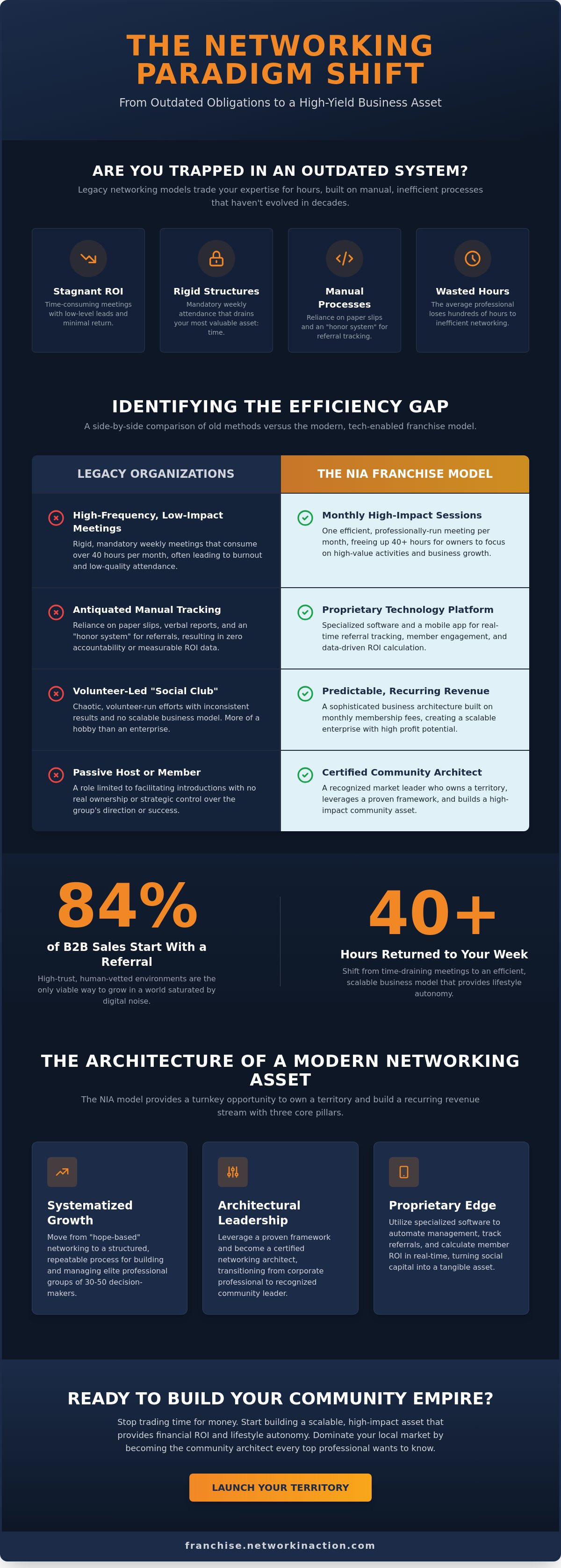
Traditional networking models are stuck in the 1980s. They rely on high-pressure environments and rigid attendance policies that ignore the reality of a modern executive's schedule. Busy professionals can't afford to spend 90 minutes every Tuesday morning trading low-quality leads just to meet a quota. This "busy work" creates a massive opportunity cost. If your time is worth $200 an hour, spending 50 weeks a year in a stale meeting room costs you $15,000 in lost productivity before you've even closed a single deal. The math simply doesn't work for high-level leaders anymore.
The Inefficiency of Outdated Networking Models
Legacy networking organizations prioritize quantity over quality. They demand "forced referrals," which often result in "trash" leads that waste everyone's time. This transactional approach lacks the depth required for high-level business growth. Modern executives are shifting toward a referral marketing strategy: unlocking growth through trust rather than obligation. Before investing your capital in a new venture, it's wise to consult a guide to buying a franchise to ensure you're backing a system built for the future. The shift away from high-pressure quotas is not just a trend; it's a necessity for those who value their professional reputation.
- Elimination of weekly "attendance for attendance's sake."
- Removal of high-pressure referral quotas that dilute lead quality.
- Focus on high-revenue connections over raw volume.
- Replacement of manual tracking with automated, ROI-driven data.
Differentiating the Modern Network Model
Network franchising has evolved into a sophisticated, tech-enabled business asset. Instead of acting as a club moderator, the franchise owner functions as a community leader and high-level connector. This model utilizes proprietary technology to track ROI, ensuring every interaction has a measurable impact on the bottom line. It's a lifestyle-friendly approach. Monthly meetings replace the weekly grind, freeing up over 70% of the time typically wasted in legacy systems. This efficiency is what attracts the elite tier of business owners who don't have time for fluff.
The modern model is exclusive by design. It doesn't open the doors to anyone with a checkbook; it curates a room of peers. This curation drives higher referral quality and builds a sustainable community where members stay for years. You aren't just selling memberships. You're building a powerhouse of social capital. By moving from social obligation to a results-oriented engine, network franchising provides the scalability and recurring revenue that outdated models can't touch. It's networking evolved for the 2026 market.
The Economics of Ownership: Scalability, ROI, and Recurring Revenue
Traditional networking models often crumble under the weight of high overhead and low engagement. In contrast, network franchising offers a lean, service-based architecture that prioritizes profitability over physical footprint. By 2026, the demand for curated professional communities is projected to hit record highs, as 73% of executives now prefer specialized, tech-enabled networking over broad, unvetted mixers. This shift allows owners to capture high margins without the burden of commercial leases, inventory, or massive staffing requirements.
Long-term financial stability is built on the bedrock of recurring monthly revenue. To calculate the lifetime value (LTV) of a member, multiply the monthly membership fee by the average retention period. In high-performing communities, retention often exceeds 36 months, creating a predictable cash flow that thrives regardless of broader economic volatility. This isn't a transactional business; it's a compounding asset where your initial effort scales into a self-sustaining ecosystem.
Financial Foundations of a Networking Business
Initial franchise fees provide the entry point into a proven system, while ongoing royalties fuel the proprietary technology that keeps the model competitive. The scalability is unmatched. You can start as a focused owner-operator and expand into a multi-group empire as your local influence grows. Low fixed costs like office rent and physical equipment make this a high-margin opportunity with rapid break-even potential. Because you don't need a storefront, your capital stays focused on growth rather than maintenance.
Strategic Growth and Exit Planning
You aren't just running meetings; you're building a saleable business asset. By 2026, professional communities will be valued as strategic data and influence hubs. Maximizing ROI requires leveraging existing professional relationships to populate your groups with high-caliber talent. To see the specific numbers behind this model, explore the Franchise Kit for detailed economic breakdowns.
Evaluating territory potential is critical for long-term success. Market saturation in the networking space remains remarkably low for premium, results-oriented models. While legacy networking organizations struggle with member fatigue and outdated structures, the NIA model thrives in high-density professional corridors where time-starved executives demand efficiency and measurable results. You have the chance to own the premier professional hub in your market before the landscape becomes crowded.
Launching a Community Asset: The Path to Strategic Leadership
Transitioning from a corporate executive to a community authority isn't just a career change; it's a legacy move. Most professionals spend decades building someone else's empire. Network franchising allows you to pivot that accumulated experience into an asset you actually own. You shift from executing tasks to architecting growth for an entire region. This transition offers a psychological ROI that traditional employment cannot match. Helping 30 or 40 local business owners increase their revenue by 22% creates a profound sense of purpose. It turns your professional network into a tangible, appreciating asset that works for you.
Network franchising provides a structured exit from the corporate grind. It replaces the 60-hour work week with a model focused on high-level facilitation and strategic connection. By 2026, the demand for curated, tech-enabled business communities will reach an all-time high as professionals flee the inefficiency of legacy networking organizations. You aren't just buying a business; you're securing a position as a market leader. This role provides the autonomy to choose who you work with and how you spend your time. It's about owning your influence rather than renting it to a corporation.
Becoming the 'Go-To' Person in Your Local Market
Elite professionals recognize that influence is the ultimate currency. When you launch a franchise, you don't start from zero. You leverage a national reputation to attract top-tier talent immediately. Being a 'Certified Networking Expert' positions you as the primary facilitator of high-level commerce in your city. You become the filter through which the best deals and partnerships pass. This isn't about collecting business cards; it's about being the authority who dictates the quality of local business interactions. Your personal brand gains instant credibility by being associated with a modern, ROI-driven system that rejects the fluff of outdated networking models.
Securing Your Future in Modern Networking
The networking industry is undergoing a massive shift toward efficiency and technology. Success in this space requires a calculated move. Start by evaluating Available Territories for 2026 expansion to see where your existing influence has the most leverage. Success requires a tight alignment between your personal values and a model that prizes measurable results over forced referrals. The path forward is reserved for those who refuse to settle for the status quo. It's for the professional who wants to build a recurring revenue stream while maintaining lifestyle autonomy. Discover if you're the right fit for the NIA elite ownership network today.
Lead Your Local Business Ecosystem
The era of inefficient, time-draining networking is over. Modern executives demand more than just a room full of business cards; they require a sophisticated system built for the 2026 economy. By choosing network franchising, you transition from a participant to a community architect. You'll leverage a model with over 150 successful locations globally that replaces the rigid, weekly grind of legacy networking organizations with a streamlined monthly meeting structure. This isn't just another business opportunity. It's a tech-enabled platform designed for maximum ROI and long-term scalability. You'll own a proprietary referral system that automates connections while you focus on high-level strategic leadership and building a recurring revenue asset. The efficiency gap between old-school methods and this modern architecture is clear. If you're ready to disrupt the status quo and reclaim your schedule, the path is already paved. It's time to step into a role that balances professional sophistication with entrepreneurial freedom. Your community is waiting for a leader who values results over tradition.
Download the NIA Franchise Kit to start your journey toward community leadership
Frequently Asked Questions
What is network franchising and how does it differ from a business club?
Network franchising is a scalable business model that grants you the rights to operate a proven system for professional community building. It differs from a standard business club because it provides a structured, turnkey framework designed for measurable growth. While clubs often rely on loose social ties, this model leverages a results-oriented system to transform social capital into a high-ROI business asset.
How much time does it take to manage a networking franchise group?
Managing a single group typically requires fewer than 10 hours of active work per month once your foundation is set. Traditional networking models demand weekly morning meetings that drain your schedule; this modern approach utilizes a streamlined monthly meeting structure. This efficiency allows you to scale your influence and manage multiple groups without sacrificing your existing professional commitments or lifestyle autonomy.
Is proprietary technology really necessary for professional networking?
Yes, because proprietary technology eliminates the manual tracking and inefficiency found in legacy networking organizations. It provides a centralized platform for reporting ROI, tracking referrals, and facilitating member communication instantly. Without these tools, you're stuck with "old-school" paper trails and "clunky" processes that fail to prove value to high-level professionals in 2026.
What kind of background do I need to be a successful network franchise owner?
Success requires a background in sales, executive leadership, or high-level consulting. You don't need prior franchising experience, but you must possess the ability to lead a room and command respect from local business owners. The model is designed for "Visionary Architects" who value efficiency and want to pivot from trading hours for dollars to building a scalable, tech-forward asset.
How do I generate recurring revenue with a networking business?
You generate recurring revenue through a membership-based subscription model that prioritizes long-term retention. By securing multi-year commitments from professionals, you create a predictable cash flow that grows as you launch additional groups. This network franchising strategy ensures your income is not tied to one-off sales but to the ongoing value of the community you lead.
Can I run a networking franchise while keeping my current consulting business?
Absolutely, and many owners find it's the ultimate competitive advantage. The model serves as a powerful lead generation engine for your existing consulting or professional services. By positioning yourself as the leader of a high-level community, you gain instant credibility and access to prospects that would otherwise require expensive, time-consuming cold prospecting.
What are the initial costs associated with starting a networking franchise in 2026?
Initial costs vary based on territory size, typically aligning with executive-level service franchises. According to the 2024 Franchise Business Review, professional service franchises often range from 50,000 to 100,000 dollars for total startup capital. These costs cover your specialized training, proprietary technology access, and the established brand systems needed to disrupt your local market immediately.
How does the model ensure that members actually provide high-quality referrals?
The model replaces forced referrals with a curated vetting process and performance tracking. Unlike the leading brand that prioritizes quantity, this system uses a proprietary algorithm to ensure quality and accountability. Members remain engaged because they see actual ROI; they aren't pressured to pass low-value leads just to meet a rigid, outdated quota.