Your business growth no longer depends on the speed of your fiber optics, but on the velocity of your professional referrals. The most successful executives in 2026 recognize that traditional infrastructure is a commodity, while elite human capital is the real competitive advantage. You've likely felt the drain of losing three hours every week to legacy networking organizations that prioritize rigid quotas over actual results. It's an outdated tax on your schedule that high-level professionals can't afford to pay in a digital-first economy.
Modern networking companies have finally evolved to meet the demands of the sophisticated entrepreneur. You're about to discover how these organizations have moved beyond hardware to provide high-ROI professional referral ecosystems built for impact. This guide explores a streamlined approach to building high-level relationships through proprietary technology and curated memberships. You'll learn how to transition from the grind of forced participation to a scalable business model that delivers recurring revenue and the time freedom you've earned.
Key Takeaways
- Discover how modern networking companies have evolved into sophisticated human capital ecosystems that prioritize high-ROI referral structures over simple digital infrastructure.
- Learn to evaluate professional organizations based on the only metric that matters: transitioning from vanity connections to measurable closed business.
- Identify the structural flaws of legacy networking organizations that rely on rigid, time-consuming weekly meetings and replace them with a modernized, elite approach.
- Uncover the economics of owning a professional network to achieve lifestyle autonomy, recurring revenue, and true scalability in a high-growth industry.
- Explore how curated, technology-enabled platforms disrupt the status quo by delivering superior business outcomes with a fraction of the traditional time commitment.
The Evolution of Networking Companies: Beyond Hardware to Human Capital
Networking evolved. For decades, the term networking companies referred exclusively to the titans of hardware; organizations like Cisco or Juniper that built the physical backbone of the internet. While Cisco reported over $57 billion in revenue in 2023, a massive shift is occurring. By 2026, the most valuable networking companies are those managing human capital rather than routers. High-level executives are moving away from tech-only connections. They realize that while AI can optimize a supply chain, it cannot replace the high-trust referral ecosystems that drive modern B2B revenue. Professional organizations are now the primary engines for growth, focusing on social capital as the ultimate currency.
The Two Worlds of Networking
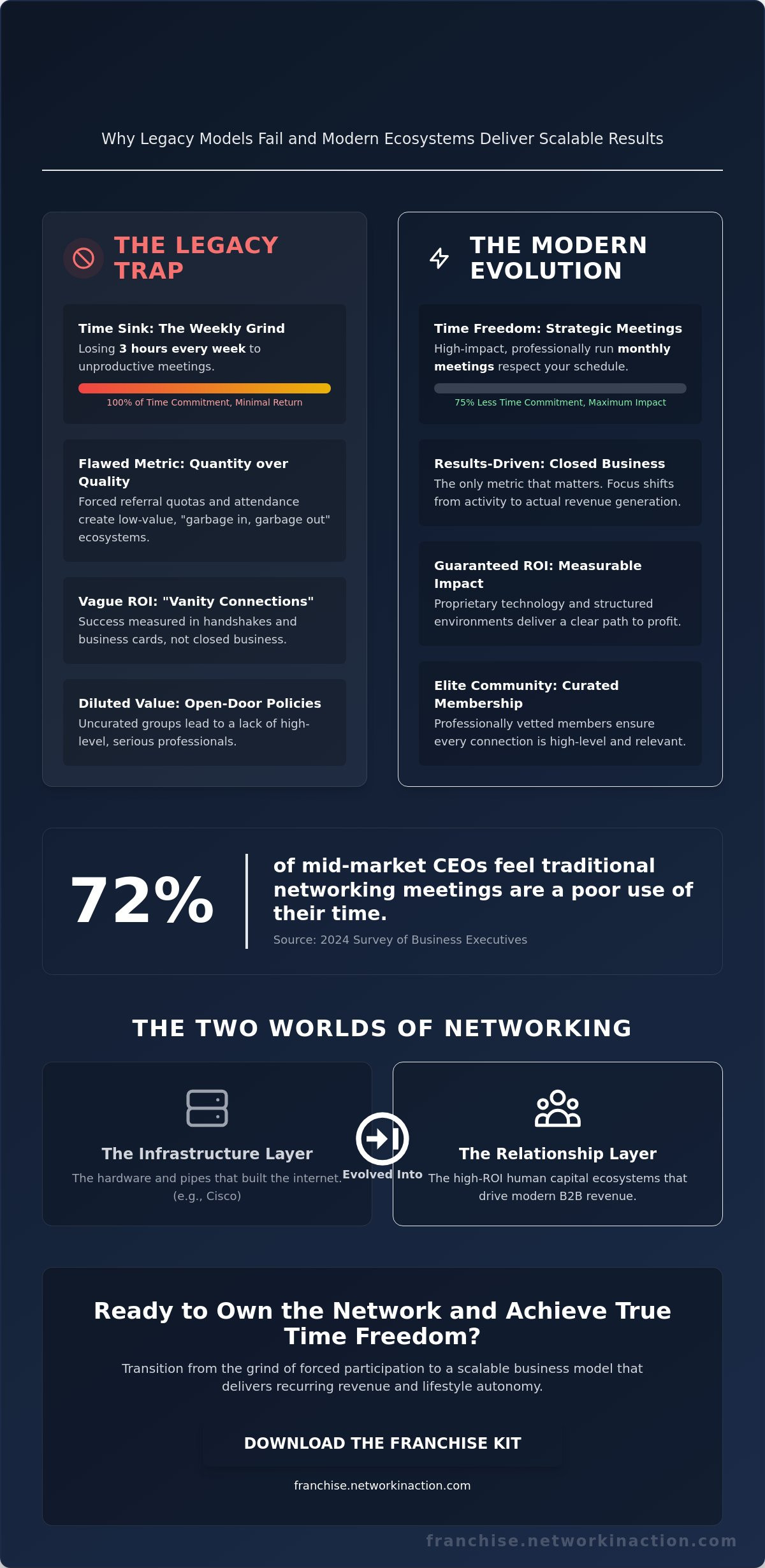
You must distinguish between the infrastructure layer and the relationship layer. The hardware giants provide the pipes, but the "Human Network" provides the profit. Business networking is no longer a casual activity; it's a strategic necessity for business owners who demand measurable results. The intersection of technology and relationship-driven growth has created a new category of elite organizations. These entities leverage proprietary technology to curate connections, ensuring that every interaction has a clear path to ROI. It's about moving from broad connectivity to deep, intentional social capital.
Why Traditional Models are Fading
The "analog" networking group is dying in a digital-first economy. Legacy networking organizations often rely on rigid, outdated rules that fail to respect the time of busy executives. A 2024 survey of mid-market CEOs revealed that 72% feel traditional networking meetings are a poor use of time. The demand for "informed disruption" is at an all-time high. Professionals are fleeing models that prioritize attendance over quality. They want efficiency, structure, and a sophisticated environment. Modern business owners require:
- High-level curation instead of open-door policies that dilute the room.
- Efficiency through technology-enabled platforms that streamline the referral process.
- Structured environments that guarantee a focus on revenue rather than social fluff.
- Time freedom provided by monthly rather than weekly commitment requirements.
This shift isn't just a trend; it's a structural realignment of how business gets done. Leaders no longer have time for the clunky, stale methods of the past. If you're ready to lead this change and build a scalable business, you can download the franchise kit to see how the model has been modernized for the next decade of growth.
Evaluating Professional Networking Organizations for ROI
Stop measuring your success by the volume of business cards on your desk. In 2026, the only metric that matters for elite networking companies is closed business. Legacy networking organizations often trap members in a cycle of attendance for the sake of attendance. This outdated model wastes your most valuable asset: time. Modern professionals demand a results-oriented approach that treats networking as a strategic investment rather than a social hobby. You can spot a high-value organization by its focus on revenue over vanity metrics. It's about moving past the "handshake" phase and into the "contract" phase with surgical precision.
Networking evolved when it stopped being about who you know and started being about how efficiently you can reach them. High-energy entrepreneurs don't have time for fluff. They need systems that filter out the noise and prioritize high-ticket opportunities. If a networking company can't show you a clear path from a meeting to a deposit, it's a liability, not an asset. The shift toward human capital means investing in relationships that have a measurable impact on your bottom line.
Quantity vs. Quality in Referral Marketing
Traditional networking models rely on forced referral quotas. This creates a "garbage in, garbage out" ecosystem where members pass low-quality leads just to hit a weekly target. It's a race to the bottom that devalues your brand. In contrast, a sophisticated referral marketing strategy focuses on curated groups. These memberships aren't open-door; they're strictly vetted to ensure every person in the room brings massive value. Investing in professional development through these elite circles ensures you're scaling your influence, not just your contact list. Curated groups produce higher conversion rates because the trust is already baked into the membership. You don't just find a lead; you find a partner.
Technology as a Differentiator
The leading networking companies of 2026 don't stop working when the meeting ends. They use a dedicated business referral platform to maintain momentum 24/7. A 2025 industry analysis confirmed that tech-enabled networking increases referral speed by 40 percent compared to manual tracking. This efficiency is non-negotiable for the modern entrepreneur. Mobile-first platforms allow you to pass leads and track ROI in real-time from your phone. It's about connectivity without the clutter. If you're ready to see how a streamlined system generates recurring revenue and scales your reach, you might download a franchise kit to explore the backend of a modern model. Technology shouldn't replace the human connection; it should accelerate it.
Elite organizations utilize proprietary technology to bridge the gap between monthly or bi-monthly sessions. This ensures that your referral pipeline never goes cold. By leveraging data-driven insights, you can identify which connections are driving the most value and double down on those relationships. This is the future of networking: sleek, modern, and unapologetically focused on growth.
The Problem with Legacy Networking Models
Traditional networking companies often operate on frameworks established decades ago, long before the digital age and the rise of the modern executive lifestyle. These legacy systems prioritize rigid infrastructure over high-value human capital. For the high-level leader, this creates a significant time-trap. When a professional commits to a weekly 90-minute morning meeting, they sacrifice 78 hours of peak productivity every year. This calculation doesn't even account for travel time or the mental fatigue of a 7:00 AM start. It's a high-cost, low-yield commitment that fails to respect the schedule of a serious entrepreneur.
The rigidity of these one-size-fits-all models is a major deterrent for sophisticated professionals. Legacy organizations treat a solo practitioner and a CEO of a mid-sized firm with the same set of rules. This creates a transactional environment where the goal is to follow a script rather than build strategic partnerships. Genuine connection can't be manufactured through forced attendance or mandatory sessions that lack clear objectives. High-level leaders require curated environments, not cookie-cutter assemblies that value quantity over quality.
The Inefficiency of Forced Referrals
Forcing members to hit weekly referral quotas is a recipe for mediocrity. When a group requires a specific number of leads every seven days, the quality of business leads inevitably drops. Research into social capital suggests that trust is the primary currency of business; forced quotas bankrupt that currency. If you're pressured to provide a name just to avoid a penalty, you're likely to pass along irrelevant contacts. This transactional networking damages professional credibility and wastes everyone's time. Modern professionals prefer a model of organic advocacy where referrals happen because of genuine confidence, not because a spreadsheet demands a report.
The Lifestyle Conflict
The 7:00 AM weekly meeting is a relic of a past era. It ignores the reality of modern business, where flexibility is a non-negotiable asset. High-impact leaders don't want to be penalized for taking a business trip or attending a family event. There's a growing demand for monthly, high-impact sessions that maximize ROI without draining the calendar. This is why the business networking franchise model resonates so deeply with the executive class. It offers a sophisticated alternative that replaces the busy work of traditional networking companies with a streamlined, technology-driven approach designed for growth-oriented professionals who value their time.
Owning the Network: A Strategic Path to Time Freedom
Most professionals spend years attending meetings without ever controlling the room. Transitioning from a member to a leader changes the math of your career. It's the difference between being a tenant and being the landlord. In the world of networking companies, the true ROI isn't found in a single referral; it's found in owning the ecosystem where those referrals happen. Leading a referral group builds local influence and professional authority faster than any traditional marketing campaign. You become the ultimate connector, the person everyone needs to know to get business done.
The economics of this shift are undeniable. Leading a group moves you away from the "pay-to-play" model of legacy networking organizations and into a position of equity. You stop trading hours for dollars. Instead, you build a community that generates value 24/7. This isn't just about business growth; it's about reclaiming your calendar. Modern leaders use these platforms to curate their own professional circle, ensuring every minute spent in a meeting is an investment in high-level human capital.
The Franchise Advantage in Networking
Building a professional community from scratch is a high-risk endeavor. Independent organizers often face a 70% failure rate within the first two years due to a lack of structure. You don't need to reinvent the wheel. A proven system provides brand equity and corporate support that eliminates the guesswork. Successful leaders leverage established frameworks to bypass the "trial and error" phase. By exploring available territories, entrepreneurs can secure market leadership before competitors saturate the local landscape. It's a turnkey route to market that prioritizes speed and stability.
Scalability and Recurring Revenue
Traditional networking models often rely on volunteer labor and clunky manual processes. Modern networking companies utilize a membership-based revenue model that creates predictable, monthly cash flow. This isn't a one-time sale; it's a recurring asset. Proprietary technology now automates up to 80% of administrative tasks, from tracking attendance to reporting ROI. This efficiency allows a single owner to manage multiple groups without a linear increase in workload. Multi-unit ownership becomes a realistic goal rather than a logistical nightmare. You scale your income without sacrificing your lifestyle.
Success in 2026 requires more than just a seat at the table. It requires owning the table itself. If you're ready to move beyond the limitations of outdated networking models, the next step is clear.
Discover your path to leadership and explore available territories today.Network In Action: The Modern Evolution of Business Connections
Networking evolved. While legacy networking organizations focus on attendance quotas and rigid rules, Network In Action (NIA) prioritizes the bottom line. It's a fundamental shift from infrastructure to human capital. Most networking companies still operate on models built in the 1980s. These outdated systems demand weekly time commitments that high-level executives simply cannot afford. NIA disrupts this status quo by replacing busywork with a sophisticated, tech-forward approach designed for the modern economy.
The traditional approach to professional groups is often manual, slow, and transactional. NIA changes the equation by integrating proprietary technology into the core of the member experience. This platform allows for seamless referral tracking and real-time communication, ensuring that no opportunity falls through the cracks. It's a streamlined solution for a world where time is the most valuable currency. By focusing on the quality of connections rather than the quantity of meetings, NIA has redefined what it means to be a leader in the professional space.
The NIA Differentiators
Authenticity drives growth. NIA eliminates the practice of forced referrals, a staple of traditional networking that often leads to low-quality leads and wasted time. Instead, the focus remains on building high-value relationships that result in organic, high-intent introductions. Meetings occur just once a month for 90 minutes. This schedule respects the calendar of a busy professional while maintaining the momentum necessary for significant business growth. Every element is engineered for maximum efficiency.
- No Forced Referrals: Quality is mandated; quantity is not. Relationships are built on trust rather than arbitrary quotas.
- Monthly Meetings: A streamlined 90-minute session replaces the grueling weekly schedule of older, less efficient models.
- Guaranteed ROI: NIA stands alone as a leader by offering a commitment to measurable results for every member who engages with the system.
- Proprietary Technology: A custom-built platform tracks referrals and connections in real-time, bringing modern transparency to a legacy industry.
Join the Future of Networking
The 2026 economy rewards those who can curate and lead professional communities. If you're an executive who values efficiency over activity, the NIA model is built for your lifestyle. Leading a franchise isn't just about hosting meetings; it's about becoming the architect of a local powerhouse network. This role offers recurring revenue and the autonomy to choose who enters your inner circle. It's time to move beyond the clunky, manual processes of the past.
Evaluating your fit for this model requires a shift in perspective. You aren't just joining a group; you're building a business asset. If you're ready to transition from an employee mindset to a community leader, Download the NIA Franchise Kit to begin your journey. The future of networking companies isn't in more infrastructure; it's in smarter, technology-led human capital.
Lead the Next Generation of Business Connections
Traditional networking is broken. Legacy networking organizations often rely on rigid, time-consuming structures that fail to deliver measurable results in a modern economy. The shift toward 2026 demands a focus on human capital and high-level efficiency. You need a model that leverages proprietary technology to streamline operations while maximizing ROI for every member involved. It's about quality, not just volume. This shift represents a fundamental change in how professionals interact and grow.
Network In Action stands as the premier choice among modern networking companies, offering a sophisticated alternative to outdated, transactional models. With over 150 locations worldwide, the brand has proven that a monthly meeting model provides the executive flexibility necessary for high-level professionals. This isn't just another group; it's a strategic path to time freedom and community leadership. You don't have to settle for the inefficiency of the past.
The proprietary technology platform included in the franchise package ensures you have the tools to build a scalable, recurring revenue stream without the stale feel of old-school methods. You can choose to lead your local business community with a turnkey system designed for the visionary architect. Explore the Network In Action Franchise Opportunity and secure your territory in the future of professional connection. The era of informed disruption has arrived.
Frequently Asked Questions
What are the main types of networking companies in 2026?
Networking companies in 2026 are split between legacy referral mills and tech-enabled professional communities. Traditional models still rely on rigid, high-frequency meetings that often lead to professional burnout. Modern alternatives focus on human capital and efficiency, using sophisticated platforms to connect high-level executives. These modern organizations prioritize the quality of the connection over the quantity of the attendees.
How do I choose between a traditional networking group and a modern model?
The choice depends on how much you value your time and the quality of your leads. Traditional groups often demand 50 weekly meetings per year and enforce mandatory referral quotas. Modern models, such as Network In Action, utilize monthly meetings and professional facilitation to save members over 80 hours annually. If you want a results-driven environment without the "busy work," the modern approach is the superior choice.
Why is a networking franchise considered a top executive business opportunity?
A networking franchise offers a scalable, recurring revenue model that leverages your existing social capital. It's an elite business opportunity because it lacks the heavy overhead of traditional brick-and-mortar industries. Data from 2025 shows that the demand for curated professional communities has grown by 15 percent annually. This makes it a prime vehicle for executives seeking lifestyle autonomy and community leadership.
What is the typical ROI for a professional networking membership?
The ROI for a membership with modern networking companies is measured by closed business and time efficiency. While legacy groups track raw referral numbers, modern organizations focus on the actual dollar value of connections. Most members see a return on their investment within the first 90 days through a single high-value partnership. This shift toward measurable social capital ensures your membership is a strategic asset rather than a sunk cost.
Can I own a networking group while maintaining my current business?
You can successfully run a networking group while managing your primary company. The franchise model is specifically designed for the "empire builder" who wants to add a recurring revenue stream without a 40-hour weekly commitment. Most franchise owners dedicate between 5 and 10 hours per month to their groups. This allows you to build a secondary asset that actually strengthens your primary business through increased influence.
How does proprietary technology improve the networking experience?
Proprietary technology moves networking from a manual, clunky process into a streamlined digital ecosystem. Features like real-time ROI tracking and mobile referral platforms eliminate the need for outdated paper slips or manual spreadsheets. By automating the administrative burden, technology ensures that 100 percent of your face-to-face time is spent building relationships. It's about using data to make every introduction more intentional and productive.
What makes NIA different from legacy networking organizations?
NIA disrupts the status quo by eliminating the forced referrals and rigid attendance policies found in legacy networking organizations. Instead of a volunteer-led "free-for-all," NIA uses professional leaders to facilitate high-level connections. This modernization ensures that the environment remains elite and focused on business growth. You aren't just joining a club; you're entering a sophisticated system built for the modern entrepreneur.
What are the requirements to start a professional networking franchise?
Starting a franchise requires a proven track record of business success and a strong local network. Successful applicants typically possess at least 10 years of professional experience and a drive for community leadership. You'll need to complete a comprehensive training program that covers the turnkey operating system. This ensures you have the tools to launch a scalable business that delivers immediate value to your local market.