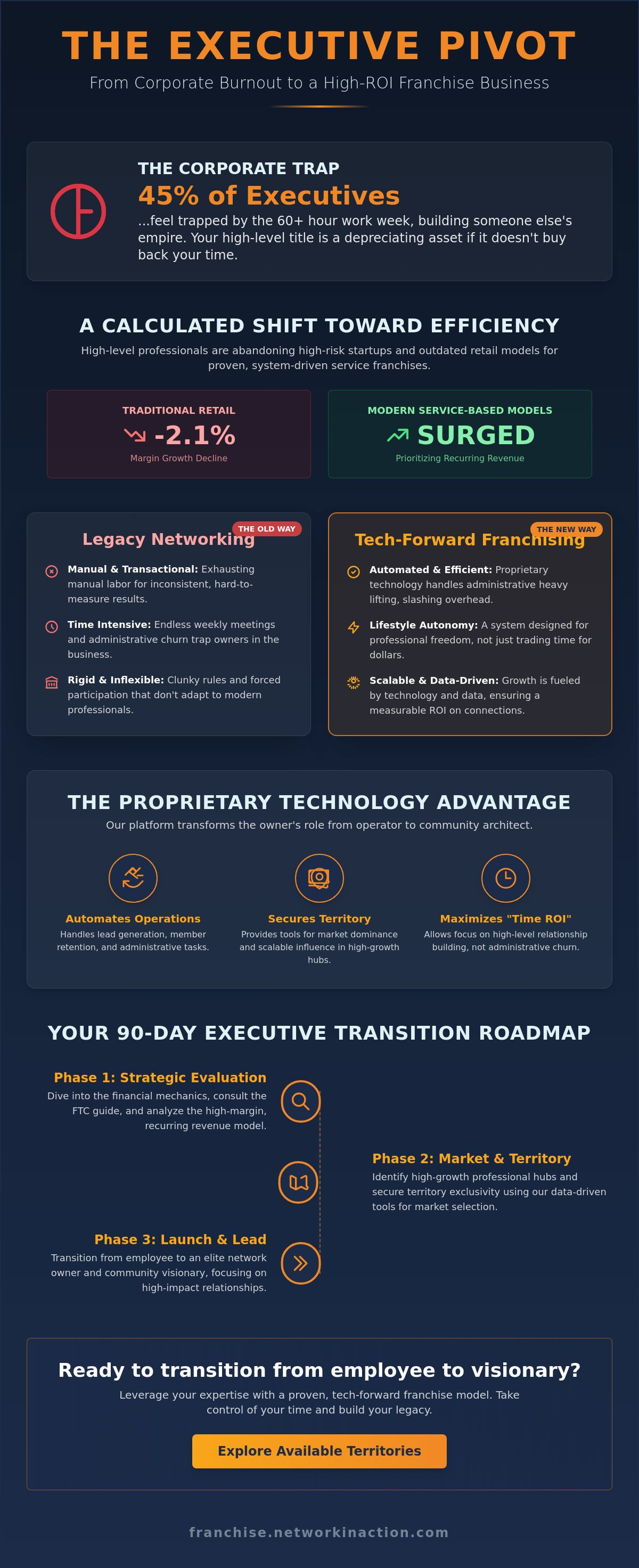
Your high-level corporate title is a depreciating asset if it doesn't eventually buy back your time. You've spent decades building someone else's empire, yet a 2024 leadership study found that 45% of executives still feel trapped by the 60 hour work week. You recognize that traditional networking models are fundamentally broken. They're rigid, transactional, and demand an exhausting amount of manual labor for inconsistent results.
It's time for a strategic pivot. This guide reveals how to leverage your professional expertise into a high-ROI franchise business that prioritizes efficiency over mindless activity. You'll learn how to replace the burnout of legacy networking with a tech-forward model designed for predictable, recurring revenue and total lifestyle autonomy. This is the blueprint for transitioning from a high-pressure corporate role to a position of community leadership. You'll discover how proprietary technology and streamlined systems allow you to build a high-impact professional community that scales without sacrificing your freedom.
Key Takeaways
- Learn why service-based models are outpacing traditional retail and how to evaluate a franchise business for maximum recurring revenue and lifestyle autonomy.
- Discover how proprietary technology replaces the manual, transactional burden of legacy networking organizations, allowing you to focus on high-level relationship building.
- Master the financial mechanics of modern networking, from calculating entry costs to leveraging a high-margin model built on professional service fees.
- Identify high-growth professional hubs and secure territory exclusivity to ensure long-term market dominance and scalable influence.
- Follow a strategic 90-day roadmap designed for corporate leaders to successfully transition from employee to an elite network owner and community visionary.
Defining the Franchise Business Model in the Modern Economy
In 2026, the definition of a successful franchise business has shifted from physical storefronts to sophisticated, system-driven enterprises. High-level professionals are abandoning the 80-hour work week associated with independent startups. They're choosing to license proven frameworks instead. This shift isn't just a trend; it's a calculated move toward efficiency. By leveraging an established blueprint, you bypass the risky trial-and-error phase that causes 20% of new businesses to fail within their first year.
Understanding What is a Franchise Business Model requires looking past the traditional retail lens. While retail sectors faced a 2.1% decline in margin growth throughout 2025, service-based models surged. These modern systems prioritize intellectual property and recurring revenue over inventory and expensive real estate. They allow owners to focus on high-value activities like community leadership rather than manual operations. It's a fundamental move from being a technician in your business to being the architect of its growth.
Modern franchising integrates proprietary technology to slash owner overhead. Automation handles the administrative heavy lifting that used to require a full-time staff. This evolution transforms the owner's role entirely. You aren't "buying a job" where you trade time for dollars. You're acquiring a scalable system designed for professional autonomy. The goal is a business that runs on logic and software, not just your physical presence.
The Evolution of Professional Services Franchising
The "white-collar franchise" is the new standard for former executives. It moves beyond food and beverage into business consulting and high-level networking. Traditional networking models often feel clunky and manual, relying on rigid rules and forced participation. Modern alternatives use data-driven platforms to ensure a measurable ROI on every connection. Professional networking is the next frontier because it treats social capital as a primary business asset. It's about curated quality, not just a room full of people.
Business Format Franchising vs. Product Distribution
Business format franchising provides a complete blueprint for success. It's different from simple product distribution because it includes the brand standards, marketing engines, and quality control systems necessary for rapid growth. In 2026, brand consistency is the ultimate currency for building trust in a fragmented market. A turnkey system eliminates the "founder's trap," where a leader becomes the bottleneck for every decision.
- Turnkey efficiency: Systems are pre-built to handle lead generation and member retention.
- Quality control: Established brand standards ensure a premium experience across every territory.
- Scalability: Growth is fueled by proprietary technology, not increased headcount.
The most successful owners treat their franchise business as a strategic platform. They use these systems to dominate local markets without the risks of ground-up development. If you are ready to lead a professional community using a modernized approach, you can explore available territories to see where this model is disrupting the status quo.
Evaluating the ROI of a Franchise Business Opportunity
Investing in a franchise business is a strategic move that demands more than a cursory glance at a balance sheet; it requires a deep dive into the unit economics of social capital. You must calculate the true cost of entry, which extends far beyond the initial franchise fee. A sophisticated investor analyzes ongoing royalties, marketing fund contributions, and the essential costs of accessing proprietary technology that drives operational efficiency. Before signing any agreement, savvy professionals consult the FTC Guide to Buying a Franchise to ensure they understand the full scope of their legal and financial commitments. This preparation ensures that your capital is deployed with precision and foresight.
The real value of this investment lies in the "Time ROI." Traditional networking models often trap owners in a cycle of endless weekly meetings and administrative churn. Modern systems prioritize high-impact interactions over high-volume attendance. This allows you to measure success by the quality of the connections made rather than the hours spent in a conference room. Scalability is the ultimate goal for the visionary architect. You want a model where growth is decoupled from labor. If doubling your revenue requires doubling your hours, you haven't built a business; you've bought a demanding job. True scalability allows for territory expansion and membership growth without a linear increase in your personal effort.
Recurring Revenue and Financial Predictability
Predictability is the cornerstone of any elite professional services model. Unlike transactional sales where you start at zero every month, membership-based models create a compounding financial foundation that rewards long-term vision. Recurring revenue in a networking context is the consistent, predictable income generated from long-term member subscriptions that value ongoing community access over one-off interactions. This stability shifts your focus from aggressive prospecting to high-level relationship management. Legacy networking organizations rely on high turnover and constant recruitment. A modern approach focuses on retention through superior technology and measurable results. It’s about building an asset that grows in value every month.
Lifestyle Autonomy and Time Freedom
The 40-hour networking week is a relic of the past. Legacy models demand a rigid, daily commitment that drains an executive’s most valuable resource: time. A streamlined, monthly meeting structure disrupts this inefficiency. It allows you to design a business that fits an executive lifestyle, ensuring you remain a leader rather than an administrator. You can download our franchise kit to see the economics of time and how a modernized schedule creates a superior lifestyle. This isn't about working less; it's about working with precision. You can lead a thriving community of professionals while maintaining the freedom to pursue other ventures or enjoy personal time. If you are ready to explore a more sophisticated way to lead, consider how this model aligns with your long-term goals.
Disrupting Traditional Networking: The Technology Advantage
Legacy networking organizations operate on a premise that expired decades ago. They prioritize attendance over achievement; they value quantity over quality. For a sophisticated professional evaluating a franchise business, time is the most liquid asset. Modern networking must respect that. Traditional models demand weekly presence, forcing members into a cycle of "referral fatigue" where the goal is simply to fill a quota rather than drive actual growth.
The Flaws of Outdated Networking Models
Outdated networking models are fundamentally transactional. Because these groups require weekly meetings, members often provide low-quality leads just to satisfy rigid requirements. This leads to high member churn. Industry data suggests that groups relying on forced referrals see significantly higher turnover rates than relationship-based models. Manual lead tracking is another bottleneck. Relying on paper slips or clunky spreadsheets in a digital-first world is inefficient. It prevents professionals from seeing the actual ROI of their social capital.
Modernizing Connection Through Proprietary Platforms
Networking evolved when technology replaced manual tracking. Proprietary platforms now allow members to maintain 24/7 connectivity without the burden of constant physical meetings. This digital ecosystem supports face-to-face relationship building by handling the administrative heavy lifting. It quantifies the value of every connection made. When you investigate the FTC's Guide to Buying a Franchise, you'll see that operational efficiency is a hallmark of a strong system. NIA delivers this through a streamlined interface that tracks referrals, captures testimonials, and facilitates communication.
Curated membership ensures every interaction is high-value. Unlike the leading brand's "open door" policy, modern networking focuses on vetting. This ensures you're in a room with peers, not just people looking for a quick sale. For more on how this model scales, see our guide on Business Networking Franchise: The Executive Guide to Modern Ownership. This approach transforms networking from a chore into a strategic franchise business asset. It provides the freedom to lead a community while leveraging a platform built for the 2026 economy. You don't need more meetings; you need better connections and the data to prove they work.
Strategic Market Selection and Territory Growth
Success in a modern franchise business depends on more than just local presence. It requires a calculated land grab in high-growth professional hubs. You aren't just buying a zip code; you're securing a perimeter for long-term market dominance. Territory exclusivity isn't a luxury; it's a requirement. It ensures that your influence remains uncontested, allowing you to curate a premier community of small to mid-sized business owners without internal competition. Professional credibility is your primary currency in this environment. High-quality members don't join groups; they join leaders. When you control the territory, you control the caliber of the room and the quality of the connections within it.
Identifying High-Potential Territories
Identifying the right market involves analyzing professional activity density with surgical precision. Look for regions where business services, legal, and financial sectors comprise at least 25% of the local economy. Ideal demographics feature high concentrations of decision-makers who value time efficiency over social hour. Evaluate local business density by targeting areas with over 2,000 registered entities within a 15-mile radius. This volume ensures a deep pool of potential members for your groups. Explore available territories near you to see where the next professional hub is forming.
Building a Referral-Based Business Empire
Legacy networking organizations focus on participation, but the modern executive focuses on ownership. Instead of paying dues to attend someone else’s rigid meeting, you leverage your existing professional capital to own the network itself. This shift from participant to architect creates a scalable model of recurring revenue. By positioning yourself as the central connector, you transform social capital into a tangible asset. This is the core of a sophisticated Referral Marketing Strategy: Unlocking Growth through Trust and Connections. You aren't prospecting; you're leading a self-sustaining ecosystem where every member's success reinforces your own authority. This franchise business model thrives because it replaces cold outreach with high-level relationship management and technology-backed ROI.
The most lucrative territories are being claimed by forward-thinking executives who understand the value of social capital. It's time to stop attending meetings and start owning the market.
Discover your territory and secure your professional future today.The Executive Transition: From Employee to Network Owner
Leaving the corporate world isn't just about changing your title; it's about reclaiming your time and leveraging your existing expertise to build a scalable asset. Most high-level professionals already possess 90% of the skills required to run a successful franchise business. The final 10% involves shifting from executing someone else's vision to curating your own professional ecosystem. You aren't just buying a job. You're architecting a community where you sit at the center of every high-value transaction.
The transition to ownership follows a structured 90-day roadmap designed for maximum efficiency and momentum. During the first 30 days, you master the proprietary technology that replaces the manual labor and administrative drag typical of legacy networking organizations. By day 60, you've identified the local power players who prioritize ROI over the social fluff found in traditional networking groups. By day 90, your first group is live, generating recurring revenue and establishing you as a premier business authority. This isn't a slow build; it's a calculated launch into a position of professional influence.
Leveraging Corporate Skills in a Franchise Environment
Your years in the C-suite or upper management have prepared you for this role. You've spent a career managing complex systems, leading teams, and driving measurable results. In the NIA model, those skills translate directly into community leadership. You stop cold prospecting and start building relationship-driven growth. It's a strategic pivot from selling a product to providing a high-tech platform for elite professionals. For a deeper look at how your executive background fits this new economy, explore Top Executive Business Opportunities in 2026: Beyond the C-Suite.
Taking the Next Step Toward Ownership
Success in a franchise business requires total alignment between your lifestyle goals and the brand's operational rhythm. Conduct your due diligence by examining how NIA's technology-enabled platform removes the friction found in outdated networking models. This is about securing your future through recurring income and social capital that grows every month. If you're ready to see how modern networking outperforms the leading brand's rigid, transactional structures, Get your free book on modern networking today. It's time to stop working for a network and start owning one.
Secure Your Position in the Future of Networking
Legacy networking organizations are failing the modern executive. They're rigid, time-consuming, and transactional. By 2026, the professional landscape requires a data-backed approach to social capital that prioritizes efficiency over volume. You've seen how proprietary technology and curated memberships replace the fluff of traditional models. Choosing a franchise business in this sector isn't just a career shift; it's a strategic play for recurring revenue and lifestyle autonomy. You aren't just buying a job. You're building a scalable asset that leverages your professional expertise.
With over 150 locations globally, Network In Action has already disrupted the status quo. The system is specifically designed for high-level executive lifestyles, providing the tools to track every connection through proprietary ROI-tracking technology. This marks the end of "hope-based" networking. It's time to lead your community with a system built for the modern economy.
Explore the NIA franchise opportunity and take control of your professional future.
The transition from employee to network owner is the most logical move for those who value time as much as profit. Start building your legacy today.
Frequently Asked Questions
What is the primary difference between a franchise and a startup?
A franchise business offers a pre-built operating system, whereas a startup requires you to invent every process from scratch. Data from the Bureau of Labor Statistics indicates that 20% of new businesses fail within their first year, but franchising mitigates this risk through proven methodology. You gain immediate access to institutional knowledge, allowing you to focus on growth instead of troubleshooting basic operations.
How much time does a networking franchise owner need to commit weekly?
Most owners dedicate 5 to 10 hours per week to managing their professional groups. This efficient schedule is a direct result of replacing the 40 hour work week with a streamlined, tech-forward management style. You don't need to sacrifice your personal life to see results. The model prioritizes high-impact activities that drive ROI, ensuring every minute spent on the business translates into tangible growth.
Is a networking franchise a good fit for someone with no sales experience?
Success in this model depends on leadership and relationship management rather than aggressive sales tactics. High level professionals often excel because they leverage existing credibility to attract quality members. Since the system focuses on ROI driven networking, the value proposition sells itself to results oriented business owners who are tired of the inefficiency found in legacy networking organizations.
Can I own a franchise business while still working a full-time job?
You can absolutely maintain a full-time career while growing your franchise business. The monthly meeting structure is built for the busy executive who values time as their most precious asset. It's a strategic move for those seeking a secondary income stream that carries the prestige of a primary career. You lead the community, and the proprietary technology manages the logistics.
What are the ongoing costs associated with owning a networking franchise?
Ongoing costs typically include technology fees, marketing expenses, and venue rentals for your monthly meetings. These overhead requirements are significantly lower than traditional brick and mortar businesses because there's no need for expensive storefronts or large inventories. This lean operational model ensures that more of your revenue stays in your pocket, maximizing your long term profitability and scalability.
How does the technology platform help franchisees scale their business?
The proprietary technology platform automates member tracking, referral monitoring, and monthly reporting to ensure measurable ROI for every participant. It replaces the clunky, manual processes found in legacy networking organizations with a sleek, digital interface. This data driven approach allows you to manage multiple groups simultaneously, maximizing your earning potential without increasing your manual workload or administrative stress.
Why is a monthly meeting model more efficient than traditional networking?
Monthly meetings respect the schedule of high level executives by condensing value into a single, high energy session. Traditional networking models demand 52 meetings a year, which often leads to burnout and diluted quality. NIA’s modernized approach ensures that every interaction is strategic, results oriented, and focused on building deep professional connections rather than just checking a box on a calendar.
What kind of training and support do franchisees receive?
Franchisees receive comprehensive training covering group launch strategies, member retention, and technology integration. This support includes ongoing coaching and access to a national network of successful owners who share best practices. The goal is to provide a turnkey solution that empowers you to lead with confidence from day one, ensuring your business thrives in any market condition through collective intelligence.