Your corporate exit strategy is either a calculated investment in a proven system or a high-stakes gamble on an unvalidated idea. Data from the Bureau of Labor Statistics indicates that 20% of new businesses fail within their first year, primarily due to a lack of market validation and structured systems. You understand that time is your most valuable asset. Starting with a blank slate often drains that asset faster than any corporate role ever could. The decision between a franchise vs starting a business from scratch determines whether you'll spend 2026 building a brand or actually operating a profitable one.
You deserve a roadmap that respects your professional experience and provides a clear path to scalable growth. This executive guide identifies the strategic differences between these two paths to help you secure the highest ROI and lifestyle autonomy for your future. You'll discover how to leverage proprietary technology to create predictable recurring revenue without the trial-and-error of an independent startup. We'll explore why high-level leaders are opting for modernized, turnkey models that offer immediate professional credibility and the time freedom you've earned.
Key Takeaways
- Understand the strategic shift from the "innovation" of a startup to the "execution" of a proven blueprint to align your investment with your professional vision.
- Analyze the statistical success rates and speed-to-market advantages of a franchise vs starting a business from scratch to ensure a faster path to reaching cash-flow positive status.
- Uncover the hidden opportunity costs of building from zero, including the significant loss of executive income during the months spent developing unproven systems.
- Identify high-margin, executive-led service models that offer recurring revenue and lifestyle autonomy over the labor-intensive demands of traditional brick-and-mortar operations.
- Discover how modern networking disrupts legacy networking organizations by leveraging proprietary technology to deliver measurable ROI and community leadership.
The Entrepreneurial Crossroads: Franchise vs Starting a Business from Scratch
The decision to enter business ownership in 2026 is no longer about simply "being your own boss." It is a fundamental choice between innovation and execution. Innovation requires inventing a solution for an unproven market; execution demands the discipline to scale a model that already works. For high-level executives, the choice between a franchise vs starting a business from scratch represents a trade-off between the chaos of creation and the precision of a blueprint. Success in the modern economy favors those who can bypass the experimental phase and move straight to generating ROI.
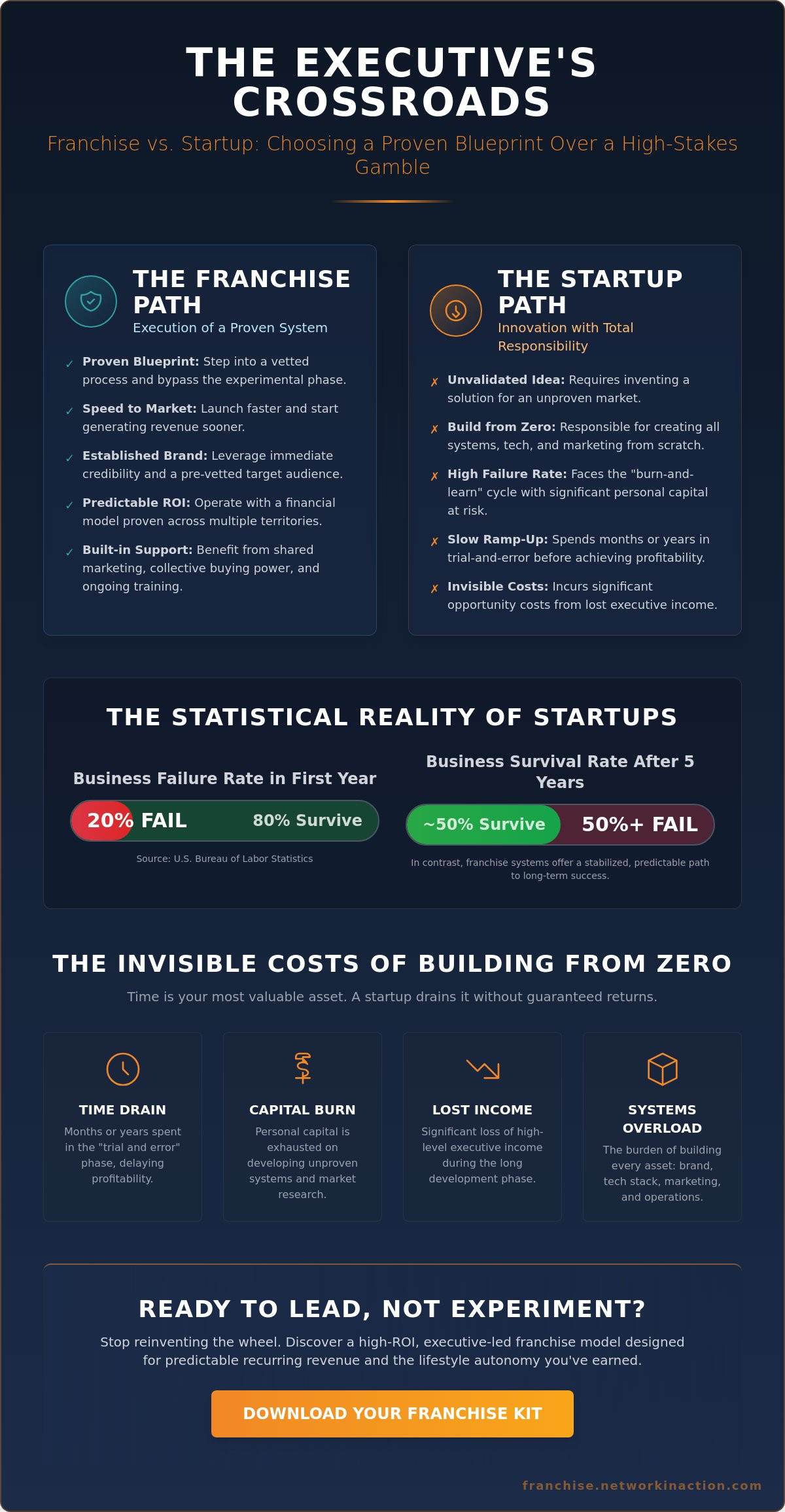
According to data from the U.S. Bureau of Labor Statistics, approximately 20% of new businesses fail during their first two years. This reality drives the 2026 entrepreneur to seek impact without the traditional "burn-and-learn" cycle. Seasoned professionals often find the trial-and-error phase of startups beneath their skill level. They value time as their most precious asset and view "reinventing the wheel" as a structural inefficiency. They don't want to build a business; they want to lead an organization.
The Startup Path: Total Control and Total Responsibility
The startup route offers absolute creative freedom. You own every pixel of the brand and every line of the operational manual. This "blank slate" approach appeals to those who want to disrupt an industry from the ground up. However, this freedom comes with a heavy burden. You must build your own proprietary technology, marketing assets, and tech stacks from zero. The high failure rates in this sector often stem from "pivoting" too late during the first 24 months. Without a proven system, you are essentially paying for your own market research with your personal capital and time.
The Franchise Path: Bypassing the Experimental Phase
The franchise model shifts the focus from invention to leadership. It is a strategic partnership where the heavy lifting of system design is already complete. You aren't guessing what works; you're managing a vetted process. For a deeper dive into the mechanics, researching What is Franchising? reveals a structure designed for rapid scalability and predictable outcomes. This turnkey approach allows you to leverage an established brand and a pre-vetted target audience from day one.
Modern professionals are increasingly choosing the franchise path to secure recurring revenue and lifestyle autonomy. If you're ready to stop experimenting and start leading a community of high-level professionals, you can download a franchise kit to explore how a modernized networking model provides a superior ROI compared to legacy networking organizations.
Evaluating the Risk-Reward Ratio of Proven Systems
Risk assessment is the hallmark of a sophisticated executive. When you weigh a franchise vs starting a business from scratch, the statistical delta is impossible to ignore. Data from the Small Business Administration consistently shows that while 20 percent of independent startups fail in year one, franchise systems offer a stabilized path. By year five, the survival rate for independent entities often drops below 50 percent. A franchise model provides a predictable financial trajectory because the variables have been solved in 100 or more territories already. This isn't just about safety; it's about the ROI-driven logic of a system that works.
Speed to market defines your initial success. An independent founder spends months or years in the "trial and error" phase, burning capital while searching for a functional sales process. A franchise owner skips this expensive experimentation. You step into a business with collective buying power and shared marketing resources that drive down customer acquisition costs from day one. This efficiency is why high-level professionals are increasingly looking at Top Executive Business Opportunities in 2026: Beyond the C-Suite to secure their next professional move.
The Safety Net of Professional Support
Initial onboarding and ongoing training function as a high-velocity filter for early-stage mistakes. You don't have to guess which technology stack works or how to structure a recurring revenue stream; the blueprint is provided. Beyond the corporate office, a community of fellow franchise owners serves as a built-in peer-advisory board. This collective intelligence ensures that if a market shift occurs, you aren't pivoting in isolation. You're part of a modernized, technology-led movement that prioritizes efficiency over the clunky, manual processes of legacy networking organizations.
Brand Equity and Market Authority
Closing high-ticket clients requires immediate credibility. When you represent a recognized national brand, you bypass the years of trust-building that independent consultants must endure. The psychological advantage of market authority allows you to command premium rates immediately. It's a strategic choice: do you spend three years building an unknown name, or do you leverage a proven brand to capture market share today? Deciding whether to Franchise or Start Your Own Business comes down to how much you value your time. If you're ready to see how a structured model can accelerate your growth, you might want to download the franchise kit to explore the specific ROI metrics of this model.
The Invisible Costs of Building from Zero
Many entrepreneurs fall for the "no-fee" fallacy. They assume that avoiding an upfront franchise fee preserves capital for growth. This logic is flawed. When evaluating the franchise vs starting a business from scratch equation, the most dangerous expenses are the ones that don't appear on a balance sheet until it's too late. You aren't just building a business; you're paying "tuition" to the school of hard knocks, and that tuition is rarely cheap.
Consider the opportunity cost of your time. For a professional accustomed to a $180,000 annual salary, every month spent "figuring it out" costs $15,000 in lost income. A typical six-month launch period for an independent startup represents a $90,000 invisible deficit. While you tinker with software integrations and brand messaging, a franchisee is already operational and generating ROI. Before you commit your life savings to an unproven concept, consult the FTC's Guide to Buying a Franchise to understand the structural protections a proven model provides.
The burn rate of capital is equally aggressive when marketing an unproven message. Independent owners often spend $20,000 to $50,000 on consultants to build systems that a franchise provides on day one. Marketing to an undefined audience with a "guess-and-check" strategy results in a high customer acquisition cost that can bankrupt a startup before it finds its footing.
The Legacy Networking Trap
Traditional networking models are notorious for consuming excessive time for minimal ROI. These legacy networking organizations rely on rigid, transactional structures that demand hours of manual effort for every lead generated. It's a "time tax" that high-level executives cannot afford. Modern alternatives replace this manual grind with technology-enabled referral systems. Instead of attending weekly meetings that feel like a chore, sophisticated professionals use proprietary platforms to trigger high-quality introductions. The cost of staying stuck in an outdated, manual networking loop is measured in lost hours and missed six-figure contracts.
The Cost of System Inefficiency
Independent business owners often spend 40% of their work week on administrative tasks. This includes vetting CRM software, managing billing, and troubleshooting tech stacks. In a service-based model, poor retention is the silent killer of profitability. Without a structured support system, client churn rates can spike by 25% or more. A modern franchise platform automates the "busy work," allowing you to focus on high-value community leadership. To see how a streamlined, technology-driven system operates in the real world, you should download the franchise kit and compare it to the chaos of building from zero.
Strategic Selection: Finding a Modern, Scalable Business Model
When evaluating a franchise vs starting a business from scratch, you must look at the exit strategy before you even sign the agreement. Most entrepreneurs trap themselves in labor-intensive "brick and mortar" models that demand 60-hour work weeks and constant staff turnover. For the high-level executive, this isn't ownership; it's a high-stress job with more liability. True strategic selection focuses on scalability and recurring revenue potential that doesn't require your physical presence at a cash register. In 2026, the most successful owners are pivoting toward models that prioritize intellectual capital over physical inventory.
The goal is market dominance through territory rights. Unlike starting from zero where you're fighting for every inch of visibility, a structured franchise grants you protected boundaries. This allows you to focus on dominating a local market rather than defending it. You should prioritize "executive-led" models where your primary role is relationship management and strategic growth, not fixing a broken HVAC unit or managing a fry station. This shift ensures you build a lifestyle-friendly business that generates profit while you maintain your personal autonomy.
Beyond Food and Retail: The Rise of Service Franchising
High-level executives are increasingly abandoning retail for professional service and networking franchises. These models offer significantly higher margins because they lack the crushing overhead of commercial leases and complex supply chains. Service-based franchises accounted for over 50% of new franchise growth in recent years because they're leaner and faster to scale. By choosing a Business Networking Franchise: The Executive Guide to Modern Ownership, you leverage your existing professional stature to build a recurring revenue stream that's insulated from the volatility of the retail sector.
Technology as a Force Multiplier
In 2026, a tech-forward model is the only way to ensure long-term relevance. Proprietary technology platforms now act as force multipliers, allowing a single owner to manage hundreds of professional relationships without a massive administrative team. This eliminates the need for "cold prospecting" and replaces it with a system that leverages a network for organic growth. Modern ownership is about efficiency; it's about using automated tools to track ROI and member engagement. The choice of a franchise vs starting a business from scratch ultimately comes down to whether you want to spend years building these systems or start using them on day one to drive immediate results.
- Low Overhead: Home-based or "office-light" models maximize profit margins.
- Recurring Revenue: Membership-based systems provide predictable monthly cash flow.
- Scalability: Technology allows you to expand your reach without doubling your workload.
- Professional Credibility: Leading a community of business owners positions you as a local authority.
Ready to move beyond the limitations of traditional business models? It's time to secure your territory and begin building your executive network.
The Network In Action Evolution: A High-ROI Franchise Alternative
The networking industry is overdue for a revolution. While legacy organizations cling to rigid, 1980s-era weekly meeting requirements, Network In Action (NIA) delivers an informed disruption. For executives debating a franchise vs starting a business from scratch, NIA provides a sophisticated framework that values time as much as capital. It replaces the "check-the-box" mentality of traditional networking with a results-only focus. This isn't just another business group; it’s a tech-forward solution for the modern economy.
Innovation defines the NIA model. Instead of the exhausting 52-week-per-year grind, NIA utilizes high-impact monthly sessions designed for the busy professional. Between these meetings, proprietary technology keeps the ecosystem connected. This platform doesn't just facilitate introductions; it tracks referral ROI with surgical precision. Members see exactly how their membership translates into revenue, turning social capital into a measurable business asset. It brings transparency to an industry that has historically relied on "hope and prayers" for results.
As an NIA franchisee, you step into the role of a Visionary Architect. You aren't a salesperson or a clerical administrator. You're the curator of your local business community. You select the members, foster the connections, and drive the economic engine of your territory. It’s a position of influence that commands immediate respect among local leaders and business owners.
Freedom, Flexibility, and Recurring Revenue
The NIA model is built for the entrepreneur who demands a high-income lifestyle without the operational headaches of a traditional business. You won't manage a massive payroll or worry about physical inventory. This is a lean, high-margin operation centered on recurring revenue. Scalability is built into the DNA. Owners can easily launch multiple groups to maximize their reach within a protected territory. You can check available territories to identify expansion opportunities in your region right now.
Building Professional Credibility and Impact
Success in this model means becoming the central hub of your local business ecosystem. You provide the platform where small to mid-sized businesses finally find the quality referrals they need to scale. There's a profound satisfaction in watching your members thrive because of the environment you built. It’s a strategic move for any professional looking to exit the corporate rat race and enter a role defined by leadership and legacy. If you're ready to lead, download the free book to master the art of modern networking ownership and see why this is the definitive choice when comparing a franchise vs starting a business from scratch in 2026.
Secure Your Executive Legacy in the Modern Economy
Deciding between a franchise vs starting a business from scratch requires a cold, calculated look at your most valuable asset: time. Building a brand from zero often demands years of trial and error; however, the right system offers an immediate shortcut to scalability. Network In Action has already disrupted the industry by replacing the clunky, time-consuming rituals of legacy networking organizations with a streamlined, executive-level framework. With over 150 successful locations globally, the model is proven and ready for deployment. It leverages a proprietary technology platform designed specifically to maximize member ROI through data-driven connections. You won't find the rigid, weekly requirements typical of traditional networking here. Instead, a monthly meeting model respects your schedule while driving significant recurring revenue. This is the future of networking evolved for the 2026 market. It's about working smarter and owning a business that serves your lifestyle. The transition from executive to owner is a strategic move, not a gamble. Take the next step toward a modernized business model that prioritizes your influence and your income.
Explore available territories and start your journey toward modern business ownership.
The opportunity to lead your professional community and secure your financial future is waiting for you.
Frequently Asked Questions
Is a franchise safer than a startup for a first-time business owner?
Franchises offer a significantly higher success rate, with industry reports suggesting a 90 percent survival rate over five years. Data from the U.S. Bureau of Labor Statistics shows roughly 20 percent of independent startups fail in their first year. Franchising mitigates this risk by providing a tested operational manual and established brand equity. You bypass the trial and error phase that sinks most independent ventures. This structured approach provides a strategic advantage for executives.
How long does it typically take for a franchise to become profitable versus a startup?
Franchises generally reach profitability faster, often within 12 to 18 months, compared to the 36 months typical for independent startups. The primary reason is the turnkey nature of the model. When comparing a franchise vs starting a business from scratch, the franchise provides immediate brand recognition and pre-built marketing funnels. You aren't building a reputation from zero; you're scaling an existing one. This acceleration maximizes your initial capital investment and speeds up your ROI.
Can I still be creative if I buy a franchise instead of starting my own business?
Creativity in franchising shifts from reinventing the wheel to optimizing the engine. While you follow a core system, you apply your executive vision to business development and community leadership. Modern models, especially in the networking space, allow you to curate high-level professional groups. You direct the culture and strategy of your territory while the franchisor handles the technical infrastructure and core branding. It's about strategic leadership rather than designing logos.
What are the most common hidden costs when starting a business from scratch?
Unforeseen expenses in independent startups often include legal fees for drafting proprietary contracts, which can exceed 5,000 dollars, and the high cost of custom software development. You also face learning curve costs, such as inefficient marketing spend that yields zero ROI. Independent owners frequently underestimate the price of building a brand from the ground up. These costs are often bundled into a transparent, predictable franchise fee in established, modern systems.
Why do executives prefer service-based franchises over retail models?
Service-based models offer higher margins and lower overhead because they eliminate the 30 to 40 percent cost of goods sold typical in retail. Executives value the scalability and recurring revenue these models provide. Without the burden of physical inventory or high-rent storefronts, you focus on high-impact activities like relationship building. This alignment with the future of networking creates a lifestyle-friendly business that prioritizes time freedom and professional influence over managing floor staff.
What should I look for in a franchise disclosure document (FDD)?
Focus on Item 19 for financial performance representations and Item 20 to see the turnover rate of existing units. A healthy system shows steady growth rather than a high percentage of closures. You should also scrutinize the litigation history in Item 3. These 23 sections provide the transparency required to make a data-driven investment decision. It's a roadmap of the franchisor’s stability and track record, essential for any sophisticated investor.
Is it possible to run a franchise while keeping a full-time job?
Semi-absentee models allow you to maintain a corporate role while building a secondary income stream. Many modern service franchises require only 10 to 15 hours of weekly oversight once the initial foundation is set. This side-hustle to CEO transition is a common path for high-level professionals. It provides a safety net while you scale your own disruptive business in a growing market. You gain lifestyle autonomy without sacrificing your current executive salary.
How does technology impact the success rate of modern franchises?
Proprietary technology drives efficiency by automating 50 percent of administrative tasks. Modern franchises use integrated CRM systems and automated marketing platforms to ensure a consistent ROI. Unlike legacy networking organizations that rely on manual tracking, tech-forward models provide real-time data to drive growth. This digital edge ensures you spend your time on high-value leadership rather than clunky, outdated manual processes. Technology is the differentiator that defines the future of networking.