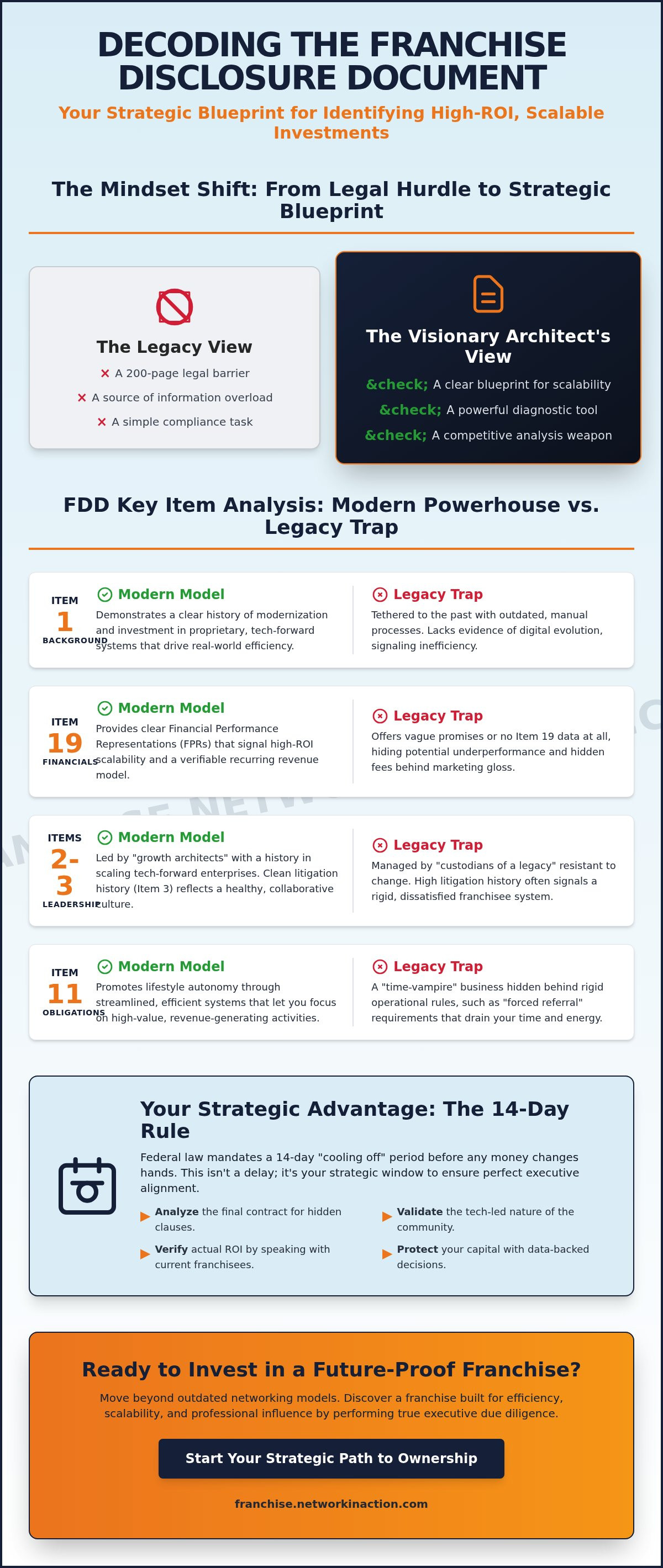
A 200 page legal filing isn't a barrier to entry; it's the most powerful diagnostic tool in a strategic investor's arsenal. While many professionals see a wall of text, a Visionary Architect sees a clear blueprint for scalability and recurring revenue. Mastering the art of understanding the franchise disclosure document allows you to filter through the noise and identify which models are built for the future and which are tethered to the past. You likely feel the weight of information overload when reviewing these massive filings, fearing that a hidden fee or a rigid, legacy networking model might drain your time and capital.
This guide provides the framework you need to move forward with absolute confidence. You'll learn to decode Item 19 for real world income potential and spot the operational red flags that signal an inefficient, "time-vampire" business. The following analysis breaks down the essential sections of the FDD to ensure your next investment is a high-ROI vehicle for professional influence and lifestyle autonomy.
Key Takeaways
- Shift your perspective on the FDD from a legal hurdle to a strategic blueprint for high-level executive due diligence.
- Gain a competitive edge by understanding the franchise disclosure document to pinpoint Item 19 financial representations that signal high-ROI scalability.
- Learn to detect "forced referral" requirements and other rigid traps hidden within the operating obligations of legacy networking organizations.
- Analyze Item 1 to verify a franchisor’s modernization history, ensuring you invest in a tech-forward model rather than an outdated, manual system.
- Follow a streamlined, ROI-driven path to ownership that prioritizes efficiency and filters for disruptive, high-growth potential.
What is the Franchise Disclosure Document (FDD) in 2026?
The FDD is a federally mandated prospectus required by the Federal Trade Commission (FTC). It acts as the definitive source of truth for any prospective franchisee. While marketing brochures promise growth, the Franchise Disclosure Document (FDD) delivers the raw, audited data required to validate those claims. Understanding the franchise disclosure document is the first step in moving from a casual observer to a strategic investor. It eliminates the guesswork. It strips away the polished sales pitch. It provides a standardized framework for executive due diligence that no other document can match.
In 2026, the FDD remains the only place to find verified, non-marketing data on a brand's health. It covers 23 specific items, ranging from litigation history to initial investment costs. For an executive, this document serves a dual purpose. It satisfies legal transparency requirements while providing the foundation for a rigorous business analysis. It's the blueprint you use to determine if a brand is a legacy networking organization or a modern, technology-forward powerhouse. You aren't just buying a business; you're auditing a system for its potential to scale.
The Legal Necessity vs. The Business Opportunity
Legacy networking organizations often treat the FDD as a legal hurdle to clear. For a visionary architect, it's a competitive analysis tool. You're looking for the franchisor’s efficiency metrics. Modern brands use this transparency as a differentiator. They don't hide behind vague promises; they lead with data. You can identify the scalability of the model by analyzing Item 19 financial performance representations. This isn't just about compliance. It's about verifying that the proprietary technology and systems actually drive the recurring revenue promised in the initial meetings. High-level professionals use the FDD to spot cracks in "old-school" models that rely on manual processes instead of streamlined efficiency. It's the difference between a job and a scalable asset.
The 14-Day Rule: Your Strategic Advantage
Federal law mandates a 14-day "cooling off" period before any money can change hands. This isn't a delay. It's a strategic window. Use this fortnight for informed disruption of your current career path. Analyze the final contract. Speak with current franchisees to gauge their actual ROI. Validate the technology-led nature of the community you're about to lead. A deep dive into understanding the franchise disclosure document during this period ensures that every move you make is backed by logic and verified data rather than emotional impulse. The 14-day rule is the final checkpoint for executive alignment, protecting your capital and your professional reputation.
Decoding the 23 Items: Identifying Scalability and Efficiency
The FDD isn't just a compliance hurdle. It's a strategic blueprint for profit. Federal law mandates a 23-item structure that strips away marketing gloss to reveal the operational reality of a brand. When you're understanding the franchise disclosure document, you're performing an autopsy on a business model. You're looking for evidence of modernization. The FTC's Guide to Buying a Franchise explains that these disclosures provide the raw data needed to verify a franchisor's claims. This transparency is your greatest asset in determining if a brand is built for the future or anchored in the past.
Item 1 provides the franchisor’s background and their history of modernization. You want to see an evolution that mirrors the digital age. Item 2 details the management team. Seek out leaders with a history of disruptive technology and ROI-driven growth. Item 3 covers litigation history. This serves as a proxy for brand health and franchisee satisfaction. High levels of conflict often suggest a rigid corporate culture that struggles to adapt to market changes. A clean record indicates a collaborative and efficient system.
Analyzing the Leadership Bench (Items 1-4)
Look for leaders who've solved industry flaws rather than just managed them. The best franchisors identify inefficiencies in traditional networking and build systems to eliminate them. In Item 2, scrutinize the executive team for experience in scaling tech-forward enterprises. You're looking for architects of growth, not just custodians of a legacy. Red flags in management history often include a pattern of "rigid" corporate culture where innovation is sacrificed for the sake of maintaining outdated networking models.
Proprietary technology mentions in the franchisor’s history are non-negotiable. If the leadership hasn't invested in a custom digital infrastructure, they're likely relying on manual, "old-school" methods that won't scale. A visionary team understands that social capital must be backed by measurable metrics. They treat networking as a science, not a hobby. This ensures the business remains relevant as professional communication continues to move online.
Understanding Your Obligations (Items 8-11)
Items 8 through 11 outline what you owe and what you get in return. Examine the technology and platform access fees to understand the digital backbone of the business. Unlike the clunky training of legacy networking organizations, modern support systems are streamlined and accessible. They prioritize efficiency over ceremony. You should see a clear commitment to providing tools that automate the administrative "fluff" of networking, allowing you to focus on high-level relationship building.
Identifying the lifestyle-friendly nature of the business is simple if you look at the required operating hours in Item 11. A truly modern franchise offers lifestyle autonomy. It doesn't demand 60 hours of weekly "cold prospecting" or attendance at rigid, daily breakfast meetings. Instead, it leverages a technology-enabled platform to create recurring revenue with minimal overhead. This structure allows you to lead your professional community without being chained to a desk. If you're ready to see how these systems translate into real-world success, consider downloading the full franchise kit to review the specifics of this modernized model.
Financial Performance and Initial Investment: Calculating Your True ROI
Strategic investors don't just buy a brand; they buy a predictable income stream. When understanding the franchise disclosure document, your focus must shift from the conceptual to the mathematical. You're looking for the intersection of lean startup costs and aggressive growth potential. This section of the FDD provides the raw data needed to build your pro forma and determine if the opportunity meets your executive standards for capital efficiency.
Before committing capital, consult the Federal Trade Commission's guide to the FDD to ensure you're interpreting the legal mandates correctly. This foundation allows you to dissect the two most critical sections for financial modeling: Item 7 and Item 19.
The Power of Item 19 for Executive Decision Making
Item 19 is the "Holy Grail" of the FDD. It represents the Financial Performance Representations that modern, transparent franchisors use to prove their model works. You should look specifically for average gross revenues and membership growth statistics. High-level professionals prioritize data on "recurring revenue" models. These models provide the long-term scalability that transactional businesses lack. Examine the NIA Franchise Economics guide to see how membership-based systems drive consistent cash flow without the constant need for new customer acquisition.
A red flag appears when legacy networking organizations omit Item 19 entirely. If a franchisor refuses to disclose financial performance, it often suggests an inefficient or outdated model. They might be hiding high churn rates or low franchisee profitability. You deserve a brand that stands behind its numbers with total transparency.
Item 7: Avoiding the "Cash Drain" Trap
Item 7 outlines your total initial investment. It goes far beyond the license fee to include working capital, equipment, and marketing. Many executives fall into the trap of high-overhead models that require massive footprints and staffing. A professional networking business offers a sleek alternative to the heavy "brick-and-mortar" expenses of traditional retail or service franchises. Item 7 should reflect a turnkey efficiency rather than a bottomless pit of ongoing operational expenses.
- Identify working capital requirements for the first six months.
- Compare the low overhead of technology-led models against legacy systems.
- Analyze the "Time to ROI" by weighing these startup costs against recurring revenue potential.
Calculating your true return on investment requires a ruthless analysis of these figures. Understanding the franchise disclosure document means recognizing that the best opportunities leverage proprietary technology to keep Item 7 low while maximizing the earning potential shown in Item 19. You're looking for a business that respects your time and your capital.
Spotting the Traps: How Legacy Networking FDDs Reveal Outdated Models
When you're understanding the franchise disclosure document, you aren't just reading a contract. You're performing a strategic autopsy on a business model. Legacy networking organizations often hide their inefficiencies in plain sight. These documents reveal a heavy reliance on 20th-century tactics that don't respect an executive's time. You'll often find forced referral requirements that prioritize quantity over quality. This creates a transactional environment where members pass "leads" just to meet a quota. It's a recipe for burnout, not business growth.
A deep dive into understanding the franchise disclosure document also allows you to see if the franchisor invests in proprietary technology or expects you to manage everything manually. Modern networking requires a tech-forward approach. If the model relies on paper tracking or outdated web portals, you're looking at a legacy brand. High-growth models use integrated technology to track ROI and facilitate connections. This isn't just a luxury; it's a necessity for scalability. A 2023 industry report noted that businesses using integrated CRM tools see 27% higher retention rates. Legacy models simply can't compete with those metrics.
The "Time-Vampire" Clause
Check Item 15 for mandates on weekly attendance. Legacy models often require 50 or more mandatory meetings per year. This "forced activity" masks a lack of real value. It turns a business opportunity into a grueling part-time job. A modernized FDD focuses on quality. It prioritizes monthly high-impact sessions that respect your schedule. You want a model that values results, not just "showing up." Executives shouldn't be forced into administrative busy work that kills their lifestyle autonomy.
Territory and Scalability Restrictions
Item 12 defines your sandbox. Many legacy brands have already saturated the best markets, leaving you with scraps. In contrast, a disruptive brand offers wide-open, high-potential territories. This allows for true scalability. You aren't boxed in by a competitor's 30-year-old footprint. Check available territories for a modern model to see where the growth is actually happening. A fresh territory means you're building a community, not fighting for leftovers.
Strategic executives look for the Future of Networking. They don't settle for "how it's always been done." If the FDD feels like a relic, it probably is. Take the next step toward a modernized business. Explore the NIA franchise kit to see the difference for yourself.
From Due Diligence to Ownership: Your Strategic Path to Franchise Success
The transition from a high-level executive to a franchise owner requires a tactical shift in perspective. You aren't just buying a business; you're investing in a scalable asset designed for efficiency. The final stage of your journey begins with a focused, ROI-driven scan of the legal paperwork. Understanding the franchise disclosure document allows you to strip away the legalese and identify the core unit economics that drive long-term profitability. Start by requesting the FDD and immediately comparing its operational requirements against the rigid, manual structures of legacy networking organizations.
- Step 1: Perform an initial scan focused on Item 19 and Item 21 to verify the financial health and historical performance of the system.
- Step 2: Cross-reference the document with the red flags of outdated networking models, such as forced referrals or mandatory weekly morning meetings that drain your schedule.
- Step 3: Use the contact data in Item 20 to initiate high-level validation calls with existing owners.
- Step 4: Map the findings to your specific goals for time freedom, community leadership, and professional influence.
Data from 2023 indicates that 84% of successful franchisees cite a thorough review of the FDD as the turning point in their decision-making process. This document is your blueprint for "Networking Evolved." It moves you away from the "clunky" systems of the past and toward a modernized, tech-forward approach to business growth.
Validation: The Franchisee List (Item 20)
Item 20 is your most powerful tool for uncovering the unfiltered truth about the brand's culture and efficiency. Don't just call names at random. Look for the "Visionary Architect" persona among the list. These are the owners who have successfully scaled their territories while maintaining a balanced lifestyle. Ask them direct questions about the tech stack. Does the proprietary technology actually save you 15 hours of administrative work every week? Does the system support recurring revenue without constant cold prospecting? Their answers will confirm if the model delivers on its promise of efficiency.
The Final Decision: Alignment and Action
A well-structured FDD should leave you feeling informed and excited, not restricted by archaic rules. Your goal is to move from "networking" as a task to "owning the network" as a strategic business. This is the moment where corporate sophistication meets entrepreneurial speed. If the data aligns with your vision for community leadership and scalability, the path forward is clear. It's time to stop navigating the inefficiencies of traditional models and start building a modern legacy. Understanding the franchise disclosure document is the final hurdle before you take control of your professional future. Download the Franchise Kit to see a modern FDD in action and take the first step toward high-impact ownership.
Secure Your Future in the Evolution of Networking
High-level professionals recognize that the FDD isn't just paperwork; it's a diagnostic tool for future profitability. By dissecting the 23 Items, you separate modern, tech-forward systems from the rigid, inefficient legacy networking organizations that stifle growth. Understanding the franchise disclosure document allows you to verify the strength of an ROI-driven networking model before committing your capital. Network In Action has already proven this blueprint across 150+ locations worldwide. The proprietary technology platform eliminates the manual friction found in traditional models, shifting the focus from forced referrals to genuine relationship-driven growth.
This is the strategic path to recurring revenue and professional autonomy. If you're ready to lead a sophisticated community and disrupt an outdated industry, the next step is clear. Start your journey by downloading the comprehensive Franchise Kit to see how this modernized system delivers measurable results. The future of networking is built on data, efficiency, and your leadership. It's time to leverage a system designed for the modern executive.
Frequently Asked Questions
Is the Franchise Disclosure Document (FDD) legally binding once I receive it?
Receipt of the Franchise Disclosure Document does not create a legal obligation to purchase a franchise or enter into a contract. It's a disclosure tool mandated by the Federal Trade Commission to ensure you have the facts before investing capital. The law requires a 14 day cooling off period between receiving the document and signing any binding agreement. This window is your primary opportunity for rigorous due diligence and strategic evaluation.
What is the most important section of the FDD for an executive to review?
Item 19 is the most critical section because it contains the Financial Performance Representations that define your potential ROI. High level professionals also prioritize Item 21, which provides audited financial statements to prove the franchisor's stability. These sections allow you to move past marketing hype and analyze the hard data that drives scalable business growth. Understanding the franchise disclosure document requires focusing on these metrics to ensure the model's long term viability.
Why do some franchisors choose not to include an Item 19 financial representation?
Franchisors often omit Item 19 if they lack a 12 month track record or want to avoid the legal liability of making specific earnings claims. While roughly 66 percent of franchisors now provide this data, its absence in legacy networking organizations often indicates a lack of modern, technology driven reporting systems. Without this transparency, you're forced to rely on validation calls with existing owners to piece together the revenue potential.
How long is a typical Franchise Disclosure Document, and do I need a lawyer to read it?
A standard FDD typically spans 100 to 200 pages of complex legal and financial disclosures. You should always hire a specialized franchise attorney to navigate this document. Understanding the franchise disclosure document involves more than just reading the text; it requires a professional to identify hidden clauses that could impact your operational autonomy. An expert review ensures your investment is protected from the start.
What is the difference between the Franchise Agreement and the FDD?
The FDD is a comprehensive disclosure document that provides a historical and structural overview of the franchise system. In contrast, the Franchise Agreement is the actual binding contract that dictates the daily rules of the relationship. Think of the FDD as the prospectus and the agreement as the operational blueprint. The agreement is usually attached as an exhibit at the end of the disclosure document.
Can a franchisor change the terms of the FDD after I have received it?
Franchisors can update their FDD at any time, but they must provide you with the revised version if the changes are material. If a franchisor issues a new document during your negotiation, the 14 day clock often resets to ensure you have time to review the modifications. This prevents "bait and switch" tactics and ensures you're making decisions based on the most current financial and legal data available.
How often is a franchisor required to update their FDD?
Federal law requires franchisors to update their FDD within 120 days of their fiscal year end. They must also issue quarterly updates if material changes occur, such as a major shift in the executive team or new litigation. This annual cycle ensures that the information you're reviewing is never more than 12 months old. Staying current with these updates is a hallmark of a transparent, results oriented brand.
What red flags should I look for in the "Litigation" section of the FDD?
Look for a high volume of lawsuits initiated by franchisees, as this often signals systemic operational failures or poor corporate support. If more than 5 percent of the total franchise network is involved in active litigation against the franchisor, it's a major red flag. You should also watch for any history of fraud or embezzlement, which indicates a lack of the integrity required for a successful partnership.