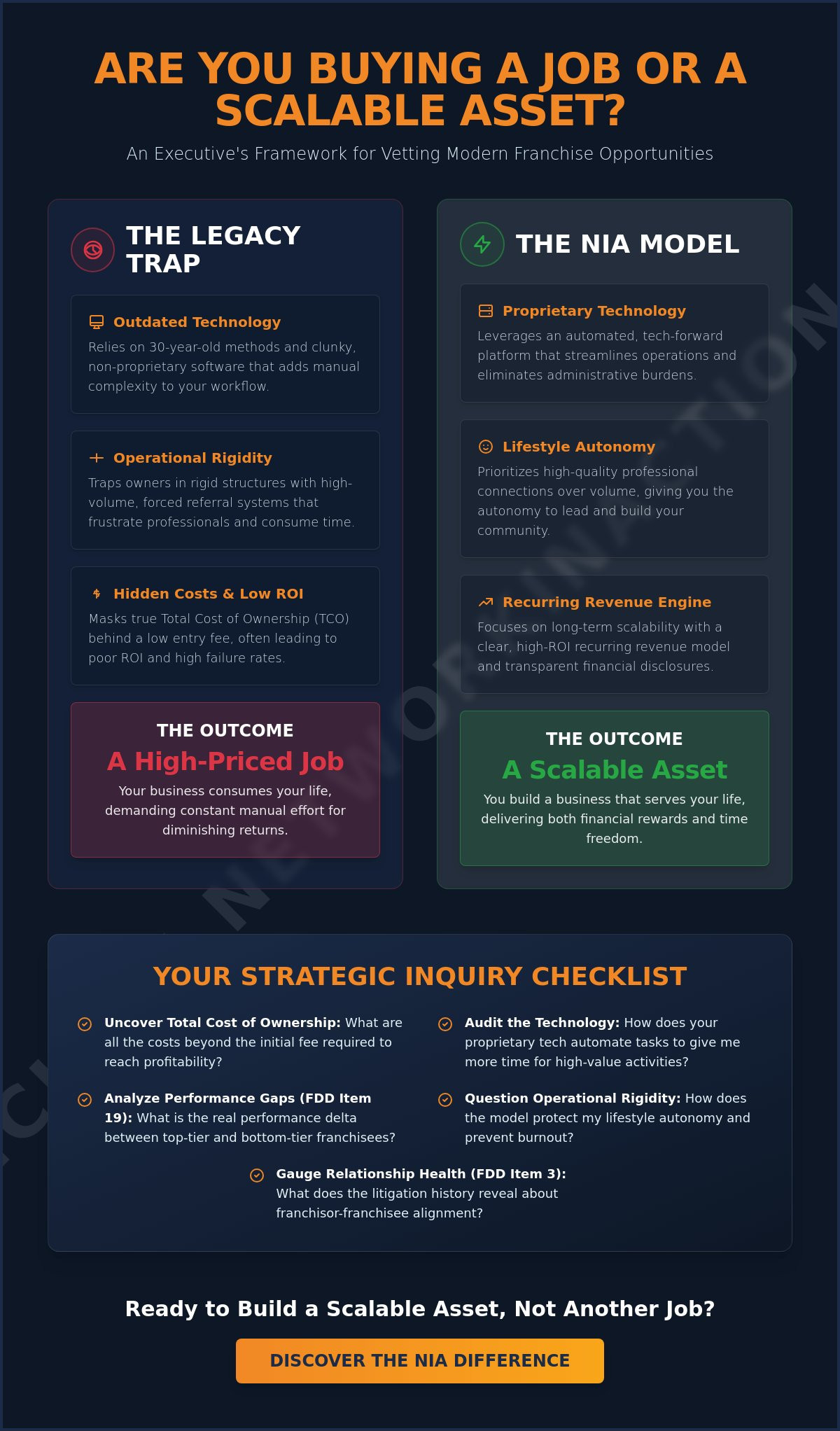
Most due diligence checklists are designed to sell you a high-priced job rather than a scalable, tech-enabled asset. You likely recognize that legacy networking organizations often rely on 30 year old referral methods that trap executives in rigid structures. To avoid the 20 percent failure rate common in new business ventures during their first year, you need a sophisticated inquiry process. Mastering the specific questions to ask a franchisor before buying is the only way to separate outdated models from modern, disruptive opportunities.
It's frustrating to realize that many sales promises mask a lack of actual operational support or proprietary technology. This guide provides a high-level framework designed to identify high-ROI, tech-forward franchise opportunities that prioritize lifestyle autonomy and recurring revenue. You'll gain a clear vetting structure to ensure your next investment delivers both professional credibility and the time freedom you've earned. By shifting your focus from entry costs to long-term scalability, you can build a business that serves your life instead of consuming it.
Key Takeaways
- Deploy a strategic executive framework to look beyond brand recognition and evaluate the underlying business system for long-term cultural and operational alignment.
- Identify the critical questions to ask a franchisor before buying to uncover the true total cost of ownership and the specific factors driving a high-ROI, recurring revenue engine.
- Avoid the "legacy trap" by auditing proprietary technology platforms to ensure they automate administrative tasks rather than adding manual complexity to your workflow.
- Protect your lifestyle autonomy by questioning operational rigidity and ensuring the model prioritizes high-quality professional connections over the high-volume, forced referral systems of traditional networking.
- Master the final validation phase with a tactical approach to discovery days and franchisee calls that reveal the unfiltered reality of the business opportunity.
The Executive Due Diligence: Why Choosing a Franchise Requires a Strategic Framework
Due diligence is more than a checklist. It's a multi-layered investigation into financial, operational, and cultural alignment. Executive-level investors look beyond brand recognition to evaluate the underlying business system. You aren't buying a job; you're acquiring a scalable network. By the 2026 benchmark, a successful franchise must deliver efficiency, proprietary technology, and recurring revenue. Understanding the foundational structure by researching What is Franchising? provides the context needed to analyze complex disclosure documents. Your goal is to identify a model that offers a strategic path to time freedom and meaningful impact.
The shift from traditional employment to franchise ownership requires a "Visionary Architect" mindset. You must scrutinize how a brand handles its social capital and technological integration. Modern entrepreneurs don't have time for clunky, manual processes. They demand high-energy environments where ROI is the primary metric. Identifying the right questions to ask a franchisor before buying ensures you invest in a system built for the future rather than a relic of the past.
Beyond the FDD: Reading Between the Lines of the Disclosure Document
The Franchise Disclosure Document (FDD) is a goldmine, but only if you know where to look. Item 19 reveals financial performance representations, yet these figures shouldn't be taken at face value. You need to identify the delta between top-tier performers and the bottom 20%. Item 3, which covers litigation history, acts as a proxy for the health of the franchisor-franchisee relationship. High litigation rates often signal a breakdown in support or unrealistic expectations. The FDD is a legal baseline that requires supplemental inquiry to reveal operational truth.
- Analyze Item 19 to see the actual earnings of existing franchisees, not just averages.
- Review Item 3 to gauge if the franchisor is in constant conflict with its partners.
- Look for transparency in marketing fund expenditures to ensure your fees drive growth.
Identifying Legacy Models vs. Modern Disruptors
Legacy networking organizations often trap owners in manual, time-consuming processes that haven't changed since the 1990s. These old-school models rely on rigid rules and forced referrals that frustrate high-level professionals. Modernized alternatives leverage technology to automate the heavy lifting. Ask how the brand has evolved in the last three years to meet changing market demands. If the model is too rigid, it's a red flag. High-level leaders need the autonomy to lead, not just follow a stale script. Scalability depends on a system that works for you, not the other way around. Knowing the right questions to ask a franchisor before buying helps you spot these inefficiencies early.
A modernized model prioritizes quality over quantity. It replaces cold prospecting with relationship-driven growth. When evaluating a brand, look for proprietary technology that streamlines operations. This allows you to focus on community leadership and building professional credibility rather than administrative tasks. The future of networking belongs to those who embrace ROI-driven systems and ditch the transactional nature of outdated models.
Decoding the Financial Engine: Questions to Uncover Real ROI and Recurring Revenue
Don't get blinded by the initial franchise fee. It's just the entry price. Sophisticated investors focus on the Total Cost of Ownership (TCO). This includes your liquid capital requirements, technology integrations, and the "runway" needed before the business sustains itself. When preparing your list of questions to ask a franchisor before buying, you must demand clarity on the breakeven timeline. Ask for specific data from the most recent Franchise Disclosure Document regarding how many months it took the top 25% of franchisees to reach operational profitability. Use the International Franchise Association's resource for questions to ask about the FDD to ensure you aren't overlooking hidden costs like mandatory marketing levies or technology "refresh" fees that can erode your margins.
Analyze the royalty structure with a critical eye. Is it a flat fee or a percentage of gross sales? Flat fees reward growth, while percentage-based models can feel like a success tax. You need to know exactly what value that monthly payment unlocks. If the franchisor can't demonstrate a clear link between royalties and lead generation or proprietary systems, you're just subsidizing their overhead.
Evaluating the Scalability of Recurring Revenue Streams
Traditional networking models often trap owners on a hamster wheel of constant cold prospecting. A modern, disruptive model should prioritize high-margin recurring revenue. Ask the franchisor how their system facilitates long-term member retention without requiring your constant physical presence. Investigate the split between "active" income, which requires your direct involvement, and "passive" streams driven by automated renewals and technology. High-performing territories in the networking space often maintain retention rates above 80% through curated experiences rather than forced attendance. To understand the math behind these professional communities, review the NIA Franchise Economics guide for a deep dive into networking ROI.
The Support-to-Fee Ratio: What Do You Get for Your Royalties?
Royalties should function as an investment in your competitive advantage. Ask about the frequency and quality of field coaching. Does the franchisor employ dedicated success coaches, or are you left to figure it out via a static online portal? You must demand a transparent breakdown of corporate staff-to-franchisee ratios to ensure you'll receive the attention an executive-level investment deserves. Inquire about the R&D budget from 2023 and 2024. If the business model hasn't evolved to include proprietary technology or streamlined workflows, it's already falling behind. You aren't just buying a brand; you're buying a system that must stay ahead of market shifts. Before committing, it's wise to check available territories to see where the most significant growth opportunities currently exist.
Technology and Innovation: Is the Model Built for 2026 or Stuck in the Past?
Legacy networking models are collapsing under the weight of their own inefficiency. While traditional organizations still rely on manual tracking and physical sign-in sheets, the modern executive demands a frictionless experience. You can't lead a high-level professional community using 1990s tactics. This is the "Legacy Trap." It's a system where technology is an afterthought, forcing you to spend 80% of your time on administrative busywork instead of high-value coaching and territory growth.
One of the most critical questions to ask a potential franchisor involves the depth of their proprietary tech. Does the platform actually drive ROI, or is it just a glorified CRM? You need a system that tracks member referrals and social capital automatically. If the franchisor requires manual logs for every interaction, they're stealing your members' time and eroding the value of the group. Modern networking requires a central dashboard where members can see their return on investment in real time.
The Tech Stack Inquiry: CRM, Apps, and Automation
Executives shouldn't waste energy building a tech stack from scratch. A modern franchise provides a turnkey digital solution that manages member life cycles and lead tracking from a single dashboard. Ask how often the software receives updates and verify if these improvements are covered by your monthly fees or if they're hidden costs. Network In Action utilizes a proprietary platform designed to modernize the referral process; it replaces the clunky, forced tracking of the past with streamlined automation that facilitates connections without the "homework" associated with legacy brands.
Innovation Roadmap: Predicting Future Disruption
Social media networking is a constant threat to stagnant models. To stay relevant, your chosen brand must have a clear 5-year plan for technological integration. Ask about their strategy for AI-driven matching and predictive analytics. A tech-forward mindset is non-negotiable for franchise owners looking toward 2026. Without a roadmap that includes automation and data-backed networking, your territory will be vulnerable to DIY digital competitors. When considering questions to ask a franchisor before buying, focus on how they use data to prove member value. If they can't show a central dashboard that visualizes ROI, the model isn't built for the future. It's stuck in the past. High-level professionals will only pay for results they can see; your technology must be the lens that provides that clarity.
Lifestyle Autonomy vs. Operational Rigidity: Protecting Your Time Freedom
Most franchise prospects invest to secure freedom, yet many end up chained to a retail counter or a rigid schedule. You aren't looking to buy a job; you're looking to own a system. One of the most vital questions to ask a franchisor before buying involves the actual time commitment required to maintain peak efficiency. Does the model demand 60 hours of "grind," or is it designed for a "manager of a system" who leverages technology to reclaim their calendar? Traditional networking organizations often trap owners in a cycle of manual administration and "forced referrals." These legacy networking organizations prioritize the quantity of meetings over the quality of the connections made. This creates a "worker in a shop" dynamic where the owner is constantly chasing attendance and policing arbitrary rules. Modern, ROI-driven models disrupt this by replacing weekly, low-impact sessions with monthly, high-value interactions. This shift alone can reduce an owner's operational burden by 75%, allowing for a true work-from-anywhere lifestyle. When evaluating these questions to ask a franchisor before buying, look for a model that prioritizes the quality of connections over the volume of meetings. High-level executives don't have time for "coffee chats" that lead nowhere. They demand a streamlined, technology-enabled platform that facilitates recurring revenue without the operational friction of outdated networking models.Curated Quality vs. Open Enrollment Models
Stop asking how many members a franchise has and start asking how they are vetted. Is the franchisor’s goal simply "filling seats" to collect dues, or are they "building elite circles" of high-performing professionals? Open enrollment models lead to high churn and owner burnout. In contrast, a curated quality approach ensures that every member brings value to the table. This elite structure fosters a self-sustaining community where the owner acts as a sophisticated facilitator rather than a high-pressure salesperson.Training and Onboarding: The Path to Independent Operation
The transition from executive to franchise owner requires more than a handbook. Effective training should span several weeks and include direct "in-the-field" support to ensure you hit the ground running. Ask if the franchisor provides a mentorship program that pairs you with veteran owners who have already scaled their territories. A robust onboarding roadmap should move you quickly from trainee to an independent leader of a professional community.To see how a modern system streamlines the path to ownership, download the NIA Franchise Kit and review our comprehensive onboarding roadmap.
Making the Strategic Move: From Inquiry to Community Leadership
The transition from a curious prospect to a franchise owner hinges on the "Final Three" validation steps. These include validation calls, Discovery Day, and a comprehensive legal review of the Franchise Disclosure Document (FDD). This phase is where you separate marketing polish from operational reality. It's the moment you stop analyzing the system and start evaluating the people who run it. You're looking for a partnership that offers more than just a brand name; you're looking for a vehicle that builds social capital and recurring revenue.
Validation calls with existing franchisees provide the most raw data you'll find during due diligence. Don't settle for the "top performers" the franchisor suggests. Request a full list and pick owners at various stages of growth. Ask them about the "good, the bad, and the ugly" of daily operations. Specifically, ask how the franchisor handled the last major technology update or a shift in market conditions. These are the essential questions to ask a franchisor before buying to ensure the support you're promised actually arrives when you need it most.
Strategic alignment is the ultimate goal. If your personal goal is time freedom, but the franchisor's model requires 60 hours of manual "old-school" prospecting, the partnership will fail. The Network In Action model is built for the "Visionary Architect" who wants to lead a community rather than just manage a group. You're positioning yourself as a local authority who leverages proprietary technology to drive ROI for members, moving away from the transactional nature of legacy networking organizations.
The Discovery Day Mindset: You Are Interviewing Them
Discovery Day is the final gut check for executive alignment. Whether the visit is physical or virtual, look for red flags in the corporate culture. Pay attention to how the staff interacts when they think you aren't looking. Is the energy high, or does it feel like a stale corporate office? Use your time with the CEO or Founder to ask about their long-term commitment to "informed disruption." Ask them how they plan to keep the model relevant as AI and new tech continue to reshape professional relationships. If their answers feel rehearsed or lack a roadmap for the future, take that as a signal.
Taking the Next Step Toward Ownership
Passive research eventually hits a ceiling. To move forward, you must evaluate the actual market potential in your specific geography. Transitioning from a researcher to an active candidate means looking at the map to see where you can plant your flag. Identifying a territory is the first step in positioning yourself as a local power player. You can check available territories to identify leadership opportunities in your region and see where the NIA model can disrupt your local market.
If you're ready to stop trading time for money and start building a scalable asset, the next move is clear. Successful entrepreneurs don't wait for permission; they seek out the best systems and execute. You can get the free book to learn the NIA philosophy of "informed disruption" and see how it replaces outdated networking models with high-ROI systems designed for the modern executive.
Secure Your Strategic Advantage
Successful due diligence requires looking beyond the surface of a typical Disclosure Document. It demands a deep dive into whether a business model serves your lifestyle or consumes it. By focusing on the right questions to ask a franchisor before buying, you'll identify which systems are built for 2026 and which are anchored in the past. Network In Action has already disrupted the industry with over 150 locations worldwide operating on a high-performance, tech-enabled platform. This isn't the rigid, time-consuming grind found in legacy networking organizations. It's a modernized, once-a-month meeting model specifically designed for the executive schedule.
The NIA framework utilizes proprietary technology that tracks and guarantees member ROI, eliminating the uncertainty that plagues traditional models. You aren't just buying a franchise; you're securing a position as a community leader in a results-driven ecosystem. The transition from executive to owner is a strategic move toward recurring revenue and total lifestyle autonomy. It's time to trade the corporate ladder for a scalable asset that rewards your expertise and respects your schedule.
Explore modern franchise opportunities and check available territories
Your future as a community architect starts with a single strategic choice.
Frequently Asked Questions
What is the single most important question to ask a franchisor?
Ask for the success rate and retention of franchisees over the last 36 months. This metric reveals the health of the system more than any marketing brochure can. High retention signals a sustainable business model and strong corporate support. It's the litmus test for whether the promised ROI actually translates to the bottom line for owners. This data provides a clear picture of the long-term viability of your investment.
How can I verify the financial claims made by a franchisor before buying?
Review Item 19 of the Franchise Disclosure Document (FDD) and cross-reference it with direct conversations with current owners. Validation calls are your most powerful tool. Ask existing franchisees about their average time to reach profitability and their monthly recurring revenue. These peer-to-peer insights provide the raw data needed to validate the financial projections presented during the discovery process. Don't rely solely on corporate spreadsheets when real-world evidence is available.
Is it better to buy a new franchise territory or an existing resale?
A new territory offers a blank canvas to build a modern, technology-led community from the ground up without inheriting the "old-school" habits of legacy networking organizations. Resales might offer immediate cash flow, but they often come with established cultures that are difficult to pivot. Starting fresh ensures you implement proprietary systems correctly from day one. This maximizes long-term scalability and brand alignment for ambitious owners looking to disrupt their local market.
What are the red flags to look for in a franchise agreement?
Watch for rigid, outdated requirements like forced referrals or mandatory weekly morning meetings that ignore executive schedules. These are hallmarks of inefficient, legacy networking models. A modern agreement should prioritize results over activity metrics. If the contract lacks clear definitions of territory protection or imposes excessive marketing fees without a proven digital strategy, it's a signal to proceed with extreme caution. Always ensure the terms protect your autonomy and growth potential.
How much support can I realistically expect after the initial training?
Expect a turnkey support structure that includes ongoing coaching and access to proprietary technology platforms. The best franchisors provide 24/7 access to training modules and regular strategy sessions to ensure your growth stays on track. Support shouldn't end after the first 30 days; it should evolve as you scale your business from a single group to a multi-territory operation. This continuous engagement ensures you stay ahead of market shifts and maintain a competitive edge.
Can I run a networking franchise part-time while keeping my executive role?
The modern networking model is designed for high-level professionals who value time efficiency. Many successful owners spend approximately 10 to 15 hours per week managing their groups by leveraging automated systems and streamlined processes. This flexibility allows you to maintain your corporate career while building a scalable asset that generates recurring revenue and strengthens your professional influence. It's a strategic move for those seeking lifestyle autonomy without sacrificing their current income stream.
What is the difference between a "legacy" networking model and a modern one?
Legacy models rely on manual tracking, forced attendance, and high-pressure referral quotas that frustrate busy executives. A modern, ROI-driven approach uses proprietary technology to track real business outcomes and curate high-quality memberships. This evolution moves away from the clunky social clubs of the past and toward a sophisticated, tech-forward platform where professional relationships are managed with precision. It's the difference between a time-consuming hobby and a results-oriented business tool.
How do I know if a franchise territory is truly "available" and protected?
Verify the specific zip codes or geographic boundaries outlined in the FDD to ensure your market is exclusive. One of the most important questions to ask a franchisor before buying is how they handle encroachment from neighboring owners. A protected territory means you have the sole right to build your brand in that 10-mile or 20-mile radius. This prevents internal competition and secures your local market dominance while you scale your professional community and influence.