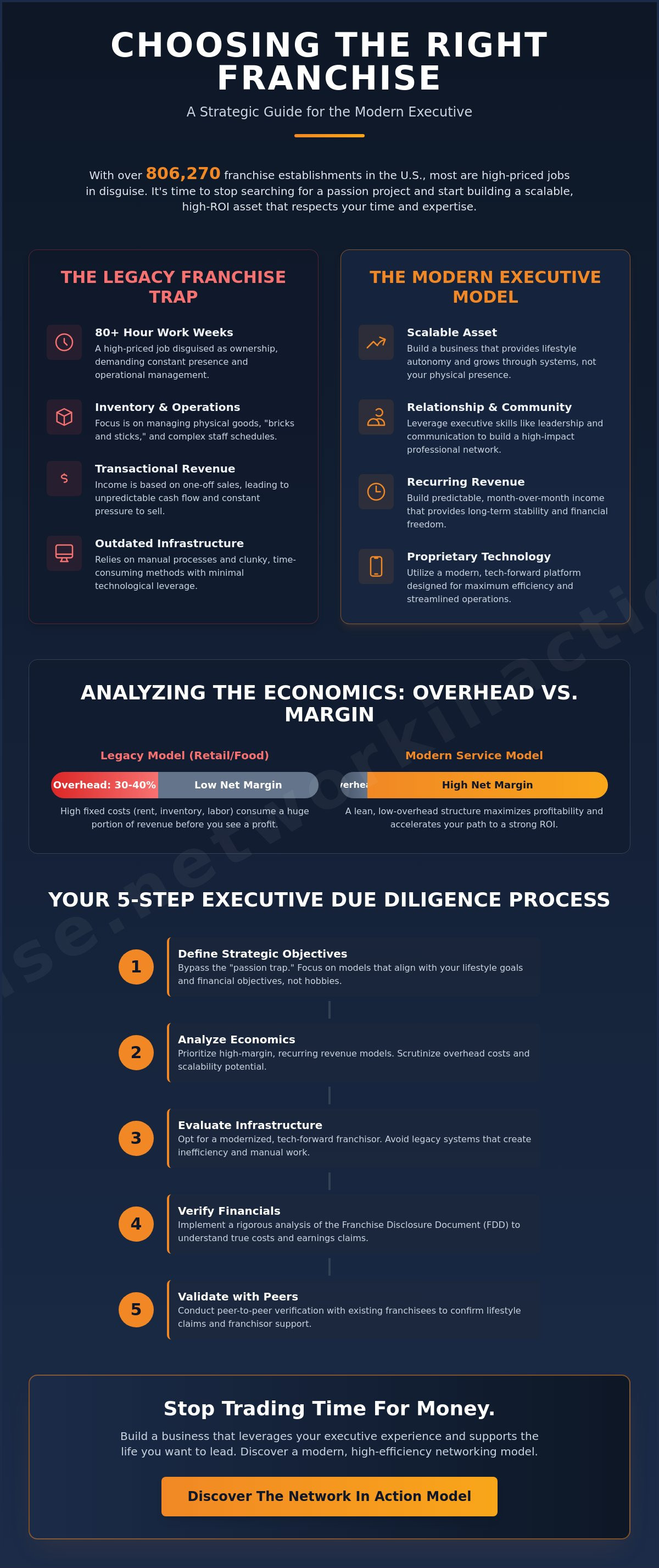
Most franchise opportunities are nothing more than high-priced jobs disguised as business ownership. You've spent decades building executive expertise and professional capital; the last thing you need is to trade a corporate office for a retail storefront that demands 80 hours a week. It's exhausting to sift through the 806,270 franchise establishments currently operating in the U.S. just to find a model that isn't stuck in the era of legacy networking organizations. You're likely asking, "how to choose the right franchise for me" that offers genuine scalability without the manual grind of outdated business models.
You deserve a business that respects your time and leverages your high-level networking skills. It's common to feel overwhelmed by generic options that offer little more than a "turnkey" path to burnout. This guide provides a strategic, ROI-driven framework to identify a model that aligns with your lifestyle goals and professional status. You'll learn how to bypass inefficient, traditional systems and focus on a modern, technology-enabled platform built for recurring revenue and elite community leadership.
Key Takeaways
- Trade the "passion trap" for a scalable asset that aligns with your professional expertise and long-term financial objectives.
- Determine how to choose the right franchise for me by evaluating high-margin, relationship-driven models against inventory-heavy alternatives.
- Identify the red flags of legacy networking organizations and opt for a modernized, tech-forward infrastructure designed for maximum efficiency.
- Implement a rigorous 5-step selection strategy to analyze financial disclosures and validate lifestyle claims through peer-to-peer verification.
- Discover how to build professional credibility and recurring revenue by leading a high-impact community in the future of networking.
Beyond Industry Passion: Defining Your Strategic Franchise Objectives
Many prospective owners fall into the "passion trap." They believe a love for boutique fitness or specialty coffee translates into a successful business. It doesn't. It often leads to operational burnout where you're managing shift schedules and inventory instead of driving growth. When asking how to choose the right franchise for me, shift your focus from hobbies to strategic objectives. You aren't looking for a new job; you're building a scalable asset.
A deep understanding the franchise model reveals that the most successful executives prioritize lifestyle autonomy over industry interest. They seek systems that leverage their existing professional skills rather than requiring them to learn a trade from scratch. This shift is critical for those exploring Top Executive Business Opportunities in 2026, where the focus is on high-level influence rather than manual labor. Stop looking for a business you love. Start looking for a business that supports the life you want to lead.
The Asset vs. Income Distinction
Ownership should provide freedom, not a ball and chain. A lifestyle-friendly business typically features low overhead and zero physical inventory. High-investment retail models often trap owners in a cycle of managing "bricks and sticks." Conversely, service-based models allow you to utilize executive-level skills like leadership and strategic communication. You want a model that scales through systems, not through your physical presence in a storefront. Professional services offer a lean, modernized alternative to the capital-heavy demands of traditional franchise sectors.
Setting Your ROI Expectations
Wealth isn't built on one-off transactions. It's built on recurring revenue. When evaluating how to choose the right franchise for me, look for models that provide predictable, month-over-month income. This stability allows you to convert your social capital into a measurable business asset. The ROI of social capital is the measurable return on relationship-driven growth. It's about turning your professional network into a revenue engine. Legacy networking organizations often fail because they focus on transactional volume. Modern, ROI-driven models focus on high-value connections that produce long-term dividends.
- Prioritize scalability over personal interest.
- Look for high-margin, service-oriented structures.
- Focus on recurring revenue to ensure long-term stability.
- Identify models that offer proprietary technology to streamline operations.
The goal is to move away from the clunky, time-consuming methods of the past. Traditional networking models require massive time commitments for minimal returns. You need a model that values your time as much as you do. By focusing on efficiency and results, you position yourself as a leader in a modernized industry. This is how you build a business that works for you, rather than you working for the business.
Analyzing the Economics: ROI, Recurring Revenue, and Scalability
The financial blueprint of a business dictates your daily stress levels and your long-term wealth. When determining how to choose the right franchise for me, you must look beyond the initial franchise fee. Inventory-heavy models, such as retail or food service, lock your capital in physical goods that may spoil or go out of style. These models are frequently burdened by high fixed costs including prime real estate rent and rising labor expenses. These overheads often consume 30% to 40% of gross revenue before you even consider your own take-home pay.
Relationship-driven service models offer a leaner, more agile alternative. By removing the need for expensive storefronts and massive payrolls, you maximize net margins from day one. Smart investors use the FTC's guide to buying a franchise to vet these financial structures during the due diligence phase. Focusing on low-overhead opportunities allows you to reinvest profits into growth rather than maintenance.
The Power of Service-Based Franchising
Service franchises often provide a faster path to profitability because they bypass the "build-out" phase that delays brick-and-mortar openings by six to twelve months. Modern disruption in this space is driven by technology. While legacy networking organizations still rely on manual attendance sheets and clunky spreadsheets, sophisticated models use proprietary technology to automate administrative tasks and member management. This automation allows you to focus on high-value leadership instead of low-level data entry. Efficiency is the ultimate competitive advantage. You can analyze potential earnings and growth trajectories using a specialized franchise ROI calculator designed for the networking industry.
Predicting Your Future Revenue Streams
Transactional businesses force you to start at zero every single month. You are only as good as your last sale. Membership-based recurring revenue flips this script. In a professional networking setting, the lifetime value of a client is significantly higher because the relationship is built on ongoing ROI rather than a one-time purchase. Curated, high-quality memberships outperform high-volume, low-cost models because they attract committed professionals who value their time. This creates a stable, predictable income stream that scales without a proportional increase in work hours. When you evaluate how to choose the right franchise for me, prioritize models where your effort compounds over time. Networking evolved into a scalable asset is the future of professional ownership.
If you are ready to move past outdated networking models and build a business based on modern efficiency, you should download the franchise kit to see how the numbers align with your goals.
Modern Disruption vs. Legacy Models: Evaluating Franchisor Infrastructure
Business networking is currently undergoing a massive shift. When asking how to choose the right franchise for me, you must look beyond the surface level of brand recognition. Legacy networking organizations often rely on infrastructure built in the 1980s. These models demand rigid, time-consuming weekly requirements that drain executive energy. They focus on attendance quotas rather than actual business growth. Modern disruption replaces these manual burdens with streamlined systems. It moves away from the clunky, paper-based tracking of the past toward an agile, high-impact framework. This informed disruption approach signals a brand that values your time as much as your investment.
The Technology Litmus Test
A franchisor's technology stack is a direct reflection of their commitment to your success. Modern franchises provide a proprietary, turnkey platform designed to manage every facet of operations. This isn't just about a website; it's about a sophisticated engine that facilitates ROI-driven networking. In legacy models, referrals are often forced or fabricated to meet arbitrary numbers. A disruptive model uses data-driven insights to ensure every connection is meaningful. High-level professionals don't have time for busy work. They need a system that tracks social capital and referral conversion rates in real time. This level of transparency ensures networking becomes a measurable asset rather than a social hobby. By eliminating manual spreadsheets and paper records, you can focus on building relationships that scale.
Support and Training for Executives
Leading a community of business owners requires more than a simple manual. It demands professional-level training that aligns with the needs of 2024 entrepreneurs. When you evaluate how to choose the right franchise for me, prioritize brands that offer comprehensive initial onboarding and ongoing corporate resources. A visionary franchisor treats you as a strategic partner, not just a site manager. This support includes everything from high-level sales strategies to mastering the technology platform. For a clear example of what this looks like, you can review the Network In Action Franchise Kit. This resource details how a sophisticated support system enables you to build a scalable business while maintaining lifestyle autonomy. Informed disruption means having the tools to challenge the status quo from day one. High-quality training transforms a franchise owner from a simple meeting facilitator into a respected community leader.
The Executive Due Diligence Process: A 5-Step Selection Strategy
Success in franchising isn't a matter of luck; it's the result of a rigorous, data-driven audit. When you're determining how to choose the right franchise for me, you must move past the marketing glossy and dive into the operational machinery. This selection strategy ensures your investment aligns with both your financial goals and your lifestyle requirements.
- Step 1: Audit the Franchise Disclosure Document (FDD). This 23-item legal document is your primary tool for financial transparency and risk assessment.
- Step 2: Conduct validation calls. Speak with current franchisees to verify if the reality of the daily grind matches the corporate sales pitch.
- Step 3: Analyze territory rights. Use data to identify market saturation risks and confirm your exclusive boundaries for future growth.
- Step 4: Assess leadership and vision. Evaluate the franchisor's executive team to ensure they're investing in innovation rather than coasting on old-school methods.
- Step 5: Evaluate exit alignment. Ensure the business model is a liquid asset that supports a 5-year or 10-year exit strategy.
Mastering the FDD and Legal Review
The FDD serves as the blueprint for your potential business. Pay specific attention to Item 19. While not all franchisors provide financial performance representations, those that do offer a clear window into potential earnings and ROI. You'll also need to scrutinize the royalty structure. Some models utilize flat fees that reward your growth, while others take a percentage of gross revenue. This distinction is critical; percentage-based fees can squeeze your margins as you scale. Verify your territory protection clauses to ensure you have exclusive rights to your market without the threat of internal competition.
Validation: Hearing the Reality
Validation calls are where you find the truth behind the support and technology claims. Don't settle for the "discovery day" highlights. Ask current owners about their actual day-to-day time commitment. Are they spending 40 hours a week on administration, or is the proprietary technology doing the heavy lifting? Ask about the support system. If a technical issue hits, does the franchisor respond in 2 hours or 2 days? Before you pick up the phone, consult the Available Territories map to identify which markets are winning. This research helps you understand how to choose the right franchise for me by showing where the brand has already established dominance. Unlike legacy networking organizations that rely on manual, time-consuming processes, a modern model should offer clear, tech-backed efficiency.
Your due diligence must conclude with a cold assessment of the brand's trajectory. If the franchisor's leadership isn't obsessed with "informed disruption," you're buying into a declining asset. Look for a brand that treats networking as an evolved, results-oriented industry. This strategic approach ensures your move into franchising is both profitable and sustainable.
The Case for Professional Networking: A High-Efficiency Business Model
Deciding how to choose the right franchise for me requires looking past traditional retail or food service. You're likely searching for a model that leverages your intellect and professional history rather than your ability to manage a supply chain. Professional networking represents the Future of Networking, where the strategic entrepreneur doesn't just attend meetings but owns the platform. Leading a referral-based business builds immediate professional credibility and influence. You become the ultimate gatekeeper in your local economy, moving from a participant to a power broker.
The efficiency of this model is found in its structure. While legacy networking organizations often mandate 50 or more weekly morning meetings a year, the Network In Action model focuses on monthly sessions. These high-impact gatherings outperform outdated weekly models because they respect the schedule of a busy executive. You aren't just selling a membership; you're offering a sophisticated environment where 30 or 40 business owners can achieve a measurable ROI on their time.
Leveraging Your Existing Social Capital
You've spent 20 or 30 years building a deep well of professional connections. Most executives let that capital sit idle after leaving the corporate world. A networking franchise allows you to turn those decades of work into a recurring revenue engine. This is a deliberate shift from the exhaustion of cold prospecting to the prestige of community leadership. Community leadership is the strategic positioning of oneself at the center of local commerce. By curating a group of high-level professionals, you're no longer chasing business. You're creating the space where business happens.
Achieving Time Freedom and Impact
A tech-enabled service model allows for a flexible, executive-level schedule that most franchise systems can't match. You aren't tied to a brick-and-mortar location or a 24-hour service cycle. Instead, you use proprietary technology to manage member relationships and track referral data. There's immense fulfillment in helping small to mid-sized business owners grow through quality referrals. If you're still evaluating how to choose the right franchise for me, consider the scalability of a relationship-driven model. It's about impact, not just attendance. You can explore the Free Book to deepen your understanding of this philosophy.
Mastering the Referral Marketing Strategy is a core competency for any modern leader. It's the difference between a transactional business and a transformational one. By choosing a model built on trust and technology, you're investing in a future where your network is your most valuable asset.
Own the Future of Professional Networking
Selecting a business isn't about finding a hobby; it's about securing a scalable asset that rewards executive experience. You've analyzed the economics of recurring revenue and the necessity of modern infrastructure over legacy networking organizations. Now, the question of how to choose the right franchise for me shifts from theoretical research to strategic action. Real success requires a platform that values time through a modernized monthly meeting model rather than the rigid, time-consuming requirements found in traditional networking.
Network In Action provides this streamlined alternative with over 150 locations across the US, Canada, and the UAE. By leveraging a proprietary technology platform built for ROI-driven networking, you lead a community of high-level professionals without the inefficiencies of outdated systems. Efficiency is the new standard. This model is designed for the modern executive lifestyle, replacing manual prospecting with a tech-forward business model that prioritizes measurable results. It's time to leverage professional capital to build a legacy of influence and recurring profit.
Download the NIA Franchise Kit to see if this modern networking model aligns with your goals.
Your transition from executive to visionary architect starts with a single strategic decision.
Frequently Asked Questions
How much can I realistically expect to make as a franchise owner?
Earnings vary based on the specific business model and your execution. Most franchisors provide an Item 19 in their Franchise Disclosure Document; this outlines historical financial performance and average gross sales. Service-based models often yield higher margins due to lower overhead. Focus on franchises with recurring revenue streams. These provide more predictable cash flow and long-term scalability for executive owners who value ROI over busy work.
Are there franchise business ideas with low startup costs for executives?
Low-overhead franchises exist, particularly in the professional services and networking sectors. These models eliminate the need for expensive real estate or large inventories. A networking franchise allows you to leverage your existing professional capital with a minimal initial investment. This lean approach focuses on high margins and rapid ROI. It's an ideal choice for executives looking for a strategic entry into business ownership without the burden of heavy debt.
What skills do I need to transition from an employee to a franchise entrepreneur?
Successful transitions require a shift from executing tasks to managing systems and leading communities. You must leverage your corporate experience in strategic planning and relationship management. While technical skills are secondary, your ability to follow a proven blueprint is critical. High-level professionals excel when they apply their existing leadership expertise to a turnkey system that automates administrative burdens and focuses on high-impact growth.
How do I know if a territory is still available for a specific franchise?
Contact the franchisor directly to request a current territory map. Most brands define territories by zip codes or population density, often targeting areas with 50,000 to 100,000 residents. Availability changes weekly as new agreements are signed. Securing a prime territory early is a strategic move, especially in high-growth markets where professional density is increasing by 15% or more annually. Don't wait for the perfect moment; territories move fast.
What is the difference between a traditional networking group and a modern networking franchise?
Traditional networking relies on rigid, manual processes and forced referrals that often yield low-quality leads. Modern networking franchises disrupt this by using proprietary technology to track ROI and curate high-level memberships. These evolved models replace weekly, attendance-based meetings with monthly, high-impact sessions. This shift ensures a professional environment where time is respected and business growth is the primary metric of success. It's networking evolved for the modern professional.
Is a service-based franchise more recession-resistant than a retail-based one?
Service-based franchises often demonstrate greater resilience during economic downturns because they lack the high fixed costs of brick-and-mortar retail. Businesses that provide essential professional services or foster business growth remain in demand regardless of market fluctuations. When considering how to choose the right franchise for me, focus on models that capitalize on recession-proof needs. Professional development and strategic relationship building are always in high demand when the economy tightens.
What happens if I want to sell my franchise in five years?
Franchises are built for eventual resale, offering a clear exit strategy that independent businesses often lack. Your franchise agreement outlines the specific transfer process and any associated fees. A business with established recurring revenue and a documented client base is highly attractive to future buyers. Most executive owners build their franchise with this equity play in mind, aiming for a profitable exit after a five to 10 year period of growth.
Can I run a networking franchise while keeping my current executive role?
Many modern networking models are designed for semi-absentee ownership, requiring only 10 to 15 hours of active management per week. This flexibility allows you to maintain your current role while building a secondary income stream. It's a strategic way to answer the question of how to choose the right franchise for me without sacrificing your current career stability. This model prioritizes efficiency through proprietary technology and streamlined operations, making it a perfect side-hustle for high-level leaders.