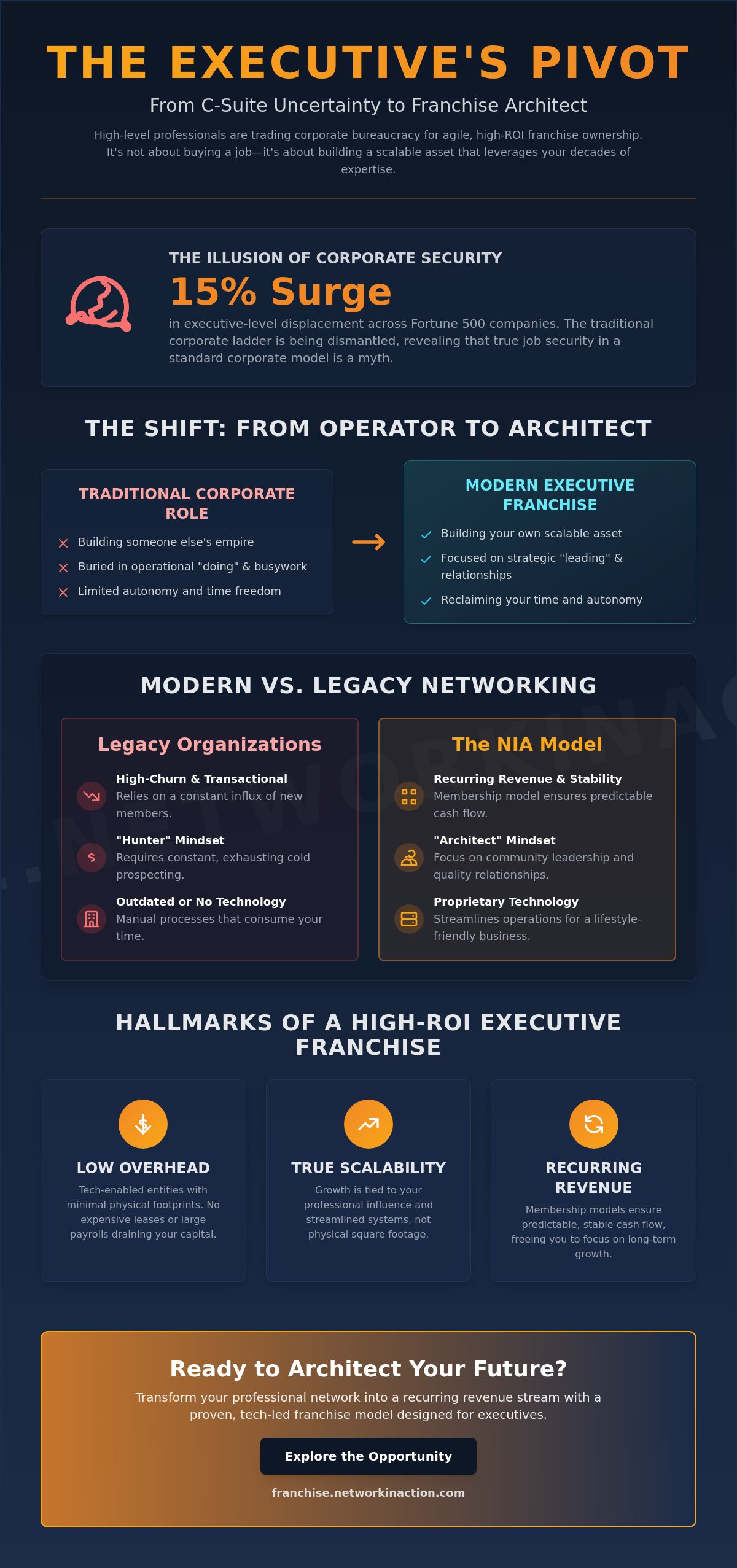
The traditional corporate ladder isn't just shaky; it's being dismantled by a 15% surge in executive-level displacement observed across Fortune 500 companies over the last year. You've spent decades mastering complex systems and building an elite professional network, yet true job security remains an illusion in the standard corporate model. It's time to stop building someone else's empire. Many high-level professionals are now looking at franchise opportunities for executives as the definitive path to reclaiming their time and autonomy.
You likely feel that the typical transactional business model is beneath your skillset, and you're right. You deserve a sophisticated, ROI-driven platform that rewards your leadership rather than burying it in administrative busywork. This guide breaks down the strategic shift toward modern, technology-led franchise models that capitalize on your existing social capital. You'll learn how to transform your professional network into a recurring revenue stream while establishing yourself as a visionary architect within your local business community.
Key Takeaways
- Learn how to pivot from operational management to strategic leadership by leveraging corporate expertise in a high-growth business environment.
- Identify high-ROI franchise opportunities for executives that prioritize recurring revenue and scalable systems over traditional brick-and-mortar risks.
- Discover why legacy networking organizations are failing modern professionals and how informed disruption creates a more efficient, results-oriented alternative.
- Audit your existing social capital to transform "legacy" leadership skills into a community-led business that maximizes professional credibility.
- Explore how proprietary technology streamlines operations to build a lifestyle-friendly business model focused on quality relationships rather than cold prospecting.
What Defines Executive Franchise Opportunities in 2026?
Executive franchise opportunities for executives in 2026 represent a radical departure from the labor-intensive, brick-and-mortar models of the past. These businesses prioritize intellectual capital over physical inventory. By 2026, the shift toward professional services and networking-based models has accelerated, with senior leaders increasingly seeking high-margin returns without the headaches of retail management. This isn't about learning a new trade from scratch; it's about understanding the franchise model as a strategic platform for leadership and community influence. You aren't buying a job. You're building a scalable asset that leverages your existing expertise to drive recurring revenue.
The core of this model is the transition from operational "doing" to strategic "leading." In a traditional business, you might manage supply chains or hourly staff. In an executive franchise, your primary role is business development and high-level relationship management. You focus on professional services, consulting, and elite networking sectors. This allows for a semi-absentee ownership structure where the business grows based on your reputation and the systems provided by the franchisor rather than your physical presence behind a counter.
The Rise of the White-Collar Franchise
Corporate professionals are exiting the C-suite in record numbers to seek "informed disruption" within the franchise sector. They're trading the bureaucracy of legacy corporations for the agility of independent ownership. This transition allows you to apply decades of professional experience to a proven system without the trial and error of a typical startup. A white-collar franchise serves as a sophisticated vehicle for professional autonomy, allowing you to reclaim your time while maintaining your status as a community leader. It turns your existing network into your most valuable business asset.
Key Characteristics of High-Level Models
Traditional retail franchises often demand 60-hour work weeks and constant staff turnover. High-level executive models flip this script. These businesses focus on professional services and networking, where the primary assets are relationships and proprietary technology. They are designed for ROI-driven individuals who value efficiency over activity.
- Low Overhead: No expensive leases or large payrolls; many operate as lean, tech-enabled entities with minimal physical footprints.
- Scalability: Growth isn't tied to physical square footage but to the expansion of your professional influence and the adoption of streamlined systems.
- Recurring Revenue: Membership-based or subscription-based models ensure predictable cash flow and long-term stability.
The goal is a model that provides the time freedom you earned during your corporate tenure. By focusing on relationship-driven growth and leveraging proprietary technology, franchise opportunities for executives offer a path to meaningful impact. You become the architect of a professional community, moving away from the transactional nature of legacy networking organizations toward a more sophisticated, results-oriented future.
Evaluating ROI and Scalability in Executive Franchises
For high-level professionals, the appeal of franchise opportunities for executives lies in the transition from managing someone else's P&L to building personal equity. You shouldn't view the Franchise Disclosure Document (FDD) as a mere legal hurdle; it's a strategic roadmap. Item 19 provides the data needed to model various growth scenarios, while Item 7 outlines the capital requirements. Understanding franchisee responsibilities is critical during this due diligence phase to ensure operational alignment with your long-term goals.
Scalability depends on the "stackability" of income. Legacy networking organizations often rely on high-churn, transactional models that require constant prospecting. Modern models prioritize recurring revenue through monthly membership fees. This creates a predictable cash flow that allows you to focus on community leadership rather than the next sale. It's a shift from a "hunter" mindset to an "architect" mindset.
Beyond the Initial Investment
Total cost of ownership includes more than the franchise fee. You must account for technology access fees, marketing funds, and working capital. High-growth executives often prefer flat-fee royalties over percentage-based models. A flat fee rewards your efficiency; the more you grow, the higher your margin becomes. You can Calculate Your ROI to see how these structures impact your bottom line. In a 2024 analysis of service-based franchises, models with capped royalties showed a 14% higher net profit margin for top-tier performers compared to percentage-based competitors.
The Technology Advantage
Efficiency is the primary driver of profit in 2026. Proprietary platforms replace manual labor and "old-school" administrative tasks that plague traditional networking. Automated referral tracking and integrated CRM systems ensure that no opportunity falls through the cracks. Tech-forward models reduce the time-to-profit for new owners by automating the heavy lifting of member management and data reporting. This allows you to scale without a massive payroll. A streamlined tech stack can save an owner an average of 12 hours per week on administrative work.
Market saturation is the enemy of ROI. You need to look for "white space" where the demand for high-level professional connection is high but the current offerings are stale. Avoid areas where the leading brand has already diluted the quality of the network with low-barrier-to-entry groups. If you're ready to secure your market, you should explore available territories to identify regions with the highest growth potential for franchise opportunities for executives.
Modern vs. Legacy Networking: A Strategic Comparison
Legacy networking organizations often feel like a relic of the 1980s. They rely on high-friction, low-yield models that demand excessive time for minimal professional return. For a high-level leader, spending 50 hours a year in a rigid weekly meeting just to trade business cards with junior-level associates is not a strategy; it's a drain on resources. These traditional models fail because they prioritize attendance over achievement and quantity over quality. They operate on a transactional basis that lacks the sophistication required for 2026 business dynamics.
The Problem with Traditional Models
Outdated networking models function as high-pressure sales environments rather than professional masterminds. These systems require weekly 90 minute commitments and mandate a specific number of referrals, regardless of whether those referrals actually convert to revenue. This forced-referral system alienates sophisticated small to mid-sized business owners who value discretion and excellence. You can explore The Problem with Traditional Networking Groups to understand why these legacy organizations struggle to retain top-tier talent. The result is often a high membership churn rate and a room full of people looking to sell, rather than people looking to build strategic alliances.
- Rigid Structures: Mandatory attendance and 7:00 AM start times don't respect an executive's schedule.
- Forced Referrals: Quotas lead to "trash" leads that waste time and damage professional credibility.
- Transactional Culture: Meetings focus on tracking numbers rather than solving complex business problems.
The Modern Architecture of Connection
Networking evolved when it moved away from the "weekly breakfast club" and toward high-impact, monthly engagement. Modern architecture leverages proprietary technology to maintain connections between sessions, ensuring that professional networks remain active without requiring constant physical presence. This efficiency is why franchise opportunities for executives are shifting away from service-based models like restoration or maintenance. Instead of managing a fleet of trucks, you lead a curated community of power players.
Executives are uniquely qualified to lead these groups because they already possess the "Visionary Architect" mindset. They understand that "owning the network" is a superior alternative to simply participating in one. By owning the community, you position yourself as the central hub of a local economy. This model offers recurring revenue and scalability with a fraction of the overhead found in traditional franchise systems. It's a move toward ROI-driven social capital where every interaction is measured by its impact, not just its frequency. This streamlined approach allows you to build a legacy while maintaining the lifestyle autonomy that a high-level career should provide.
The Executive Transition: From C-Suite to Community Leader
Transitioning from a corporate VP or Director role to business ownership requires a strategic pivot rather than a complete career overhaul. Most franchise opportunities for executives fail to account for the high-level social capital you've already built. The NIA model changes this. It transforms your existing corporate authority into community leadership through a deliberate four-step process designed for high-impact results.
- Step 1: Audit your social capital. Map out your existing professional connections. These aren't just contacts; they're the foundation of your initial membership base and the primary drivers of your early ROI.
- Step 2: Identify legacy skills. Your ability to manage complex budgets, lead diverse teams, and execute long-term strategic plans translates directly to scaling a franchise. These are the skills that "legacy networking organizations" lack in their leadership.
- Step 3: Select strategic territories. Focus on regions with a projected GDP growth of at least 2.4 percent to ensure a fertile ground for business expansion. Alignment with regional growth trends is critical for long-term scalability.
- Step 4: Execute relationship marketing. Shift your focus from cold prospecting to high-level relationship building. The goal is to cultivate a curated circle of professionals rather than managing a high-volume, low-quality lead list.
Leveraging Professional Credibility
Your corporate reputation acts as an immediate trust accelerator. High-quality business owners don't want to be sold; they want to be led by a peer who understands their specific challenges. Transitioning from managing employees to leading a community of business owners requires a shift in mindset. You're no longer enforcing internal KPIs; you're facilitating measurable growth for your members. Explore Finding Available Franchise Opportunities Near You to see where your reputation can make the most significant impact.
Mastering the Referral Marketing Strategy
The most efficient path to growth for executive owners is a referral-based model. Traditional networking organizations often rely on rigid, transactional rules that lead to member burnout and high turnover. A modern referral marketing strategy focuses on quality over quantity. This approach allows you to build a referral-based business empire while maintaining professional autonomy and time freedom. By leveraging proprietary technology and curated memberships, you create a self-sustaining ecosystem of trust. It's about building a scalable asset that delivers recurring revenue through sophisticated connection and informed disruption.
Ready to leverage your expertise for a new level of ownership? Download your franchise kit today to start your transition.
Why Network In Action is the Premier Choice for Executives
Network In Action (NIA) represents an informed disruption of a stagnant industry. Since its inception in 2011, the brand has challenged the inherent flaws of legacy networking organizations that rely on manual, outdated processes. NIA changed the game by integrating proprietary technology into a turnkey franchise model. This shift moves networking from a social obligation to a strategic business asset. It's a system built for those who value efficiency over activity. High-level professionals looking for franchise opportunities for executives often prioritize models that offer recurring revenue without the massive overhead of 50-person staff counts or physical inventory. The NIA platform allows owners to manage multiple groups through a streamlined dashboard, creating a lifestyle-friendly business that doesn't require a 60-hour work week.
The focus remains squarely on ROI-driven results. In a world where time is the most valuable currency, NIA delivers a sophisticated environment where social capital is measured and maximized. The model isn't about passing out business cards; it's about curated, high-quality referrals among vetted professionals. This technology-forward approach ensures that every interaction is purposeful and every connection is documented, providing the transparency that modern business owners demand.
The NIA Differentiators
The NIA model succeeds because it removes the friction found in traditional networking. There are no forced referrals. Instead, the focus remains on authentic relationship building and professional trust. Meetings occur in 90-minute monthly sessions rather than weekly, respecting the executive's schedule. This 75% reduction in meeting time compared to older, rigid models doesn't sacrifice results. It enhances them by ensuring that only the most committed professionals are in the room. A custom-built technology platform facilitates member communication 24/7, ensuring that the network stays active between physical meetings. It's networking evolved for the 2026 business climate. To see how these systems function in practice, download the franchise kit for a deep dive into the model.
Building Your Legacy
NIA franchisees become the Visionary Architects of their local business community. By curating groups of elite professionals, you position yourself at the epicenter of local economic activity. The model is built for scalability. You can expand into multiple territories, leveraging the same core systems to multiply your impact and income. This isn't just another business venture; it's a platform for building long-term professional capital and influence. Transitioning from corporate leadership to business ownership requires a strategic move that matches your level of sophistication. Network In Action offers a path to autonomy that leverages your existing skills without the typical startup risks. It's time to stop managing someone else's vision and start building your own. Explore available territories and start your journey with NIA today.
Command Your Next Career Evolution
The transition from the C-suite to business ownership in 2026 demands a model that respects your time and leverages your expertise. Legacy networking organizations continue to struggle with inefficient, manual processes that fail to deliver measurable value. Network In Action solves this by replacing outdated methods with a proprietary technology platform designed specifically for high-level professional ROI. This isn't just another business; it's a strategic move to lead your community while securing recurring revenue and lifestyle autonomy.
With over 150 locations worldwide, the NIA model proves that sophisticated systems outperform traditional networking every time. You don't need to settle for clunky, high-pressure environments when you can own a tech-forward solution that prioritizes quality over quantity. Exploring franchise opportunities for executives means identifying where your leadership can make the most impact. It's time to trade the corporate grind for a scalable asset that you control.
Download the Network In Action Franchise Kit to explore your future
The future of networking is already here, and it's waiting for those ready to lead with intent.
Frequently Asked Questions
What exactly is an executive franchise?
An executive franchise is a sophisticated business model designed for high-level professionals who want to leverage leadership skills rather than perform daily manual labor. These franchise opportunities for executives focus on strategic growth, community influence, and building a scalable asset. You transition from a corporate employee to a business owner who manages systems and people. This model prioritizes recurring revenue and long-term equity over trading hours for dollars.
How much can an executive franchise owner expect to make?
Earnings depend on your ability to scale groups and retain members within the NIA ecosystem. While specific income varies by market, the model is built on high-margin recurring revenue and low overhead costs. According to the International Franchise Association, the franchise sector is projected to reach a total output of $893.9 billion in 2024. Your ROI is directly tied to the efficiency of the proprietary technology and the quality of the professional relationships you curate.
Do I need prior industry experience to own an NIA franchise?
You don't need a background in professional networking or franchise management to succeed with NIA. The brand seeks individuals with a 10 year or 20 year history of corporate leadership and a robust professional network. The Visionary Architect persona thrives here because the system is already built. You provide the influence and local authority while the proprietary technology handles the logistical heavy lifting.
What is the typical time commitment for an executive-level franchise?
Owners typically spend 10 to 15 hours per month per group once their initial memberships are established. This isn't a traditional 40 hour grind that consumes your entire life. The model is built for lifestyle autonomy, allowing you to manage multiple groups without sacrificing personal freedom. It's a strategic shift where you work on the business, not in it, using streamlined systems to maintain high performance.
How does NIA compare to traditional networking organizations?
NIA disrupts the status quo by replacing outdated networking models with a tech-forward, ROI-driven approach. Unlike legacy networking organizations that require weekly meetings and forced referrals, NIA meets monthly and focuses on high-quality, curated membership. You won't deal with the rigid, transactional nature of the leading brand. Instead, you offer a modernized platform that values time efficiency and measurable business results for every member.
What kind of training and support does NIA provide to new owners?
New owners receive a comprehensive, turnkey onboarding package that covers everything from member recruitment to technology deployment. NIA provides ongoing support through a dedicated franchise success team and a library of proprietary marketing assets. You'll master the Future of Networking through hands-on training sessions that focus on scalability and revenue growth. This support system ensures you're never building in a vacuum, even while maintaining your independence.
Is it possible to run this business while keeping my current job?
Many NIA owners successfully launch their franchise as a semi-absentee venture while maintaining their current executive roles. The business is designed for flexibility, allowing you to scale at a pace that fits your existing schedule. It's an ideal bridge for those planning a 12 month exit strategy from corporate America. You build your local influence and recurring revenue stream now, creating a safety net for your future transition.
What are the most important skills for a successful NIA franchise owner?
Success requires strong interpersonal communication, a high level of emotional intelligence, and a results-oriented mindset. You must be comfortable leading a room of high-level professionals and facilitating meaningful connections. The most successful owners are those who view networking as a strategic asset rather than a social hobby. If you have a history of managing teams and driving business growth, you already possess the core competencies needed.