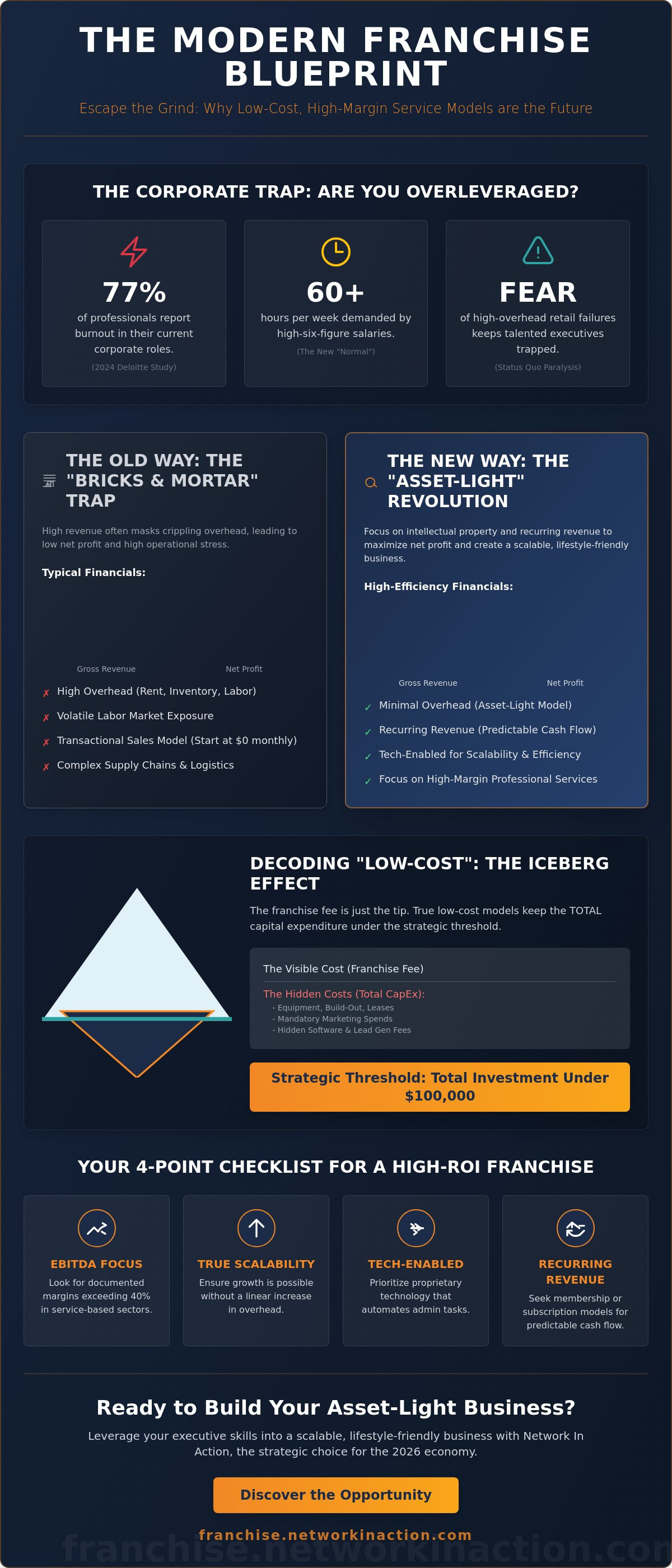
The most dangerous risk you face in 2026 isn't a market crash; it's the continued reliance on a high-six-figure salary that demands 60 hours of your life every week. You've likely reached a point where the corporate grind no longer offers the ROI your talent deserves. A 2024 Deloitte study found that 77% of professionals have experienced burnout at their current roles, yet the fear of high-overhead retail failures keeps many trapped in the status quo. You deserve a business that leverages your skills without the burden of expensive leases or complex supply chains.
Networking evolved. This guide changes the narrative by showing you how to identify low-cost franchises with high profit that prioritize executive leadership over manual labor. You'll learn to move beyond legacy networking organizations that waste your time with forced referrals and rigid, transactional structures. Instead, you'll discover how to leverage your professional network into a high-margin business built on recurring revenue and proprietary technology. The following analysis identifies the specific criteria for high-efficiency models that allow you to reclaim your time and scale your influence.
Key Takeaways
- Master the distinction between initial license fees and total capital expenditure to ensure your investment remains strategically under the $100,000 threshold.
- Identify low-cost franchises with high profit by prioritizing professional service models that leverage recurring revenue over high-overhead retail assets.
- Abandon the inefficiencies of legacy networking organizations and discover why modern, relationship-driven growth outperforms rigid, forced-referral systems.
- Apply a rigorous 5-step framework to analyze Franchise Disclosure Documents and accurately calculate your projected time to break-even based on low-overhead costs.
- Explore how proprietary technology and monthly executive-level meetings create a scalable, lifestyle-friendly business model for the 2026 economy.
Defining Low-Cost Franchises with High Profit in 2026
The search for low-cost franchises with high profit requires a departure from traditional vanity metrics. In 2026, savvy investors define "low-cost" as an all-in initial investment under $100,000. It is vital to distinguish between the initial franchise license fee and the total capital expenditure (CapEx) required to reach break-even. Many systems look affordable on paper but hide massive equipment or build-out costs that drain liquidity before the business even opens. The franchising business model has evolved to reward those who prioritize EBITDA margins over raw gross revenue. High profit isn't about the size of the check; it's about what stays in your pocket after the overhead is cleared. The 2026 market demands lean, service-oriented models that leverage technology to minimize headcount and maximize output.
The Myth of the Retail Goldmine
High-revenue retail locations often mask a dangerous reality. While a storefront might generate $1 million in sales, the net profit is frequently eroded by escalating commercial rents and a volatile labor market. This is the "bricks and mortar" trap. Asset-light business models have disrupted this cycle. By removing the physical footprint, you eliminate the single largest fixed cost in business. Informed disruption means choosing systems that prioritize intellectual property and proprietary technology over expensive real estate. Traditional networking organizations often fail here by requiring physical meeting spaces and rigid attendance, whereas modern models focus on digital efficiency and high-value social capital.
Investment Tiers: What to Expect Under $50k
A sub-$50,000 investment in 2026 buys access to a refined system rather than physical assets. These models typically focus on high-margin consulting, specialized services, or professional networking. You aren't buying a job; you're buying a scalable framework. However, you must identify hidden costs like lead generation software or mandatory marketing spends that legacy brands often bury in the fine print. For those transitioning from corporate leadership, these Executive Business Opportunities offer a strategic path to recurring revenue without the administrative burden of traditional management. Success in this tier depends on your ability to lead a community rather than manage a supply chain. Consider these factors when evaluating low-cost franchises with high profit:
- EBITDA Focus: Look for margins exceeding 40% in service sectors.
- Scalability: Ensure the model allows for growth without a linear increase in overhead.
- Tech-Enabled: Prioritize franchises that use proprietary technology to automate administrative tasks.
- Recurring Revenue: Seek out membership or subscription models that provide predictable monthly cash flow.
Efficiency is the new currency. By focusing on asset-light models, you bypass the friction of old-school business and move directly toward measurable ROI.
The Economics of High-Margin Service Franchises
Professional services represent the elite tier of the franchise world. Unlike retail or food service, where margins are squeezed by rising supply costs and complex logistics, service-based models focus on human capital and intellectual property. This shift creates a lean operation. You aren't paying for spoiled inventory or expensive storefronts in high-traffic zones. Instead, you're investing in a system that scales through expertise. This is why service models are consistently identified as low-cost franchises with high profit potential for the 2026 market.
The ROI-driven potential here is unmatched. When you remove the "physicality" of the business, your overhead drops. Most professional service franchises operate with 15% to 25% higher net margins than traditional brick-and-mortar setups. This efficiency relies on following established rules for franchisees to ensure the system is executed with precision. Scaling intellectual property is a matter of replicating a proven process, not renting more warehouse space. It's about working smarter, not just harder.
Recurring Revenue vs. Transactional Sales
Transactional models are a treadmill. You sell, you deliver, and you start over at zero the next month. In contrast, membership-based models offer a predictable financial horizon. Subscription revenue stabilizes your cash flow and allows for aggressive reinvestment. It also slashes the long-term cost of customer acquisition. Once a member is in the ecosystem, the focus shifts from hunting to harvesting. This creates a business that grows compounding value over time.
- Stability: Membership fees provide a financial "floor" for monthly income, shielding the business from seasonal dips or market volatility.
- Efficiency: Retaining a current member is statistically five times cheaper than acquiring a new one, allowing for higher profit retention.
- LTV: Lifetime Value represents the total net profit a business can expect to earn from a single professional connection over the entire duration of the relationship.
Leveraging Tech-Enabled Platforms
Modern franchising has moved beyond the manual binder. Proprietary technology now handles the "heavy lifting" of business management. This reduces the need for a large administrative staff. Often, a single owner-operator can manage a territory that would have required three employees in 2016. Data-driven lead generation ensures that your time is spent closing deals rather than chasing cold leads. You're buying a system that works while you sleep.
This tech-forward approach is exactly how a sophisticated Referral Marketing Strategy fuels growth without the friction of legacy networking organizations. By automating the tracking of connections and ROI, you provide members with tangible proof of value. It's a modernized solution for an industry that has stayed stagnant for too long. If you're ready to see how this fits your market, you can explore available territories to find your next strategic move.
Legacy Networking vs. Modern Disruptive Models
The era of the stale, 7:00 AM breakfast meeting is over. High-level executives and seasoned entrepreneurs no longer tolerate rigid structures that prioritize attendance over outcomes. While legacy networking organizations cling to 20th-century protocols, a new wave of disruptive models is redefining how professional social capital is built. This shift creates a unique opportunity for low-cost franchises with high profit to capture market share from bloated, manual operations that fail to respect an executive's time.
Modern professionals demand efficiency. They seek environments where relationships are cultivated, not forced. Identifying the right opportunity requires a strategic approach. Professional investors utilizing the SBA’s framework for evaluating a franchise often discover that the most resilient models are those that solve a fundamental human need through modern technology. Network In Action (NIA) represents this evolution, replacing clunky, outdated systems with a streamlined, ROI-driven approach.
The Flaws of Traditional Networking Groups
Legacy networking organizations rely on high-pressure environments that frequently lead to member burnout. These groups often require weekly 90-minute meetings, which translates to over 75 hours of seated time annually, excluding travel. For a professional billing $250 per hour, the opportunity cost exceeds $18,000 every year just to stay in the room. This "time tax" is unacceptable for high-earners who value productivity.
The transactional nature of these groups is equally problematic. "Forced referrals" compel members to pass leads regardless of quality, often resulting in low-conversion junk data that wastes everyone's time. When participation is mandated by rigid quotas rather than genuine connection, the culture becomes one of obligation rather than opportunity. Executives avoid these clunky structures because they recognize that a "referral" without a relationship is just a cold call in disguise.
The Modern Evolution: Quality Over Quantity
The future of networking belongs to curated, relationship-driven growth. Modern models replace the weekly grind with high-impact monthly meetings, allowing members to maintain their professional momentum while staying connected. This shift from 50 meetings a year down to 12 increases the value of every interaction. It ensures that when leaders gather, they are focused, prepared, and ready to engage in meaningful business logic.
Technology serves as the backbone of this disruption. Proprietary platforms now keep members connected between physical meetings, tracking ROI and facilitating introductions in real-time. NIA acts as the visionary architect of this space, leveraging tech-forward systems to create a scalable, recurring revenue model for franchisees. By focusing on elite, curated memberships, NIA ensures that every group is an engine for high-level growth. You aren't just selling a membership; you are leading a community of top-tier professionals who are ready to invest in low-cost franchises with high profit that respect their lifestyle and their bottom line.
Ready to lead the evolution of business networking in your city? Download our franchise kit to see how the NIA model outperforms traditional networking structures.
A 5-Step Framework for Evaluating Franchise ROI
Identifying low-cost franchises with high profit requires more than a casual glance at a brochure. It demands a rigorous, executive-level audit of the business model's mechanics. You aren't just buying a job; you're investing in a scalable asset. Use this five-step framework to separate high-performing disruptors from stagnant legacy models.
- Step 1: Audit Item 19 Financials. Open the Franchise Disclosure Document (FDD) and head straight to Item 19. If a brand hides its financial performance, it's a red flag. Look for high gross margins and low recurring expenses. In the 2026 market, transparency is the only currency that matters.
- Step 2: Calculate the Break-Even Velocity. Focus on models with minimal overhead. When you eliminate expensive leases and heavy inventory, your time to break-even shrinks from years to months. High-profit potential is directly tied to how fast you can stop funding the business and start paying yourself.
- Step 3: Audit the Proprietary Technology. Is the tech a differentiator or an afterthought? A modern franchise must offer a technology-enabled platform that automates administrative tasks. If the system doesn't drive efficiency, it's a liability, not an asset.
- Step 4: Conduct Lifestyle Interviews. Talk to existing franchisees. Don't just ask about the money. Ask about their Tuesday afternoons. If they're chained to a desk or on-call 24/7, they haven't bought freedom; they've bought a high-stress job.
- Step 5: Test the Scalability Multiplier. Can you own three territories without tripling your stress? True scalability means your systems do the heavy lifting. You should be able to expand your footprint while maintaining your role as a high-level strategist rather than a micro-manager.
Vetting for Lifestyle and Freedom
Modern ownership is about reclaiming your time. Beware of franchises that require constant "on-call" management or manual oversight of hourly labor. These are 20th-century headaches. A true turnkey model must include a proven, automated system for lead generation. Without a steady stream of prospects delivered by the system, you're stuck in a cycle of cold-calling. You can view available territories to see where the next generation of professional networking is taking hold.
The Role of Community Leadership
Success in 2026 is built on social capital. When you lead a professional community, you aren't just a business owner; you're a local authority. This creates a "Multiplier Effect" where your network becomes your most valuable asset. Owning a network is far more profitable than owning a single transactional business. It creates recurring revenue through deep, long-term professional relationships. For a deeper dive into this strategy, read our Business Networking Franchise Guide to see how modern ownership works.
Ready to see how a high-margin, tech-forward model fits your goals? Download the Franchise Discovery Kit and start your evaluation today.
Why Network In Action is the Strategic Choice for 2026
The traditional networking model is a relic of the past. For executives seeking low-cost franchises with high profit in 2026, Network In Action (NIA) represents a fundamental shift in how professional communities operate. Legacy networking organizations often prioritize attendance over outcomes, forcing members into weekly meetings that drain time without delivering measurable value. NIA disrupts this cycle by focusing on a monthly cadence designed for high-level professionals who value their calendar as much as their bottom line. It's a business model built on recurring revenue with zero requirement for a physical storefront, expensive inventory, or a massive payroll.
Efficiency drives every aspect of this franchise. By eliminating the overhead associated with traditional brick-and-mortar businesses, owners can focus entirely on relationship building and group scaling. This lean structure allows for a faster path to profitability. The model is built for the modern economy, where social capital is the most valuable currency. You aren't just selling a membership; you're facilitating a high-ROI environment for the most influential business leaders in your community.
The NIA Differentiators
- No forced referrals: Quality always beats mandated quantity. While outdated networking models require members to pass a specific number of leads every week, NIA eliminates forced referrals. This ensures that every connection made within the group is authentic and high-value.
- Proprietary technology: This is the engine behind member retention and group growth. NIA utilizes a custom platform to track member ROI, facilitate introductions, and streamline group management. This tech-forward approach simplifies the administrative burden for the franchise owner.
- Franchise-in-a-Box: The support system is designed for rapid market entry. New owners receive a comprehensive blueprint that covers everything from initial member recruitment to long-term group sustainability.
Taking the Next Step
Transitioning from a professional executive to a community leader is a strategic move. It requires leveraging a career's worth of expertise to curate a room of elite professionals. Success in this model depends on the alignment between your personal values and a business model that rewards genuine leadership. This is an opportunity to own the room rather than just occupy a seat in it. Networking has evolved; the question is whether you will lead that evolution in your local market.
If you're ready to secure your future with one of the most efficient low-cost franchises with high profit available today, the path is clear. You can Download the Franchise Kit to begin the discovery process and see if your territory is still available. Position yourself at the forefront of the modern networking industry and start building a business that works for your lifestyle.
Secure Your Strategic Advantage in 2026
The search for low-cost franchises with high profit ends where modern technology meets elite community building. You've seen the data. Legacy networking organizations are failing because they prioritize rigid attendance over actual business results. In 2026, the market demands efficiency and measurable ROI. Network In Action delivers this through a proprietary technology platform and a curated membership model that respects your time. With over 150 locations worldwide, the system is proven. It replaces the clunky, manual processes of traditional organizations with a streamlined, high-margin business model built for the modern executive. This isn't just another franchise opportunity; it's a disruption of a stale industry. You now have the framework to evaluate ROI and the roadmap to lead your local business community. High-level professionals don't settle for outdated systems. They seek scalability and recurring revenue. You're positioned to leverage your professional capital into a scalable asset that offers both lifestyle autonomy and significant impact. The future of networking is results-oriented, tech-forward, and ready for your leadership.
Ready to own the network? Download the Network In Action Franchise Kit today.
Frequently Asked Questions
What is considered a "low-cost" franchise in 2026?
A low-cost franchise in 2026 typically requires an initial investment under $100,000, according to industry benchmarks from sources like Franchise Business Review. These models often eliminate the need for expensive real estate or massive inventory. Instead of sinking capital into bricks and mortar, you invest in systems and brand equity. This price point allows for a faster path to profitability and significantly lower overhead.
Can a low-cost franchise really generate high profits?
Yes, low-cost franchises with high profit potential exist because they leverage high-margin services rather than physical goods. By removing the burden of high rent and large payrolls, a larger percentage of every dollar earned goes directly to the bottom line. Many service-oriented models report net profit margins exceeding 40 percent in their second year of operation. It's about efficiency, not the size of the initial check.
How do service-based franchises compare to retail in terms of ROI?
Service-based franchises generally outperform retail in ROI because they lack the expensive overhead associated with storefronts and inventory depreciation. Retail models often take 36 to 48 months to break even, while service models can achieve this in under 12 months. You aren't paying for "dead" shelf space. Instead, you're scaling based on demand and relationships, making the return on invested capital much more aggressive.
What are the most profitable low-cost industries right now?
Professional networking, home services, and specialized consulting lead the market in 2026. The professional networking sector is particularly lucrative because it offers recurring revenue without the headache of physical logistics. Data from 2025 shows that businesses focusing on "social capital" and B2B connections have lower churn rates. These industries capitalize on the growing demand for curated, high-quality professional communities over outdated networking models.
How much time do I need to commit to a networking franchise?
You can manage a modernized networking franchise in approximately 10 to 15 hours per week per group. This efficiency stems from a technology-enabled platform that automates administrative tasks like attendance and referral tracking. Unlike legacy networking organizations that demand constant manual oversight, this model is designed for lifestyle autonomy. It allows you to lead your community while maintaining your existing professional commitments.
What should I look for in a franchise disclosure document (FDD)?
Focus on Item 19 for financial performance representations and Item 20 to see the franchise's growth and closure rates over the last three years. High-quality franchisors provide transparent data on average gross sales and operating expenses. You should also examine the litigation history in Item 3 to ensure the brand's stability. A clean FDD signifies a mature, well-governed system that prioritizes franchisee success over rapid, unsustainable expansion.
Is it possible to run a high-profit franchise without employees?
Operating a high-profit franchise as a solopreneur is entirely possible in sectors like professional networking or specialized coaching. These models rely on your expertise and proprietary systems rather than a large headcount. By avoiding the 20 to 30 percent labor costs typical of retail, you retain more earnings. It's a strategic move for those who want to lead a community without the management burden of a traditional staff.
How does proprietary technology impact franchise profitability?
Proprietary technology drives profitability by reducing manual labor and increasing the value of the service provided. In the networking space, a dedicated platform ensures members see a clear ROI on their social capital through measurable data. This tech-forward approach eliminates the "clunky" feel of traditional models. It streamlines operations, allowing you to scale your business without a corresponding increase in your daily workload or administrative expenses.