Traditional networking is dead, and your calendar is the primary victim of its slow demise. You've likely spent 50 hours or more this year sitting through rigid, weekly meetings that prioritize attendance over actual business growth. If you're tired of "clunky" legacy systems, learning how to start a business networking group is the strategic move to reclaim your schedule. Recent industry data indicates that 82% of high-level executives prefer curated, results-driven environments over the transactional noise of open-membership groups.
This executive guide provides the strategic blueprint for launching a high-impact engine for measurable ROI. You'll discover how to leverage proprietary technology to eliminate manual logistics and build a scalable model that commands professional authority. Networking evolved. It's time to move beyond the inefficiency of legacy networking organizations to create something elite. This article breaks down the transition from "old-school" manual management to a streamlined, technology-enabled system that delivers consistent value to every member.
Key Takeaways
- Learn exactly how to start a business networking group by identifying the market gaps left by legacy organizations and implementing a disruptive, high-ROI vision.
- Master the "less is more" philosophy by replacing the rigid demands of traditional networking with a streamlined monthly structure designed for high-level executives.
- Build an elite professional community using a rigorous vetting process that prioritizes high-trust relationships and professional compatibility over forced referral quotas.
- Harness proprietary technology to automate administrative tasks and maintain constant connectivity, ensuring your group operates with modern efficiency and scalability.
- Discover the strategic path to scaling your impact by transitioning from a local leader to a network owner with sustainable, recurring revenue streams.
Defining Your Vision: How to start a business networking group in 2026
The traditional networking landscape is cluttered with relics. Legacy networking organizations often prioritize rigid attendance over actual results; they focus on the volume of referrals rather than the value of the connection. If you want to know how to start a business networking group that actually commands respect, you must begin with informed disruption. You aren't just starting a club. You're architecting a high-performance ecosystem that respects the time and intelligence of the modern executive.
Identifying the Market Gap
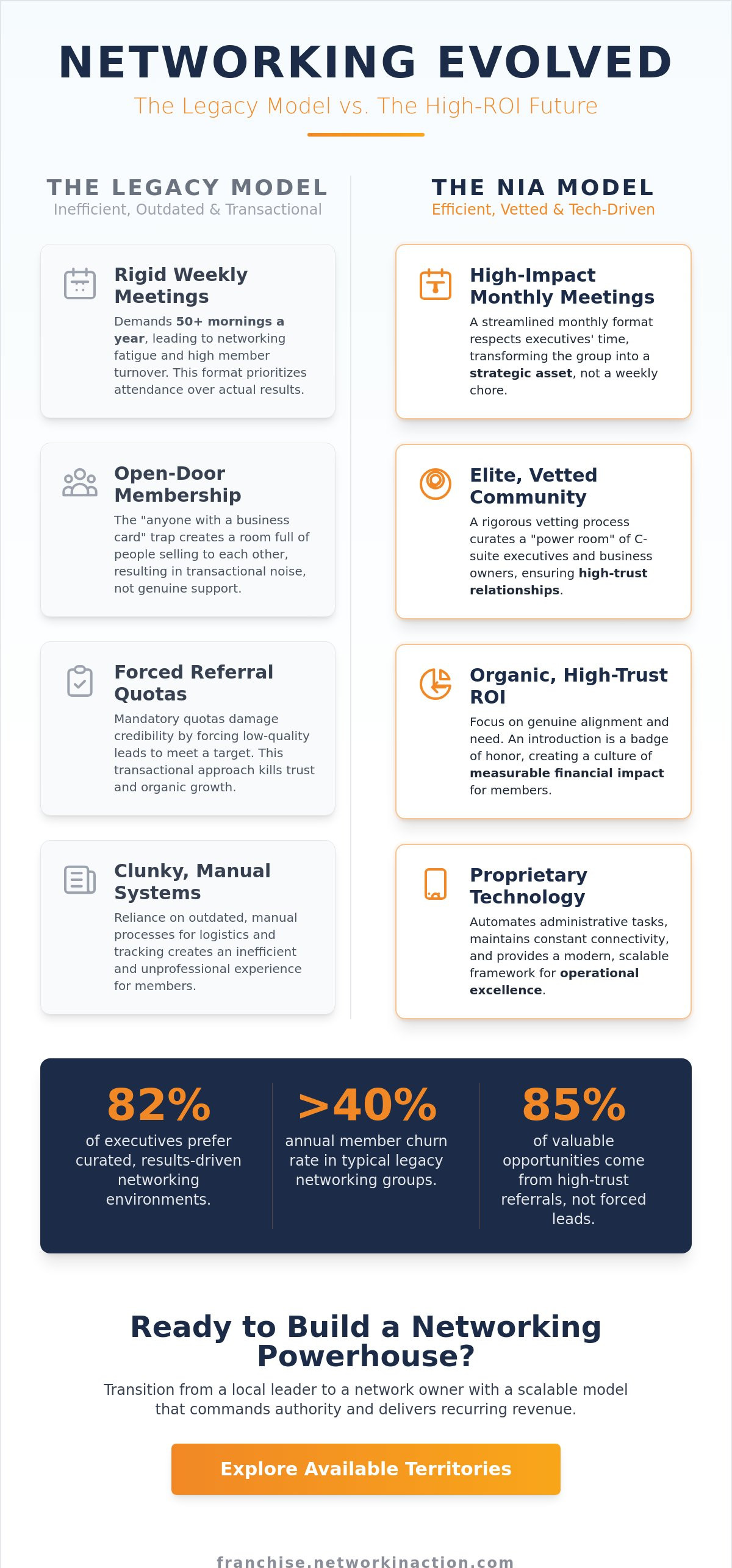
Modern professionals are exhausted by the outdated "coffee and cards" routine. Industry data indicates that traditional networking groups often see member churn rates exceeding 40% annually because they fail to deliver a consistent, measurable ROI. While Business networking fundamentals remain essential for growth, the delivery method is fundamentally broken. Legacy models rely on forced referrals and manual tracking, which creates a transactional environment that feels desperate rather than elite. The Modern Networking Group is a results-oriented, professional ecosystem designed to maximize social capital through proprietary technology and intentionality. It replaces the clunky, stale feel of old-school groups with a streamlined, executive-level experience that fits into a busy calendar.
Curating a High-Level Membership Profile
The biggest mistake in the industry is the "anyone with a business card" trap. This leads to a room full of people selling to one another instead of supporting one another. Success depends entirely on the quality of the room. You must target small to mid-sized business owners and C-suite executives who bring established credibility and diverse resources to the table. Executives at mid-sized firms report that 85% of their most valuable opportunities come from high-trust referrals, not cold prospecting. This creates a "power room" where every member adds measurable value to the collective.
- Reject the transactional: Shift the focus from "passing leads" to long-term relationship-driven growth.
- Prioritize time efficiency: High-level leaders value monthly, high-impact interactions over weekly, low-value meetings.
- Leverage structured ROI: Use modern systems to track the actual financial impact of every connection made.
When you understand how to start a business networking group with this level of precision, you stop chasing leads and start building a scalable asset. This is about professional leadership and community impact. It's a strategic path to recurring revenue and professional authority. If you're ready to secure your place as a leader in your local market, checking available territories is your first strategic move toward building a modern networking powerhouse that leaves the legacy models behind.
Structuring for ROI: The Blueprint for Efficient Networking
Networking evolved. Traditional models are broken. When you research how to start a business networking group , you'll find that the most successful leaders prioritize efficiency over activity. Busy executives don't want another obligation. They want a strategic asset. Efficiency is the foundation of high-level leadership. Results matter more than attendance records.
The Shift from Weekly to Monthly Formats
Legacy networking organizations demand 50 mornings a year. This frequency leads to networking fatigue and high membership turnover. It often attracts those with too much time and too little business. A streamlined monthly schedule attracts high-tier leadership. It transforms the group into a high-impact monthly board meeting. This format respects the schedule of a 2026 executive who values results over coffee. It positions the group as a strategic business asset rather than a weekly chore.
Eliminating Forced Referrals
Mandatory referral quotas damage professional credibility. They force members to pass low-quality leads just to hit a weekly target. This is a transactional approach that kills trust. A modern referral marketing strategy focuses on organic alignment and genuine need. It creates a culture where an introduction is a badge of honor, not a box to check. High-trust introductions happen when members actually know and respect one another's expertise. Quality always beats quantity in a professional circle.
Results must be measurable. Building a valuable networking group requires a culture where ROI is tracked and celebrated. You should implement technology that tracks the actual dollar value generated by the group. This turns social capital into a concrete metric. When you understand how to start a business networking group that actually pays off, you become a visionary architect in your local economy. You move beyond social networking and into the sphere of business growth.
Efficiency is the new currency. By the year 2026, the gap between social clubs and ROI-driven networks will only widen. If you're serious about leadership, you'll build a system that respects time and rewards performance. To see how this structure scales, savvy leaders often download a franchise kit to review the underlying systems. It's time to build something that lasts.
Member Recruitment and the Vetting Process
Building a powerhouse group requires a shift from a "growth at all costs" mentality to a curated, invitation-only approach. When you learn how to start a business networking group , you'll find that the strength of the collective depends entirely on the caliber of its individual members. You aren't just filling chairs; you're architecting an elite ecosystem where every participant brings measurable value. This exclusivity drives long-term retention because high-level executives don't want to spend time with entry-level sales reps.
Seed your group by identifying 5 to 7 influential leaders within your existing circle. These founding members set the tone for the entire organization. Focus on professionals who have already achieved significant market share in their respective industries. By positioning the group as a solution to executive isolation, you create a compelling value proposition that transcends simple lead generation. It's about building a high-level brain trust focused on ROI and strategic growth.
The Art of the Strategic Invitation
Approaching a CEO or a seasoned entrepreneur requires a sophisticated touch. Avoid the desperate energy of a traditional sales pitch. Instead, frame the invitation as a selective opportunity to join a modern, tech-forward community. Highlight how this group functions as a remedy for the inefficiencies found in legacy networking organizations. You're offering a streamlined path to how to build a professional network that actually respects their time. Successful recruitment hinges on the "give-first" philosophy; ensure every potential member understands that their primary role is to contribute expertise before seeking personal gain.
Vetting for Professional Integrity
A single bad actor can derail a group's momentum. Mastering how to start a business networking group means vetting for quality over quantity every single time. Implement a rigorous process that includes professional reference verification and background checks. This isn't just about ethics; it's about protecting the group's collective reputation. Recent data suggests that 70% of business professionals value trust over any other factor when making a referral. Maintain strict industry exclusivity to eliminate internal competition. Set clear standards for participation, including:
- Verifiable professional track record of at least 5 years.
- Commitment to a results-oriented mindset.
- Consistent attendance to maintain group cohesion.
- Active engagement with proprietary technology platforms to track ROI.
By treating the recruitment phase as a high-stakes talent acquisition process, you ensure that your group remains an elite, disruptive force in the local business community. If you're ready to lead your own curated circle, check available territories to see where you can plant your flag.
Operational Excellence: Leveraging Technology and Modern Formats
Efficiency isn't a luxury; it's a requirement for the modern executive. When you're learning how to start a business networking group , the biggest mistake you can make is relying on manual administration. Legacy networking organizations often trap their leaders in a cycle of clunky, paper-based systems and disjointed email chains. This creates friction that kills momentum. Modern networking demands a streamlined, technology-first approach that prioritizes a member's time and ROI above all else. By implementing a proprietary technology platform, you ensure that your members stay connected and productive every day of the month, not just during scheduled meetings.
The Digital Backbone of Modern Networking
Manual tracking is the primary reason 75% of independent networking groups dissolve within their first 24 months. Leaders quickly become bogged down in the minutiae of attendance and dues, losing sight of strategic growth. Utilizing a business referral platform scales your operations instantly by removing human error from the equation. Technology serves as the permanent bridge that maintains professional momentum between monthly face-to-face meetings, ensuring the network remains active 24/7.
Measuring ROI and Group Performance
High-level executives don't join groups for coffee; they join for measurable results. You must identify and track key performance indicators like "dollars passed" and successful introductions through a centralized system. Providing members with 100% transparent reporting on their networking investment transforms the group from a social hour into a high-yield business asset. When members can see a 10x or 20x return on their dues through a digital dashboard, retention becomes automatic.
Automating the mundane is the hallmark of a "Visionary Architect." When you automate dues collection and meeting RSVPs, you reclaim 10 to 15 hours of administrative work every month. This allows you to focus on the high-value activity that members actually pay for: facilitating strategic introductions. Your role as a leader is to use digital tools to measure the group's total economic impact and then use those insights to drive deeper connections. By leveraging a modern format, you position yourself as a tech-forward leader who respects the time and bottom line of every professional in the room. This is the core of how to start a business networking group that actually lasts.
Ready to lead a group backed by the industry's most advanced technology? Explore available territories and see how the NIA model drives real-world results.
Scaling Your Impact: Transitioning from Group Leader to Network Owner
Leading a single group is a solid start; owning a network is a legacy. Most professionals learning how to start a business networking group eventually hit a ceiling. You can't scale a manual process that relies solely on your physical presence at every meeting. The shift from group leader to network owner requires a transition from being the "talent" to being the "architect." This means moving beyond a simple meeting schedule and into the realm of a scalable, high-growth business model. You're no longer just facilitating a conversation. You're building a community asset that generates value regardless of whether you're in the room.
Evaluating the DIY route versus a turnkey business opportunity is the first real decision an aspiring entrepreneur makes. Building everything from scratch means reinventing the wheel on technology, marketing, and member retention. It's a slow, grueling path that leads to 60 percent of independent groups folding within their first two years. Choosing a proven system allows you to skip the "trial and error" phase and focus on high-level strategy and leadership.
The Business Model of Networking
Success in this industry is built on predictable, recurring revenue. Membership dues provide the baseline, but the real profit lies in strategic sponsorships and multi-group expansion. A high-quality member in a results-driven environment often stays for 36 months or longer. This creates a significant lifetime value (LTV) that dwarfs the initial acquisition cost. When you look at executive business opportunities, networking stands out because it leverages social capital into a tangible, scalable asset. It's about ROI, not just RSVPs.
The Franchise Advantage for Professional Leaders
Starting from scratch is a recipe for burnout. Legacy networking organizations often rely on rigid, clunky systems that frustrate high-level executives. You don't need to spend years developing proprietary technology or refining a brand identity. A modernized franchise model allows you to bypass the "old-school" hurdles that plague traditional networking. You get the freedom of entrepreneurship with the support of a corporate backbone. This is how you scale from one group to a multi-territory empire without losing your sanity. It's the most efficient way to finalize your transition from employee to community leader.
Stop trading hours for dollars. Reclaim your time and build something that lasts. Download the Network In Action Franchise Kit to see how to lead your own professional community and secure your place in the future of networking.
Architect the Future of Professional Connection
Traditional networking is broken. It's time to move past the rigid, time-consuming legacy models that prioritize attendance over actual outcomes. Mastering how to start a business networking group in today's market requires a shift from manual coordination to tech-enabled leadership. Success hinges on three critical pillars: vetting high-caliber professionals, implementing a monthly meeting model that respects executive schedules, and leveraging a proprietary technology platform to track member ROI with precision.
You aren't just starting a club; you're building a scalable asset. With over 150 locations worldwide, the Network In Action model has already disrupted the status quo by replacing forced referrals with genuine, relationship-driven growth. This is a strategic path to time freedom and professional credibility. It offers a modern, efficient solution for your community's elite business leaders while establishing a foundation for recurring revenue and lifestyle autonomy.
Start your journey toward professional network ownership—download our free book today.
The future of networking is results-oriented, and it's ready for your leadership.
Frequently Asked Questions
Is it difficult to start a business networking group from scratch in 2026?
Starting from scratch is challenging but rewarding if you use a streamlined system rather than legacy networking organizations' manual processes. In 2026, the demand for curated, tech-driven communities is expected to grow by 12 percent as professionals flee low-value social media groups. Success requires moving beyond outdated networking models that rely on volunteer labor and zero accountability. By focusing on modern systems, you position yourself as a leader in a growing market.
How do I recruit high-level business owners for a new networking group?
You recruit high-level owners by offering a clear ROI and a commitment to time efficiency. Executives avoid traditional networking because it often wastes 50 hours a year on administrative fluff. Instead, target decision-makers through LinkedIn data or local business registries, focusing on your group's ability to provide high-level connections without the rigid, forced referral requirements found in older models. High-level professionals respond to logic and results, not high-pressure sales tactics.
What is the ideal meeting frequency for a professional networking organization?
Monthly meetings are the gold standard for high-level executives who value their time. Weekly meetings, often mandated by the leading brand in the industry, lead to burnout and a 30 percent higher turnover rate among busy professionals. A monthly cadence allows for deep relationship building while leaving 95 percent of the month open for actual business operations and revenue-generating activities. It's the most efficient way to maintain a high-performing professional network.
Should a business networking group be industry-exclusive?
Yes, industry exclusivity is essential to eliminate internal competition and maximize the referral potential for each member. When you learn how to start a business networking group , ensuring only one CPA or one realtor is present creates a powerful referral dynamic. This structure encourages members to share their best leads freely, knowing their direct competitors aren't in the room to intercept the opportunity. It builds a foundation of trust and mutual growth.
How can I monetize a networking group to turn it into a full-time business?
Monetization happens through a recurring revenue model based on membership dues and professional management fees. Instead of treating the group as a hobby, treat it as a professional service where members pay for curated access and proprietary technology. By scaling to four groups, a leader can replace a corporate salary while working fewer than 20 hours a week. This creates a scalable business model that offers both lifestyle autonomy and significant financial upside.
What kind of technology do I need to manage a growing networking group?
You need a centralized CRM and a mobile application that tracks referrals, attendance, and ROI in real time. Legacy networking organizations still rely on paper slips or clunky spreadsheets, which decrease efficiency by 40 percent. Modern leadership requires a tech-forward platform that allows members to pass leads instantly and monitor their social capital through a digital dashboard. This ensures total transparency and proves the value of the group to every member involved.
How do I ensure members stay engaged and don't drop out after a few months?
Engagement remains high when you focus on quality over quantity and provide measurable results. Statistics show that 85 percent of professional relationships thrive when there's a structured environment without high-pressure sales tactics. By removing forced referrals and replacing them with genuine relationship-building exercises, you create a culture that keeps high-level executives invested for years. It's about building a community that professionals actually want to attend, rather than one they feel obligated to join.
What is the difference between a casual meetup and a professional referral group?
The primary difference lies in accountability and the quality of the audience. A casual meetup is often a "pitch-fest" with no vetting process, while a professional referral group uses a curated selection process to ensure every member brings value. Understanding how to start a business networking group involves moving away from the stale feel of open mixers toward a sophisticated, ROI-driven environment. This approach respects the executive's schedule and focuses on long-term relationship development.