Most executives believe that a high-yield franchise return requires a seven-figure investment and a massive payroll. They're wrong. You've likely spent decades building social capital, only to see it underutilized while you're tethered to a traditional corporate desk or a high-maintenance brick-and-mortar operation. You recognize that legacy networking organizations often demand your time but offer zero technological leverage. This outdated approach doesn't just drain your bank account; it drains your most valuable asset: your time.
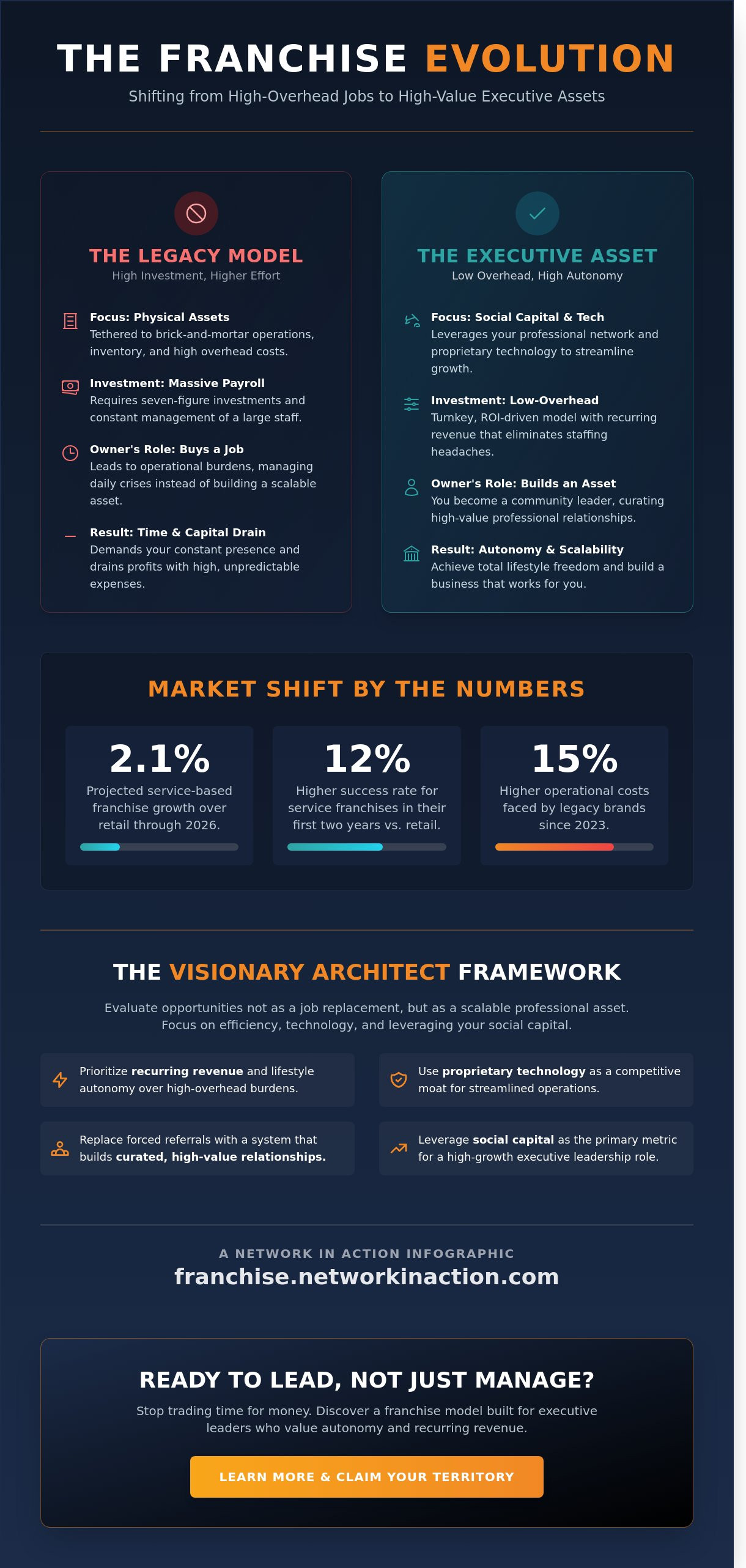
This guide reveals how to identify the best of franchise opportunities in 2026 by shifting your focus from physical assets to social capital and proprietary technology. According to the International Franchise Association, service-based franchises are projected to outpace retail growth by 2.1% through 2026. You'll discover a turnkey, ROI-driven model that replaces staffing headaches with recurring revenue and total lifestyle autonomy. This analysis explores how to leverage professional status to build a scalable business that works for you, rather than the other way around. It's time to stop managing overhead and start leading a professional community.
Key Takeaways
- Move beyond superficial rankings to identify the best of franchise opportunities that prioritize recurring revenue and executive-level lifestyle autonomy over high-overhead operational burdens.
- Apply the "Visionary Architect" framework to evaluate business efficiency, ensuring your investment builds a scalable professional asset rather than a time-consuming job.
- Discover how proprietary technology creates a competitive moat by streamlining operations and allowing for a rapid, turnkey launch into your local market.
- Contrast the inefficiencies of legacy networking organizations with a modernized, results-oriented system that replaces forced referrals with curated, high-value professional relationships.
- Learn to leverage social capital as a primary metric for ROI, transforming traditional business development into a high-growth executive leadership role.
Defining the 'Best' Franchise in 2026: Moving Beyond Traditional Rankings
Traditional franchise rankings are fundamentally broken. They reward the sheer volume of units rather than the actual profitability or lifestyle flexibility afforded to the owner. For a high-level executive, a brand with 5,000 locations isn't an opportunity; it's a management nightmare. In 2026, the best of franchise opportunities aren't found in labor-heavy retail or high-overhead food services. They exist in lean, high-margin models that leverage intellectual capital and relationship-driven assets.
While understanding the franchise model is the first step, interpreting the data through an executive lens is what separates a job-replacement from a wealth-building asset. The 2026 market demands a balance between predictable, recurring revenue and the autonomy to lead without being tethered to a physical storefront. You aren't looking for a "business in a box" to manage; you're looking for a scalable system to lead.
The Flaw in Volume-Based Rankings
High unit counts often signal market saturation rather than growth potential. Legacy brands face 15 percent higher operational costs in 2026 compared to 2023, driven by rising labor demands and supply chain volatility. These "old-school" models require massive overhead and constant oversight. When you evaluate the best of franchise options, look for emerging brands that offer "first-mover" advantages in protected territories. These opportunities provide the runway for rapid scaling that established giants simply can't match. An executive eye ignores the "Top 500" lists and focuses on Item 19 disclosures that prove unit-level profitability and low churn rates.
Identifying Executive-Level Opportunities
Executive-level franchises attract leaders who value time as much as ROI. Professional service models are currently outperforming traditional retail because they eliminate the "three Ms": maintenance, manufacturing, and massive staffing. These models focus on relationship-driven growth and proprietary technology to streamline operations. They allow you to build a community of high-value professionals rather than managing a revolving door of hourly employees.
Modern networking franchises, for example, offer a turnkey solution for those ready to lead their local business ecosystems. These models prioritize social capital as a primary metric for success. Before committing to a legacy industry, it's vital to check available territories to see where your leadership can make the most immediate impact. The shift toward intellectual assets means your value lies in your network and your ability to drive results, not in your ability to manage a supply chain.
Evaluating Franchise ROI: Capital Investment vs. ROI of Time
The Visionary Architect doesn't just calculate startup costs. They measure the efficiency of the profit engine. When you evaluate the best of franchise opportunities, the real metric isn't the initial investment listed in a disclosure document. It's the ratio of your time to your net income. Many entrepreneurs fall into the trap of buying a job. They spend $300,000 to manage a staff of 20 and clear a modest salary. A professional asset, by contrast, scales without a linear increase in your hours.
Low-overhead models provide a faster path to break-even. In 2023, service-based franchises showed a 12 percent higher success rate in their first two years compared to retail-heavy models. This speed is driven by recurring revenue streams. Monthly membership dues create a predictable cash flow that traditional transactional businesses lack. You aren't starting at zero every month. You are building on a foundation of consistent, reliable income.
The Hidden Cost of Traditional Operations
Legacy networking organizations and brick-and-mortar franchises often rely on three anchors: staffing, inventory, and real estate. These costs drain your margins before you ever see a profit. According to the official FTC guide, understanding these financial obligations is vital for due diligence. Modern, technology-enabled platforms eliminate the need for massive administrative teams. By automating member tracking and communication through proprietary technology, you reclaim 15 to 20 hours of your work week. This lifestyle-friendly factor is a core component of ROI. If a business doesn't give you back your time, it isn't an investment. It's a burden.
Leveraging Social Capital as a Business Asset
Your professional network is the most valuable tool in your toolkit. Relationship-driven growth removes the friction of expensive cold prospecting. In the best of franchise models, you aren't selling a product. You are curating a community of high-level professionals. This approach ensures that your growth is organic and sustainable. When you focus on a Referral Marketing Strategy: Unlocking Growth through Trust and Connections, you turn your social capital into a measurable business asset. You eliminate the need for a $5,000 monthly ad spend because your reputation does the heavy lifting.
To see how this model fits your goals, you might consider downloading the franchise kit to explore the data.
The Modern Evolution of Networking: A Case Study in Efficiency
Networking evolved. The days of handing out stacks of business cards at noisy, disorganized mixers are over. Modern business owners don't have time for fluff; they need systems that deliver measurable results without compromising their calendars. Traditional networking models are failing because they rely on outdated, manual processes that drain time without guaranteeing a return on investment. You need a curated community, not just a crowded room. To find the best of franchise opportunities in this sector, you must look for models that treat social capital as a serious business asset.
The Problem with Outdated Networking Models
Legacy networking organizations operate on a 1980s playbook. They demand weekly attendance at dawn, forcing high-level executives to choose between a rigid schedule and actual business growth. This clunky, manual approach lacks integrated technology for tracking ROI, leaving members guessing about the value of their participation. When the leading brand in the space prioritizes quantity, the membership pool dilutes. You end up in a room with junior salespeople rather than decision-makers. These organizations often suffer from several core flaws:
- Rigid Structures: Weekly requirements act as a barrier to high-level professionals who travel or manage large teams.
- Manual Tracking: A lack of proprietary technology means referrals and closed business are tracked on paper or spreadsheets.
- Forced Referrals: Members are pressured to provide leads regardless of quality, which erodes trust and professional credibility.
- Quantity over Quality: High member counts are prioritized over the actual professional caliber of the individuals in the room.
What a Modernized Model Looks Like
Efficiency defines the modern professional community. Instead of the "forced referral" systems found in legacy groups, a modernized model relies on organic, trust-based growth. Meetings happen once a month, not once a week. This shift respects your calendar while ensuring that every interaction is high-impact. When evaluating newer franchise opportunities, savvy investors look for this kind of disruption. The best of franchise options today leverage technology to keep members connected 24/7, allowing for real-time collaboration without the need for constant physical presence.
Proprietary technology replaces the manual clunkiness of the past. A dedicated platform allows members to track every referral and dollar earned, providing a clear picture of their networking ROI. This is the future of professional connection. It's a system built for the executive who values scalability and recurring revenue. If you're ready to lead a group of high-level professionals, you can download a franchise kit to see how this model scales. This isn't just about meeting people; it's about mastering a sophisticated system that creates long-term influence and professional freedom.
Key Indicators of a High-Growth Executive Franchise
Identifying the best of franchise opportunities requires looking past flashy marketing to the underlying engine. High-level professionals don't just want a business; they want a scalable asset that leverages their existing expertise. A high-growth model must offer a competitive moat through proprietary technology and a turnkey system that removes the friction of starting from zero. You need a model that generates immediate community impact without a long, painful ramp-up period. True executive franchises focus on high-margin results rather than low-value administrative tasks.
Technology as a Differentiator
Never buy a franchise that relies on manual spreadsheets or outdated software. Legacy networking organizations often force members to track referrals on paper or through clunky, non-intuitive portals. This is a growth killer. The best of franchise systems use automated referral tracking and member management to increase franchisee margins. A unified platform is essential for multi-unit management. It allows you to oversee several territories from a single dashboard, ensuring that your overhead doesn't balloon as your empire expands. This technology-forward approach turns social capital into a measurable, ROI-driven asset.
Training and Ongoing Support Systems
High-level professionals require a different caliber of onboarding. You don't need a basic sales script; you need a strategic framework that bridges the gap between corporate experience and business ownership. Effective training focuses on the "modernized" networking approach, which rejects the rigid, transactional nature of traditional networking. A peer-to-peer support network within the system is equally vital. It provides a sounding board of other elite entrepreneurs who understand the nuances of high-growth leadership. This collaborative environment ensures you are never building in isolation.
Scalability is the ultimate litmus test for any executive investment. If your overhead grows at the same rate as your revenue, you haven't bought a business; you've bought a high-stress job. The superior model allows for territory expansion through lean operations. By leveraging a centralized tech stack, you can scale across multiple regions while maintaining a lifestyle-friendly schedule. This focus on recurring revenue and autonomy is what defines the next generation of professional services. Download the NIA Franchise Kit to see modern support in action and discover how to build your own high-growth community.
Ready to see if your market is open for a more sophisticated model? Explore available territories to start your journey toward networking evolved.
Network In Action: The Result-Oriented Path to Business Ownership
The networking industry is undergoing a massive shift. Legacy networking organizations have relied on rigid, manual systems for decades. These outdated models often feel like a second job rather than a growth strategy. Network In Action (NIA) offers informed disruption by replacing forced referrals and weekly time commitments with a sophisticated, tech-enabled platform. For professionals evaluating the best of franchise opportunities, NIA stands out as a high-margin, recurring revenue model that prioritizes efficiency over activity.
The NIA advantage is built on three pillars that solve the friction points of traditional groups:
- No Forced Referrals: Quality replaces quantity. Members refer based on genuine trust, not a mandatory quota.
- Monthly Meetings: High-level executives don't have time for weekly breakfasts. NIA meets once a month, respecting the schedule of busy leaders.
- Proprietary Technology: A custom-built platform tracks ROI, manages referrals, and keeps members engaged between meetings.
This model allows you to position yourself as a community leader. You aren't just joining a club; you're owning a network. It's a strategic move for those ready to stop prospecting and start presiding over a room of high-caliber professionals.
A Business Model Built for Freedom
Aspiring entrepreneurs often get trapped in businesses that own them. The NIA model is different. It's designed for lifestyle autonomy. By leveraging technology to automate administrative tasks, franchise owners focus on community leadership and strategic growth. This structure provides the time freedom necessary for family-oriented leaders to thrive while building a scalable asset. The proprietary platform drives member satisfaction by making the networking process seamless and measurable. To understand the strategy behind this shift, read this Free Book on Modern Networking for a deeper strategic dive.
Securing Your Territory in 2026
By 2026, the demand for curated, high-trust professional communities will reach an all-time high. As digital noise increases, the value of a vetted, human-centric network becomes the ultimate currency. This makes the current window the ideal time to secure your market before competitors realize the potential of relationship-driven service franchises. You can check for Available NIA Territories in your region to see where you can establish your footprint. Contact Network In Action today to align your executive skills with a modern business model that turns social capital into a professional legacy.
Secure Your Position in the Next Era of Business Growth
The landscape of business ownership has shifted. High-level professionals no longer settle for the rigid, time-consuming structures found in legacy networking organizations. Success in 2026 requires a model that prioritizes the ROI of time through a proprietary ROI-driven technology platform. You need a system that replaces forced referrals with curated, high-quality relationships that actually convert. Efficiency isn't just a goal; it's the baseline for any serious executive investment.
Network In Action has been redefining networking since 2015, proving that scalability and professional freedom aren't just buzzwords. With over 150 locations worldwide, this model offers the recurring revenue and lifestyle autonomy that modern leaders demand. When evaluating the best of franchise opportunities for the coming year, the focus must remain on measurable results and disruptive efficiency. Don't waste another hour on outdated networking models that don't respect your schedule or your expertise. It's time to leverage a turnkey solution designed for the sophisticated architect of business communities.
Discover the future of professional networking and download your franchise kit today.
The path to community leadership and unparalleled professional influence is waiting for you to take the lead.
Frequently Asked Questions
What is the best franchise to own for a first-time executive owner?
The best of franchise for a first-time executive owner is one that leverages existing professional capital and minimizes operational friction. Low-overhead models focused on business-to-business services allow you to transition from the corporate suite to business ownership without the headaches of inventory or massive real estate leases. These models prioritize recurring revenue and high-margin service delivery. This ensures your time is spent on leadership rather than micro-managing a large hourly workforce.
How do I evaluate the ROI of a service-based franchise?
You evaluate the ROI of a service-based franchise by calculating the lifetime value of a client against the cost of acquisition and monthly overhead. Outdated networking models often fail here because they demand excessive time for low financial returns. A modern, tech-enabled franchise focuses on high-impact hours and scalable systems. Look for a 24-month horizon where the business generates consistent cash flow while requiring less than 20 hours of direct involvement per week.
What is the average startup cost for a high-level professional franchise?
High-level professional franchises typically require a total investment ranging from $50,000 to $150,000 according to 2024 industry data from the International Franchise Association. This range covers the initial franchise fee, working capital, and technology setup costs. Unlike brick-and-mortar retail franchises that often exceed $500,000 in startup costs, professional service models offer a lean entry point. This lower barrier to entry allows you to allocate more capital toward growth and market penetration.
Can I run a networking franchise while keeping my current job?
You can manage a networking franchise while maintaining a current executive role if the model is designed for efficiency. Legacy networking organizations demand a rigid, full-time commitment that shackles owners to a specific schedule. Modern alternatives utilize automated systems and monthly rather than weekly meetings. This flexibility means you spend 10 to 15 hours a month on high-level facilitation while your proprietary technology handles the administrative heavy lifting in the background.
What makes a modern networking organization different from traditional models?
Modern networking organizations differ from traditional networking by prioritizing curated quality over raw member volume. While the leading brand relies on forced referrals and repetitive weekly meetings, modern systems use sophisticated algorithms to match professionals based on actual needs. This shift moves the focus from transactional lead passing to strategic relationship building. It's the difference between a high-pressure sales environment and a sophisticated executive boardroom experience.
How does proprietary technology impact the success of a franchise?
Proprietary technology acts as the central nervous system of a successful franchise, automating the tasks that usually drain a business owner's time. In the networking space, a custom platform tracks member engagement and ROI in real time, providing data that outdated networking models simply can't offer. This tech-forward approach eliminates the need for manual record-keeping. It ensures every interaction within the network is documented, measurable, and optimized for maximum professional impact.
What are the most profitable franchise sectors to watch in 2026?
The B2B service sector and tech-enabled professional networking are projected to be among the most profitable franchise sectors through 2026. Data from the 2024 Economic Outlook report suggests that as remote work remains a permanent fixture, the demand for structured, high-level professional communities will grow by 12 percent annually. Investing in the best of franchise opportunities within these niches allows you to capitalize on the increasing need for social capital and strategic business connections.
How do I determine if a franchise territory is available and viable?
You determine territory viability by analyzing the concentration of small to mid-sized businesses and the density of high-income professionals within a 20-mile radius. Most franchisors provide sophisticated mapping tools that use census data and business registration counts to identify hot markets. A viable territory isn't just an open zip code; it's a region with at least 5,000 active business entities. This ensures a deep pool of potential members for long-term scalability.