Why would a seasoned executive with a 20 year track record of managing multi-million dollar budgets struggle with the mechanics of funding a franchise? You've spent your career optimizing P&Ls and scaling departments, so you understand that capital efficiency is the only metric that truly matters. In 2026, successful ownership requires more than just a bank loan; it demands a sophisticated financial architecture. You likely realize that the traditional lending landscape is cluttered with high-overhead legacy models and opaque SBA regulations that can stall your transition from the C-suite to business ownership.
This guide masters the financial strategies required to move into franchise ownership with a high-ROI mindset. You'll gain a clear roadmap for capital acquisition that leverages existing assets like 401(k)s through ROBS while avoiding the inefficiencies of outdated business structures. This analysis explores how to identify low-overhead, high-margin opportunities that prioritize recurring revenue and scalability over physical infrastructure. This is the blueprint for deploying strategic capital into the future of professional networking.
Key Takeaways
- Transition from executive leadership to business ownership by mastering the strategic allocation of capital for modern, scalable territories.
- Identify high-impact vehicles for funding a franchise, including the SBA 7(a) gold standard and tax-free retirement fund rollovers.
- Compare the heavy overhead of legacy brick-and-mortar models against lean-capital service franchises to maximize your initial investment and long-term ROI.
- Follow a rigorous five-step roadmap to audit your financial standing and align your funding strategy with a lifestyle-friendly exit plan.
- Explore how recurring revenue models and proprietary technology disrupt traditional networking to create a high-efficiency, turnkey business system.
The Financial Architecture of Ownership: Funding a Franchise in 2026
Funding a franchise in 2026 is no longer about simply "buying a job" in a legacy industry. It's the strategic allocation of capital to secure a proven, scalable business system designed for the modern economy. While outdated networking models rely on manual processes and high overhead, the current landscape favors lean, service-based franchises that leverage proprietary technology. By mid-2026, economists project interest rates to stabilize around 3.5%, creating a prime environment for executives to pivot from corporate management to strategic ownership. This is the era of "Informed Disruption," where high-level professionals reject the status quo of inefficient, time-consuming business models in favor of streamlined, ROI-driven systems.
Transitioning from Corporate Employee to Strategic Owner
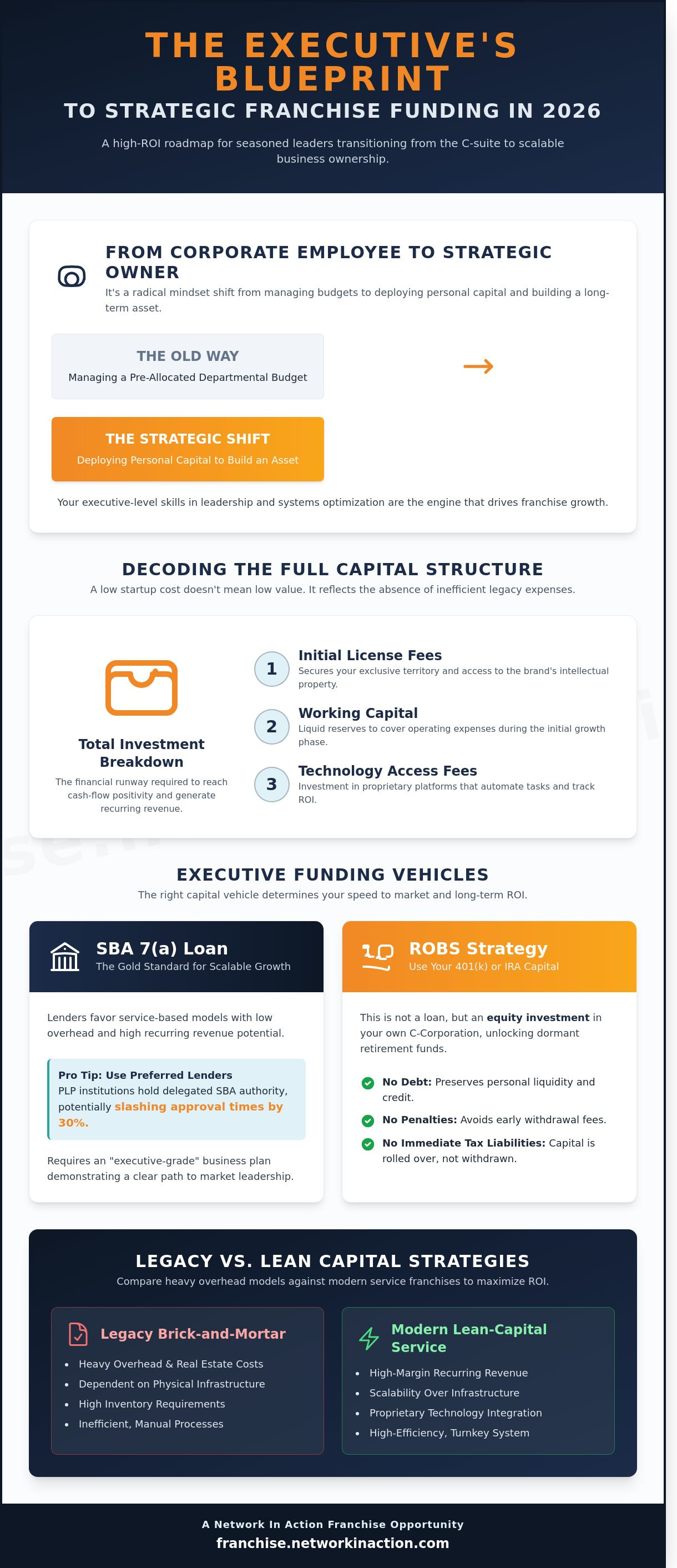
Moving from a corporate role to franchise ownership requires a radical mindset shift. You are no longer managing a pre-allocated departmental budget; you're deploying personal capital to build a long-term asset. Many high-level leaders realize they're ready to be an entrepreneur when they recognize that their executive-level skills are their most valuable hidden assets. Your experience in leadership, systems optimization, and relationship management is the engine that drives growth. By understanding the franchise model as a vehicle for professional leverage, you can transition from a salary-dependent employee to a community leader who controls their own time and income.
Total Investment vs. Initial License Fees
Successful candidates for funding a franchise look beyond the initial entry price to understand the full capital structure. A modern, tech-forward investment typically breaks down into three distinct components:
- Initial License Fees: The cost to secure your exclusive territory and access the brand's intellectual property.
- Working Capital: The liquid reserves needed to cover operating expenses during the initial growth phase.
- Technology Access Fees: The investment in proprietary platforms that automate administrative tasks and track ROI.
It's a mistake to assume that a "low startup cost" indicates low value. In a modernized, service-based model, lower costs often reflect the absence of "clunky" legacy expenses like heavy real estate or inventory. Total Investment is the comprehensive financial runway required to sustain operations until the business reaches cash-flow positivity and begins generating recurring revenue.
Executive Funding Vehicles: SBA Loans, ROBS, and Beyond
Capital is more than a resource; it's a strategic tool for market disruption. When you're funding a franchise, the vehicle you choose determines your speed to market and your long-term ROI. Modern executives don't just look for cash. They look for leverage that preserves personal liquidity while fueling rapid scalability. In the current 2026 economic environment, the distinction between a standard loan and a strategic funding plan is the difference between struggling for air and dominating a territory.
Leveraging the SBA 7(a) for Scalable Growth
The SBA 7(a) loan program remains the undisputed gold standard for funding a franchise. In 2026, lenders have sharpened their focus on service-based professional models that demonstrate low overhead and high recurring revenue potential. To bypass the bureaucratic gridlock typical of local banks, savvy executives prioritize Preferred Lender Program (PLP) institutions. These lenders hold delegated authority from the SBA. This status can slash approval times by 30% compared to standard processing. Your business plan must be executive-grade. It needs to reflect a sophisticated understanding of unit economics and a clear path to market leadership to secure the best terms.
ROBS: Using Your 401(k) Without Debt or Penalties
Rollovers as Business Startups (ROBS) allow you to unlock dormant 401(k) or IRA capital without triggering early withdrawal penalties or immediate tax liabilities. This isn't a loan; it's an equity investment in your own future. The mechanics involve establishing a C-Corporation that creates its own retirement plan, which then purchases stock in the new company. It's a high-leverage move for those who prefer betting on their own executive talent rather than the unpredictability of the stock market. Professional third-party administration is non-negotiable. Compliance with IRS and ERISA regulations is complex; a single filing error can jeopardize your tax-deferred status. Done correctly, it provides a debt-free start that accelerates your path to profitability.
Alternative Financing for High-Net-Worth Leads
High-net-worth candidates often look beyond traditional debt to maintain their investment momentum. A Securities-Backed Line of Credit (SBLOC) provides liquidity by leveraging your investment portfolio as collateral. This allows you to maintain market exposure and continue earning dividends while accessing the capital needed for a launch. Unlike a Home Equity Line of Credit (HELOC), an SBLOC is typically faster to secure and doesn't tie up your real estate assets. For those prioritizing speed, unsecured executive business loans offer a "fast-track" option, often funding in as little as 72 hours for qualified leads. As you evaluate these vehicles, consider how they align with the available territories that match your capital profile and growth ambitions.
Choosing the right vehicle is a calculation of risk, speed, and long-term equity. If you're ready to move from analysis to action, you can download a franchise kit to see how these funding strategies apply to a high-growth networking model.
Legacy Models vs. Modern Lean Capital Strategies
High-level executives aren't just looking for business ownership; they're looking for an exit from the inefficiency of traditional capital deployment. When you evaluate the landscape of funding a franchise, the distinction between "heavy" capital and "lean" intellectual property models becomes the primary driver of long-term profitability. Traditional brick-and-mortar operations require massive upfront investment in real estate, equipment, and inventory. These assets often become liabilities in volatile markets, tying up liquid capital in depreciating physical goods.
Modern lean strategies prioritize agility. By focusing on service-based models and proprietary technology, you eliminate the friction of physical overhead. This shift allows for a more strategic allocation of funds toward growth and member acquisition rather than maintenance and utilities. It's a move from being a property manager to becoming a community architect.
The Burden of Brick-and-Mortar Overhead
Commercial real estate costs and escalating labor expenses act as persistent ROI-killers for traditional franchisees. With commercial vacancy rates hitting 19.6% in 2024, the risk of long-term leases has never been higher. Massive staffing requirements don't just drain your bank account; they drain your most valuable resource: time. This is why savvy professionals are pivoting toward top executive business opportunities in 2026 that focus on intellectual property and high-level service delivery. These models eliminate the need for physical storefronts, allowing you to prioritize time freedom while maintaining a sophisticated professional footprint.
Disrupting the Traditional Networking Model
Legacy networking organizations often rely on a model that demands a heavy time commitment for a low-tech, manual experience. You'll find that "the leading brand" in the industry often forces members into rigid, weekly meetings that prioritize attendance over actual business results. These systems are clunky and transactional. NIA disrupts this stale environment by utilizing a monthly meeting model and proprietary technology to streamline connections. This approach reduces the "hidden costs" of member burnout and administrative busywork.
- Efficiency: Monthly meetings respect the schedules of high-earning professionals.
- Technology: Proprietary platforms replace manual referral tracking, reducing long-term operational expenses.
- Leadership: The "Visionary Architect" approach positions the franchisee as a community leader rather than a club secretary.
By funding a franchise that leverages tech-enabled referral platforms, you secure a business that scales without the need for additional headcount. NIA’s model maximizes member ROI through curated, high-quality interactions. It’s a modernized system designed for those who value results over ritual. This evolution ensures your capital works harder, providing a clear path to recurring revenue and lifestyle autonomy.
The 5-Step Roadmap to Securing Your Franchise Capital
Securing capital for a high-growth venture isn't a passive exercise; it's a strategic operation that demands precision. In the 2026 market, lenders aren't just looking at your bank balance. They're evaluating your ability to execute a sophisticated business model. Successfully funding a franchise requires a methodical approach to prove you're a low-risk, high-yield investment asset. Follow this roadmap to move from initial audit to full disbursement with speed and confidence.
- Step 1: Conduct a comprehensive personal financial audit and credit check to establish your baseline.
- Step 2: Align your funding choice with your desired lifestyle and exit strategy to ensure long-term ROI.
- Step 3: Secure professional business plan development and financial projections that stand up to institutional scrutiny.
- Step 4: Execute the application process with a specialized lender who understands the nuances of funding a franchise.
- Step 5: Finalize the Franchise Disclosure Document (FDD) review and ensure capital is liquid before finalization.
Preparing the Executive Financial Profile
Lenders today prioritize transparency and readiness over promises. You'll need to present three years of personal and professional tax returns, detailed P&L statements, and verifiable proof of liquidity. This documentation serves as the foundation of your credibility in a competitive lending environment. Beyond the numbers, you must present your new business owner skills as a primary risk-mitigation factor. Showing a history of leadership and strategic decision-making proves you can manage a disruptive model like Network In Action. Maintaining a FICO score above 700 is non-negotiable if you want to secure premium interest rates and favorable terms.
Navigating the FDD and Funding Contingencies
The Franchise Disclosure Document is your most powerful tool for due diligence. Pay specific attention to Item 7, which outlines the total initial investment, and Item 19, which provides the financial performance representations. These sections allow you to cross-reference your funding strategy against real-world performance data from existing territories. To see how these numbers translate into a scalable business, use the free book to understand NIA’s disruptive unit economics. Before you reach "Discovery Day," ensure your funding is liquid and ready for disbursement. Waiting until the final contract is signed to secure capital is a rookie mistake that stalls momentum. Successful executives close the deal with their capital already positioned for maximum impact.
Ready to see if your financial profile aligns with the future of networking? Explore our available territories today.
Maximizing ROI: Why NIA is the Smartest Financial Move
Strategic investors look beyond the initial cost of funding a franchise; they prioritize the velocity of return and the sustainability of the revenue stream. Network In Action (NIA) delivers a high-margin, recurring revenue model that bypasses the heavy overhead typical of traditional service industries. You aren't managing a fleet of vehicles, maintaining a massive inventory, or juggling a large, low-skill payroll. You're leveraging a sophisticated membership engine. This model creates a predictable cash flow that scales without a linear increase in operational headaches.
Proprietary technology drives this scalability. While legacy networking organizations rely on manual processes and rigid, outdated structures, NIA utilizes a tech-forward platform to streamline lead generation. This shifts the focus from administrative busywork to high-value relationship building. NIA is networking evolved. Owners build social capital that translates into long-term business equity. This asset becomes more valuable as the network grows, turning your territory into a fortress of professional influence.
- Monthly Meetings: NIA replaces the weekly legacy grind with high-impact monthly sessions. This respects the schedule of elite professionals and reduces the time commitment by 75 percent compared to traditional models.
- Tech-Enabled Ecosystem: A centralized platform manages referrals and tracks ROI, ensuring data-driven results for every member.
- Professional Curated Membership: Focusing on quality over quantity ensures a stable membership base with significantly lower churn than outdated networking groups.
The Economics of a Referral-Based Empire
A robust referral marketing strategy is inherently recession-proof. In economic downturns, businesses don't stop needing clients; they stop wasting capital on ineffective, cold advertising. They turn to trusted connections instead. NIA franchisees capitalize on this market shift by providing a tech-enabled environment that guarantees a higher ROI for members than old-school, transactional groups. This efficiency results in higher profit margins because the business operates with surgical precision rather than brute force. High retention rates are the natural byproduct of a system that values a member's time and provides measurable financial gains.
Securing Your Future: Next Steps for the Visionary Architect
The transition from corporate executive to community leader is a strategic move for those who value time freedom and professional autonomy. You've spent years building someone else's empire. Now you can build your own. Funding a franchise with NIA isn't just a career change; it's an investment in a lifestyle that rewards leadership and strategic vision. The next step is to evaluate the data and see how this modern model fits your financial goals. You are encouraged to download the franchise kit to review the comprehensive breakdown of the numbers and the proprietary system. Explore the opportunity. Align your capital with a business built for the 2026 economy.
Master Your Strategic Move Into 2026
The shift toward the next era of business requires a clean departure from outdated networking models that drain time without delivering measurable results. Strategic capital is no longer just about simple liquidity; it's about deploying resources into systems that scale with precision. By mastering the 5-step roadmap and leveraging executive vehicles like SBA loans or ROBS, you position yourself to lead a high-growth territory. Funding a franchise in today's market demands a focus on lean efficiency and proprietary technology that traditional organizations simply can't match.
Network In Action has already proven this disruptive model with over 150 locations worldwide. Its proprietary technology platform removes the manual friction of legacy networking, creating a turnkey solution for recurring revenue and elite professional connection. This isn't just another business venture. It's a calculated move into a modernized industry where ROI is the primary metric of success. The path to ownership is clear for those who value efficiency over activity.
Discover the future of networking—Download your NIA Franchise Kit today.
The window for market disruption is open for those ready to lead their communities with confidence.
Frequently Asked Questions
How much liquid capital is typically required for funding a franchise?
Liquid capital requirements for funding a franchise generally range from $50,000 to $150,000 for service-based models, while brick-and-mortar concepts often demand $250,000 or more. Most franchisors require this cash on hand to cover the initial fee and first six months of operating expenses. Having a 20 percent cushion beyond the minimum is a strategic move to ensure stability during the ramp-up phase without compromising your personal financial security.
Can I use my 401(k) to fund a franchise without paying early withdrawal penalties?
You can utilize your 401(k) to fund a business without early withdrawal penalties by using a Rollover for Business Startups (ROBS) structure. This strategy allows you to invest retirement funds into your own franchise corporation, providing debt-free capital for funding a franchise. It’s a popular path for executives; over 10,000 entrepreneurs used ROBS in 2023 to bypass the 10 percent early withdrawal tax while maintaining their investment's tax-deferred status.
Is an SBA loan the best option for a service-based business networking franchise?
An SBA 7(a) loan is a viable option for a service-based business networking franchise, though it often requires more collateral than necessary for low-overhead models. These loans offer 75 percent to 90 percent financing with terms up to 10 years. For a high-margin model like Network In Action, many executives find that ROBS or personal lines of credit offer faster execution and fewer restrictions than the 90 day SBA approval cycle.
What is the difference between franchisor financing and third-party lending?
Franchisor financing involves borrowing capital directly from the brand owner, whereas third-party lending comes from banks, credit unions, or private investors. Internal financing often features streamlined approvals but might cover only the franchise fee. Third-party lenders provide broader capital for working expenses and equipment. Choosing the right mix depends on your balance sheet and the specific 2026 interest rate environment, which dictates your long-term debt obligations.
How does a low-overhead model like Network In Action compare to brick-and-mortar ROI?
Network In Action offers a significantly faster path to ROI compared to brick-and-mortar models because it eliminates high fixed costs like commercial rent and inventory. While a retail franchise might take 24 to 36 months to reach break-even, a technology-led networking model focuses on recurring revenue from the start. You're investing in social capital and proprietary technology rather than expensive real estate, maximizing your profit margins and scalability.
What happens if my credit score is below 680 when seeking franchise funding?
Seeking franchise funding with a credit score below 680 typically requires a higher down payment or additional collateral to offset the lender's perceived risk. Most traditional lenders view 680 as the baseline for competitive rates. If your score is lower, consider alternative funding like ROBS, which doesn't depend on credit history, or partner with a co-investor who brings a stronger financial profile to the application to secure better terms.
How long does the typical franchise funding process take from application to closing?
The typical franchise funding process takes between 45 and 90 days from the initial application to the final closing. ROBS transactions move the fastest, often completing in under 21 days because they involve your own assets. SBA loans sit at the longer end of the spectrum, requiring extensive documentation and a multi-stage review. Starting your financial preparation three months before signing a franchise agreement ensures you don't miss key growth milestones.
Why do lenders prefer franchises over independent startups for small business loans?
Lenders prefer franchises because they operate on proven systems with documented success rates, reducing the bank's risk compared to unproven independent startups. A 2023 study showed that franchised businesses have a significantly higher five-year survival rate than independent ventures. The existence of a turnkey model and professional support makes the loan a safer bet for financial institutions. They value the predictability of a brand that has already solved market inefficiencies.