The era of the labor-intensive, high-overhead franchise is dead. For decades, executives seeking an exit from the corporate grind have been sold on the idea that success requires managing fifty employees or maintaining massive physical storefronts. When you ask yourself what's the best franchise to own in 2026, the answer isn't found in a fast-food kitchen or a cleaning crew. It's found in the ownership of social capital and high-level professional influence.
You already know that trading sixty hours a week for a paycheck is a losing game. It's time to demand a business model that scales without sacrificing your sanity. This guide provides the definitive framework for identifying high-ROI opportunities that replace traditional labor with sophisticated systems. You'll learn how to transition from a corporate cog to a community leader by leveraging a model built on predictable recurring revenue and lifestyle autonomy. This executive selection guide breaks down the 2026 market shift toward tech-enabled networking and explains why legacy networking organizations are failing the modern entrepreneur.
Key Takeaways
- Move beyond legacy metrics like unit count to evaluate franchises based on ROI-driven models that prioritize lifestyle autonomy and professional influence.
- Discover what's the best franchise to own in 2026 by identifying opportunities that replace labor-heavy retail with strategic, high-level networking assets.
- Learn to identify the hidden costs of legacy networking organizations and why modern, tech-enabled platforms deliver superior value for sophisticated entrepreneurs.
- Analyze the shift from executing for others to owning for yourself by leveraging a curated membership model that builds authority and recurring revenue.
- Master the financial feasibility of your investment by distinguishing between deceptive low-cost entry fees and long-term scalability through proprietary technology.
Defining the Best Franchise to Own: Beyond Simple Revenue
The landscape of business ownership has shifted. By 2026, the old guard of franchising, defined by massive unit counts and heavy physical footprints, has lost its luster. For the modern executive, determining what's the best franchise to own requires a move away from buying a job toward securing a high-leverage asset. Traditional models often trap owners in a cycle of labor management and high overhead. Modern investors prioritize systems that scale through proprietary technology and strategic relationships instead of raw headcount.
A deep understanding the franchise model reveals that the most successful ventures in 2026 aren't necessarily the ones with the most storefronts. They're the ones that offer the highest return on energy. High-level professionals are abandoning brick-and-mortar investments in record numbers. Data from the last two years shows a 15 percent increase in executive interest for service-based, tech-enabled models. Physical real estate is often a liability. The best path forward involves lean operations that maximize social capital and professional influence.
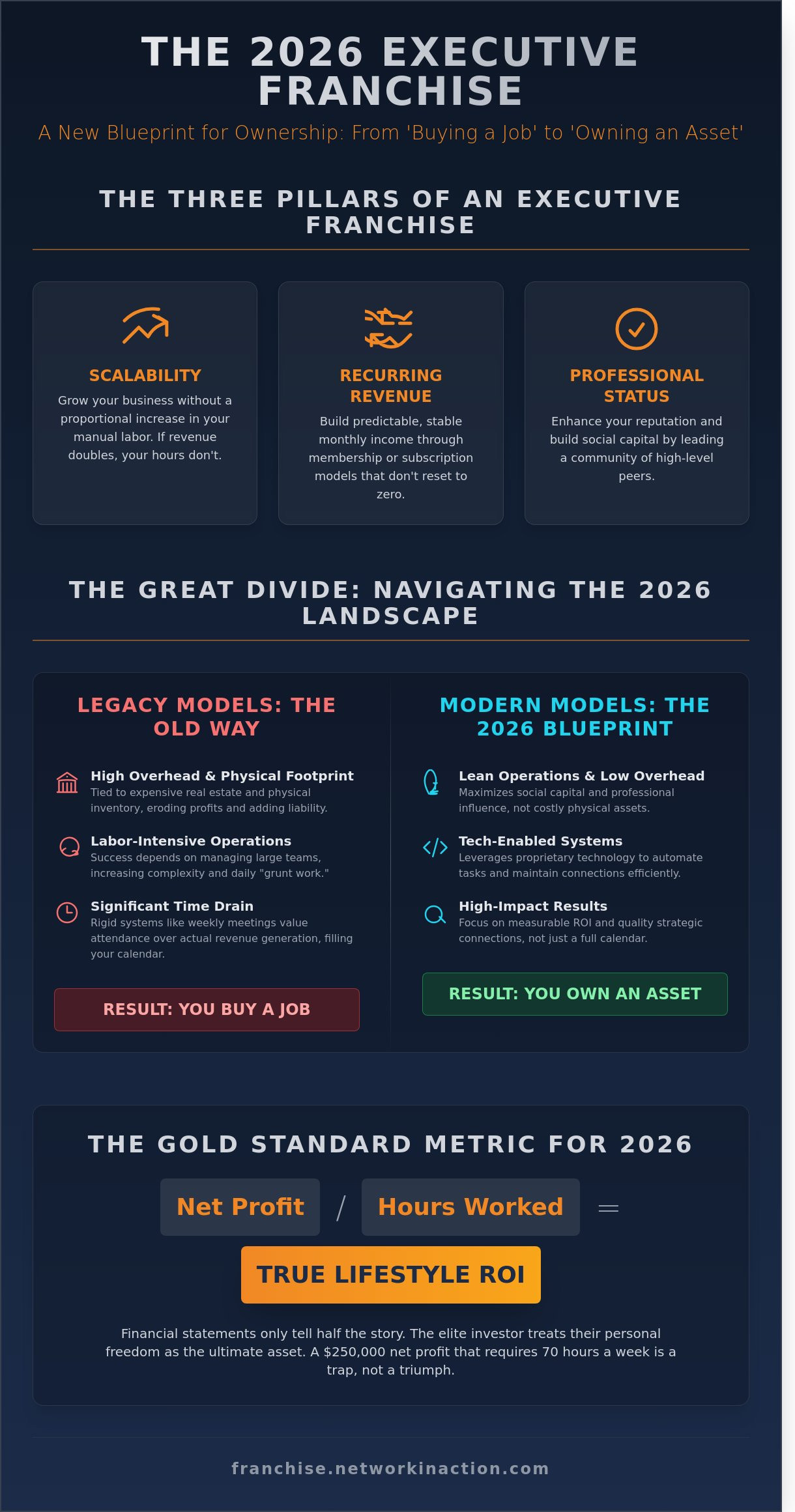
The Three Pillars of an Executive Franchise
- Scalability: The business must grow without demanding a proportional increase in your manual labor. If doubling your revenue requires doubling your hours, you haven't built a business; you've built a cage.
- Recurring Revenue: Focus on models that provide predictable monthly income. Stability in 2026 comes from subscription-based or membership-driven cash flow that doesn't reset to zero every month.
- Professional Status: Your franchise should enhance your reputation. Leading a community of high-level peers provides more social capital than managing a retail staff or a delivery fleet.
Evaluating the ROI on Your Time
Financial statements only tell half the story. The elite investor looks at "Net Profit per Hour Worked" as the primary success metric. If a franchise nets $250,000 annually but requires 70 hours a week, the hourly rate is lower than many mid-level corporate roles. Lifestyle-friendly models prioritize efficiency. They leverage technology to automate the administrative "grunt work," allowing you to focus on high-level strategy and relationship building. This approach moves the needle from simple income to true wealth.
The Time-ROI framework serves as the gold standard for 2026 franchise evaluation because it treats your personal freedom as the ultimate asset.
When you ask what's the best franchise to own, you're really asking which model allows you to maintain your executive identity while shedding the corporate grind. Outdated networking models and rigid retail structures fail this test. The future belongs to the visionary architect who builds a business around their life, not a life around their business.
Traditional vs. Modern Franchise Models: Navigating the 2026 Landscape
Selecting a business in 2026 requires a sharp departure from 20th-century logic. High-level executives often ask what's the best franchise to own, but the answer depends entirely on your tolerance for operational friction. Legacy networking organizations and labor-heavy retail models carry hidden costs that erode both your time and your bottom line. Modern entrepreneurs are pivoting toward lean, tech-enabled systems that prioritize high-impact results over physical presence. This shift represents a fundamental move from "buying a job" to "owning a system."
The Pitfalls of Legacy Networking Organizations
Traditional networking models are failing tech-savvy professionals. These rigid, transactional systems value attendance over actual revenue generation. Weekly meetings create a significant time drain, often forcing members to prioritize showing up over strategic growth. These legacy networking organizations struggle to adapt to the speed of modern business because their structures are built on manual tracking and forced referrals. By contrast, monthly, tech-enabled models leverage proprietary technology to maintain connections without the administrative bloat. This shift ensures your social capital produces a measurable ROI rather than just a full calendar.
Why Brick-and-Mortar is No Longer the Default
The 2026 landscape is unforgiving to businesses with massive physical footprints. Commercial real estate costs have risen significantly; physical inventory management often results in slim profit margins that barely cover the electric bill. Service-based franchises offer a superior alternative. They provide recurring revenue with minimal overhead, allowing you to focus on community leadership rather than facility maintenance. Before committing capital, consult the consumer's guide to buying a franchise to understand the financial implications of different asset classes.
Comparing service-based margins against the low profits of food and retail is essential for any serious investor. You should review this guide on how to evaluate available franchise opportunities to ensure your selection aligns with your lifestyle goals. When you strip away the need for a storefront, you strip away the biggest barrier to scalability.
Owning a business doesn't have to mean managing 50 employees. The most successful 2026 models allow for high scalability with a minimal headcount. This lean approach eliminates the headaches of traditional HR while maximizing your personal freedom. You can build a powerhouse business by leveraging a network of professionals rather than a revolving door of hourly staff. If you're ready to explore a more efficient path, you can download the franchise kit to see how modern networking facilitates this elite lifestyle.
The Rise of Professional Networking Franchises
Networking is no longer a casual social hobby or a morning coffee ritual. In the high-stakes business environment of 2026, it has evolved into a strategic business asset. This shift represents an informed disruption of the industry, moving away from the inefficiency of legacy networking organizations toward a model built on measurable results. When executives ask what's the best franchise to own, they increasingly look toward sectors that prioritize efficiency and high-level connections over volume and vanity metrics.
The networking industry remains remarkably recession-resistant. During economic downturns, the demand for high-quality, vetted referrals actually intensifies. Businesses cannot rely on expensive ad spend or cold prospecting when budgets tighten; they turn to trusted relationships. This constant demand ensures that a well-structured networking franchise provides a stable foundation for growth. Data from the last decade shows that referral-based businesses often thrive when traditional marketing channels fail, making this a secure play for the long term.
Owning the Network vs. Just Participating
Most professionals spend their careers as participants, paying dues to join groups where they have little control over the quality of the room. Moving from a member to a Visionary Architect changes the dynamic entirely. You stop chasing leads and start curating the community. This role allows you to leverage your existing professional social capital to build a scalable, recurring revenue stream. It's a transition from being a worker in the network to being the owner of the infrastructure. For those conducting deep due diligence, the FTC's guide to buying a franchise provides a framework for evaluating the financial and legal obligations of such an investment. You can find more details on high-performance models in our Top Ten Franchises for Executives: The 2026 ROI-Driven Selection Guide.
Technology as a Force Multiplier
Traditional networking is plagued by manual grunt work, such as paper-based referral tracking and clunky email chains. Modern platforms have eliminated these bottlenecks. Proprietary technology serves as a force multiplier, allowing a single franchise owner to manage up to 10 separate referral groups effortlessly through automated reporting and streamlined communication tools. This tech-forward approach ensures that the focus remains on ROI and data-driven results rather than administrative tasks. By tracking every referral and closed deal, the platform maintains a high-quality membership base that values transparency. This is the future of networking. It's why savvy investors believe this is what's the best franchise to own for those who value time freedom and professional influence.
Financials and Feasibility: What You Need to Know Before Investing
Investment decisions require more than a cursory glance at a disclosure document. When you evaluate what's the best franchise to own, you must look past the initial price tag to the underlying economic engine. A professional service franchise operates on a different logic than traditional retail. You aren't managing inventory or paying for high-rent storefronts. Instead, you're investing in a system designed for high margins and rapid scalability.
Assessing Initial and Ongoing Costs
The initial license fee is your entry ticket, but the recurring royalty structure defines your long-term partnership with the brand. Many entrepreneurs fall for the "low-cost" myth, choosing a franchise solely because the entry fee is minimal. This often leads to a lack of support, outdated tools, and limited growth potential. In 2024, a franchise without a robust proprietary technology stack is a liability. Your financial roadmap should account for platform access fees that power your daily operations and streamline your member management.
- Territory Reservation: Securing market exclusivity is vital for protecting your future revenue and establishing local authority.
- Technology Fees: Modern networking requires sophisticated ROI tracking tools that manual systems cannot replicate.
- Operational Efficiency: A professional service model allows you to grow without a proportional increase in overhead or headcount.
You can download the Franchise Kit for a detailed breakdown of how these economics work within a modernized networking framework.
Predicting Your Break-Even Point
The path to profitability is accelerated by a recurring revenue model. Retail models often suffer from 24 to 36 month break-even windows due to high overhead and debt service. When determining what's the best franchise to own for your specific lifestyle goals, the break-even timeline is often the deciding factor. Service-based models, especially those built on high-level professional memberships, shift the focus from constant hunting to sustainable harvesting.
Traditional networking models are often transactional and inefficient, relying on high-volume, low-value memberships. By contrast, a technology-enabled platform allows you to manage multiple groups with precision, shortening the ROI window significantly. To understand the mechanics of building a referral-based empire, you should check out the Free Book which outlines the strategic shift from manual labor to community leadership. This approach ensures that your time is spent on high-value activities rather than administrative tasks.
Ready to see how these financials align with your personal growth goals? Explore available territories to start your professional roadmap today.
Making the Move: How to Align a Franchise with Your Executive Goals
Transitioning from a corporate leadership role to business ownership is a profound psychological evolution. You're shifting from executing someone else's vision to becoming the architect of your own professional ecosystem. For high-level professionals asking what's the best franchise to own in 2026, the answer depends on leverage. You don't want a franchise that feels like a new job; you want a platform that multiplies your existing influence. Network In Action (NIA) offers this by allowing you to lead a curated, high-quality membership of business owners. This model builds your professional credibility while generating recurring revenue through a system built for efficiency.
Finding Your Perfect Territory
Evaluating a market requires a strategic look at regional economic data. You should target high-growth business hubs where traditional networking models have become stale and transactional. Data from 2024 indicates that over 80 percent of business owners prefer networking over cold prospecting, yet many are dissatisfied with the time commitment of legacy organizations. Securing exclusive rights in a thriving territory ensures you own the local market for modern, tech-enabled connection. You can Explore Available Territories to see where you can lead a sophisticated business community.
The Executive Roadmap to Ownership
A "Visionary Architect" vets a franchise based on its ability to scale without increasing manual labor. You must align your personal brand with an organization that prioritizes proprietary technology and measurable ROI. NIA’s model removes the friction of outdated networking practices, replacing them with streamlined systems that respect your time. This alignment is critical for maintaining an elite image while scaling your impact. To understand how this fits into your long-term strategy, review The Best Rated Franchise Opportunities of 2026: An Executive Selection Guide.
The transition concludes with a focused 90-day launch phase. This isn't a period of trial and error. It's a structured execution of a proven playbook. You'll secure your founding members and establish your presence as a community leader within your first three months. Ultimately, what's the best franchise to own is the one that empowers your lifestyle while growing your influence. You've spent years building value for others; now, it's time to build a legacy that belongs entirely to you.
Claim Your Lead in the New Networking Economy
Identifying what's the best franchise to own in 2026 requires a shift from legacy industries to tech-forward, high-efficiency models. Traditional networking organizations often trap owners in a cycle of weekly, low-value meetings that drain time without delivering clear growth. The modern executive demands a turnkey system that prioritizes professional credibility and measurable results over simple attendance. By focusing on relationship-driven growth and community leadership, you can transition from a corporate role to a position of local influence without the friction of outdated methods.
Network In Action has already established over 150 locations worldwide by disrupting the status quo. The brand's proprietary technology platform for ROI-tracking removes the guesswork that plagues older networking models. Its streamlined monthly meeting model ensures maximum executive efficiency, allowing you to build a scalable business while maintaining lifestyle autonomy. This is the future of networking: a sophisticated, results-oriented approach designed for the high-level professional. Don't settle for "clunky" systems when you can lead a curated community built on modern business logic.
Explore the NIA franchise opportunity and discover your path to time freedom.
The transition to business ownership is a strategic move that rewards those who act on proven data and superior systems.
Frequently Asked Questions
What is the most profitable franchise to own for a single operator?
The most profitable franchise for a single operator is typically a professional service model with low overhead and recurring revenue. When considering what's the best franchise to own, executives prioritize businesses that don't require expensive real estate or large payrolls. Networking franchises stand out because they leverage your existing professional capital. By focusing on high-margin memberships rather than physical goods, you maximize your ROI while maintaining a lean, efficient operation.
Can you own a franchise while keeping a full-time job?
You can absolutely own a franchise while maintaining an executive career if you choose a model designed for efficiency. Modern networking franchises require significantly less time than traditional businesses, with some owners dedicating just 20 to 30 hours per month to their groups. This semi-absentee approach allows you to build a secondary income stream without sacrificing your current role. It's about working smarter through technology rather than grinding through manual labor.
How much does the average franchise owner make in the professional services sector?
Franchise owners in the professional services sector see a wide range of earnings, with top performers often exceeding $150,000 in annual profit according to 2023 industry benchmarks. These figures depend heavily on your ability to scale and the recurring nature of the service. Unlike one-off retail transactions, professional services rely on long-term contracts. This stability creates a predictable revenue floor that many retail or food-service owners struggle to achieve.
What are the best low-overhead franchise opportunities for 2026?
The best low-overhead opportunities for 2026 are technology-enabled service franchises that function without a physical storefront. These models eliminate the 10% to 15% of gross revenue typically lost to commercial rent and utilities. By operating in a virtual or community-based capacity, you redirect those funds into marketing and growth. This lean structure is exactly what's the best franchise to own for those seeking high profit margins and rapid scalability.
Is it better to buy a new franchise or an existing one?
Choosing between a new or existing franchise depends on whether you prioritize territory control or immediate cash flow. New franchises allow you to hand-pick your market and build a culture from the ground up at a lower initial price point. Existing franchises offer historical data and established revenue but often come with a 2x or 3x valuation premium. Most growth-oriented entrepreneurs prefer new territories to maximize their long-term equity and expansion potential.
How do networking franchises differ from traditional networking groups?
Networking franchises differ from traditional networking groups by replacing volunteer leadership with professional, paid facilitators and proprietary technology. Legacy networking organizations often rely on rigid, forced referral systems that feel transactional and stale. Modern models focus on ROI-driven connections and curated memberships. This professional oversight ensures a higher quality of interaction, making the group a strategic asset rather than a weekly chore for busy executives.
What should you look for in a Franchise Disclosure Document (FDD)?
You must scrutinize Item 19 and Item 20 of the Franchise Disclosure Document to understand the true health of the system. Item 19 provides the financial performance representations, showing you what current owners actually earn. Item 20 tracks the growth and turnover of the franchise over the last three years. These sections reveal if the brand is expanding or if owners are quietly exiting, providing the hard data you need for a smart investment.
What is the typical timeframe from signing to opening a service franchise?
The typical timeframe from signing your agreement to hosting your first event is 60 to 90 days. Service franchises move much faster than brick-and-mortar concepts because you don't have to wait for construction permits or site build-outs. This accelerated timeline means you start generating revenue in the first quarter of operation. It's a turnkey process designed to get you into the market while your entrepreneurial momentum is at its peak.