The standard franchise playbook is broken. Most high-level professionals invest in legacy models only to realize they've purchased a high-overhead job rather than a scalable asset. You've likely seen the data showing that traditional brick-and-mortar operations often demand 60-hour work weeks just to maintain thin margins. It's time to demand a higher return on your most valuable resource: time.
This executive guide reveals how to identify the most lucrative franchise business ideas for 2026 by focusing on models that prioritize proprietary technology and lifestyle autonomy. You'll discover how to move past the inefficiency of traditional networking and manual labor models to build a business rooted in recurring revenue. We'll analyze the shift toward asset-light opportunities and provide the exact framework needed to leverage your professional network for maximum growth. The future of business ownership isn't about working harder; it's about deploying smarter systems that deliver measurable results.
Key Takeaways
- Identify the shift from capital-intensive brick-and-mortar models toward asset-light, service-oriented systems that prioritize executive-level scalability.
- Master the "Executive Filter" to evaluate modern franchise business ideas based on recurring revenue, proprietary technology, and lifestyle autonomy.
- Avoid the "Legacy Trap" by choosing modern operational models over rigid, outdated systems that demand manual labor and high overhead.
- Learn how to rigorously vet financial performance representations in Item 19 of the FDD to ensure long-term ROI and operational stability.
- Discover how leading a high-level professional network can transform your social capital into a scalable business asset and establish you as a community visionary.
The Evolution of Franchise Business Ideas in 2026
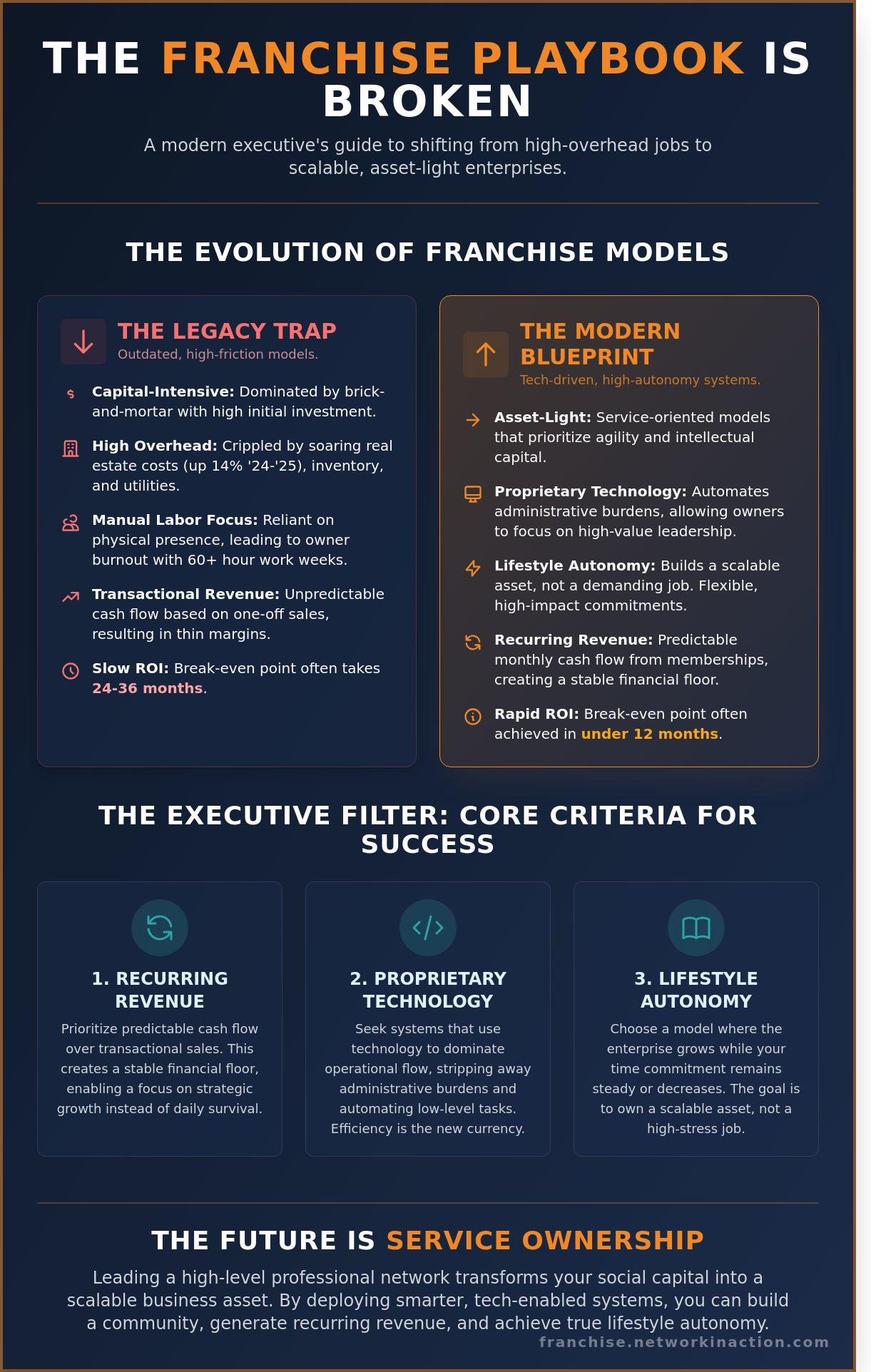
Franchise business ideas are no longer just about fast food or retail storefronts. They represent structured, high-velocity opportunities to scale proven systems using a franchisor's established brand and support infrastructure. By leveraging the franchising business model, savvy professionals can bypass the 90% failure rate typical of independent startups. In 2026, the market has undergone a radical transformation. The era of capital-intensive, brick-and-mortar dominance has faded. It's been replaced by asset-light, service-oriented models that prioritize agility and high margins over physical footprints.
Professional services now outpace retail in both growth and owner satisfaction. This shift is driven by a move toward intellectual capital over physical inventory. Industries once dominated by legacy networking organizations are facing informed disruption. Modern entrepreneurs aren't looking for a job; they're looking for a scalable platform that offers recurring revenue and lifestyle autonomy. Networking evolved from a social chore into a strategic business asset that delivers measurable results.
Why Traditional Models are Losing Ground
The 2026 economy has been unkind to "old-school" business structures. Commercial real estate costs in prime urban markets surged by 14% between 2024 and 2025, making high-overhead models a liability. Manual labor shortages continue to create friction for transactional businesses, leading to inconsistent service and shrinking margins. Savvy investors are pivoting toward recession-resistant service sectors where overhead is low and scalability is high. Traditional networking models that require high-pressure sales and rigid, weekly 7 AM commitments feel clunky and inefficient. These legacy networking organizations focus on quantity over quality, a tactic that fails to resonate with the high-level professionals of today. Investors now prioritize ROI-driven systems that value time as much as capital.
The Rise of the Tech-Enabled Service Franchise
Modern franchise business ideas leverage proprietary technology platforms to strip away administrative burdens. Technology doesn't just assist the business; it dominates the operational flow. Data-driven lead generation has replaced the exhausting grind of cold prospecting. This allows owners to focus on community leadership rather than clerical tasks. The most successful franchises in 2026 utilize sophisticated algorithms to match members and track social capital in real-time. Efficiency is the new currency. Monthly, high-impact meetings have rendered weekly requirements obsolete for busy executives. These streamlined systems allow for a lifestyle-friendly business model that doesn't sacrifice growth. For those ready to claim a stake in this evolution, checking available territories is the first step toward building a high-ROI professional community. The future of networking is here, and it's built on a foundation of technology and elite membership.
Core Criteria for High-Performance Executive Franchises
Selecting from various franchise business ideas requires an "Executive Filter" to strip away the noise. You aren't looking for a hobby; you're looking for a vehicle that converts professional capital into recurring wealth. A superior model prioritizes monthly recurring revenue over transactional one-offs. This creates a predictable financial floor, allowing you to focus on growth rather than survival. High-performance models also demand scalability. If your physical presence is required for every dollar earned, you've bought a high-stress job, not a business. The goal is to build a system where the enterprise grows while your time commitment remains steady or even decreases. Autonomy isn't just a perk. It's a requirement for the modern leader.
ROI-Driven Metrics for the Modern Owner
Smart entrepreneurs distinguish between being an employee of their own brand and being a true enterprise owner. In retail models, reaching a break-even point can take 24 to 36 months due to heavy overhead and inventory costs. Service-based models, especially those in the professional networking space, often reach that milestone in less than 12 months. When vetting a franchise opportunity, you must calculate your hourly value. If the system forces you into low-level administrative tasks, the ROI on your talent is negative. Modern systems automate the busy work so you can lead. You should look for systems that offer:
- Predictable cash flow through membership-based models.
- Low overhead with no requirement for expensive brick-and-mortar leases.
- Technology that replaces manual data entry and reporting.
Scalability and Geographic Freedom
Legacy networking organizations often tether owners to a single, hyper-local basement meeting room. Modern alternatives leverage technology to manage professional communities across entire regions. You should evaluate available franchise opportunities based on their ability to expand into multiple territories without doubling your workload. Territory-based models allow you to dominate a market while proprietary technology handles the member tracking and reporting. This shift from local-only to national-scale capability is what separates a modern franchise business ideas from outdated, manual-labor models. If you're ready to see how this works in practice, you can view available territories to see where your influence can grow.
Analyzing Franchise Categories: Service vs. Traditional Models
When evaluating franchise business ideas, the divide between brick and mortar and service based models is stark. Traditional food and beverage operations often demand capital investments exceeding $500,000 for equipment, real estate, and inventory. Service models flip this script. By removing the physical storefront, you eliminate the single largest drain on your ROI. Before committing capital, consult the SBA guide to buying a franchise to understand how control and overhead impact your long-term profitability. High level professionals now prioritize models that favor intellectual capital over physical assets.
Service-Based Franchises: Low Overhead, High Impact
Executive suite or home based models allow you to trade inventory for influence. Relationship driven growth replaces the massive monthly marketing budgets common in retail. You leverage your existing professional network to drive revenue, creating a business that is both lean and scalable. This shift is why elite professionals gravitate toward the top ten franchises that prioritize leadership over labor. These franchise business ideas focus on recurring revenue through high level community management, offering margins that traditional storefronts simply cannot match. It's about working smarter, using proprietary technology to automate the mundane while you focus on high value connections.
The Problem with Traditional Networking Groups
Many professionals fall into the "Legacy Trap" by joining outdated networking organizations. These legacy groups rely on rigid, thirty year old operational requirements that waste your most valuable asset: time. Forced referrals lead to low quality leads, while mandatory weekly attendance feels more like a chore than a strategic business move. It is a volume over value approach that fails the modern executive. In contrast, a modernized system values the quality of the connection over the quantity of the handshake.
- Inefficient Attendance: Weekly 7 AM meetings are a relic of the past that disrupt executive schedules.
- Forced Referrals: Quantitative quotas result in "trash" leads that damage professional credibility.
- Lack of Technology: Most traditional groups lack a centralized platform to track actual ROI for members.
- Rigid Structure: Outdated rules prevent the flexibility needed to run a modern, high growth business.
Community leadership is the new frontier for former executives who want to disrupt the status quo. You aren't just running a group; you're architecting a high performance ecosystem. By choosing a curated membership model, you ensure every participant is a decision maker. This creates a sophisticated environment where the focus remains on measurable results and sustainable growth. Networking evolved is not just a slogan; it is a requirement for the modern entrepreneur.
How to Vet a Franchise Opportunity for Long-Term Scalability
Smart entrepreneurs don't buy a job; they invest in a scalable asset. When evaluating various franchise business ideas, the difference between a high-growth vehicle and a stagnant legacy model lies in the data. Start with the Franchise Disclosure Document (FDD). Item 19 is your most powerful tool. It provides the financial performance representations that separate reality from marketing fluff. If a franchisor hides behind "averages" without clear breakdowns of high and low performers, it's a signal to dig deeper into their transparency standards.
Validation calls are your next tactical step. Don't let the sales team cherry-pick your contacts. Reach out to current owners and ask about the technology. Does the platform actually drive efficiency, or is it a digital paperweight? You need a turnkey experience that allows you to focus on growth, not troubleshooting software. A franchisor's commitment to proprietary platform development is a non-negotiable indicator of long-term viability. If they rely on third-party, off-the-shelf tools, they lack the agility to lead the market.
Due Diligence: Beyond the Sales Pitch
Effective vetting requires asking the hard questions. Reach out to existing franchisees and ask: "How many hours a week did you spend on administrative tasks in your first six months?" and "Does the proprietary technology save you at least 10 hours a week compared to traditional networking methods?" Identify red flags like rigid, legacy-style agreements that penalize innovation or stifle local leadership. Use a professional framework to project your potential earnings and ensure the numbers align with your lifestyle goals before signing. It's essential to analyze the competitive landscape in your desired available territories to ensure the market isn't saturated with transactional, low-value models.
Evaluating the Support Ecosystem
Support is more than a printed manual. It's an evolving ecosystem. Look for a franchisor that provides ongoing training that shifts with technological trends. In the networking industry, a "brand name" isn't enough. You need to determine if the franchisor provides actual lead generation or just a logo. High-level professionals demand an elite environment, not a transactional referral mill. Evaluate the quality of the peer network you'll be joining. You are looking for:
- Proprietary Technology: Systems that automate the "grunt work" of business management.
- Curated Membership: A focus on high-quality professionals rather than a "first come, first served" approach.
- ROI-Driven Metrics: Tools that allow you to track and prove the value of the network to your members.
Modern franchise business ideas must prioritize the owner's time. Ensure the training and onboarding process is a true 90-day ramp-up that covers both the technology and the psychology of community leadership. If the training hasn't been updated in the last 24 months, the model is already obsolete.
Discover how a modern, ROI-driven model outperforms the competition by exploring our available territories today.
The Future of Service Ownership: Leading Your Own Professional Network
Leading your own professional network isn't just about making connections. It's about controlling the local business ecosystem. High-level executives often search for franchise business ideas that leverage their existing social capital rather than requiring them to start from zero. Most low-cost options in the market feel like buying a job or a set of repetitive chores. Owning a network franchise is a different breed of investment. You aren't just attending meetings; you're the architect of local commerce. This role builds immediate professional credibility and influence within your city. You become the central hub for local business growth. It's a strategic shift from performing a repetitive activity to owning a scalable, recurring revenue asset that works for you.
Networking Evolved: The NIA Advantage
Outdated networking models rely on a rigid, weekly grind that usually leads to burnout for busy professionals. Network In Action (NIA) disrupts this legacy approach by prioritizing quality over quantity. By shifting to 12 high-impact monthly meetings per year, the model respects the schedule of high-level participants. The membership is curated, ensuring that 90% or more of participants are seasoned decision-makers who actually have the authority to refer business. NIA uses a proprietary technology-enabled platform to modernize the referral process. Members stay connected through a sophisticated app, removing the need for manual tracking or forced referrals. It's efficient. It's ROI-driven. It's built for the modern era. You should download the franchise kit to see the operational blueprints that make this modern system work.
Take Action: From Executive to Network Owner
Moving from an executive role to a network owner is a strategic play for lifestyle autonomy. You're no longer trading hours for dollars in a corporate silo or managing a massive overhead. Instead, you're building a community-driven business that scales through social capital and professional influence. This is one of the most sophisticated franchise business ideas for those who value impact and efficiency. The model focuses on measurable results rather than just attendance. It's time to stop participating in legacy networking organizations and start leading a modern alternative that produces real growth. Your next step is to explore available territories and start your discovery process today.
Secure Your Stake in the New Economy
The landscape for franchise business ideas has shifted permanently toward efficiency and high-level professional service. Success in 2026 requires moving past the rigid, time-consuming structures found in legacy networking organizations. You need a model that leverages technology to produce measurable growth without the burden of manual oversight. Network In Action has already proven this concept across more than 150 locations by replacing outdated tactics with a streamlined, tech-forward approach.
This ROI-driven model is specifically engineered for executives who demand lifestyle autonomy. It's a business that respects your schedule; there are no mandatory weekly meetings to drain your productivity. Instead, you'll use a proprietary technology platform to manage a curated community of elite professionals. It's time to trade the "old-school" grind for a scalable asset that builds long-term social and financial capital. You've spent years building your expertise, and now you can use it to lead a disruptive professional network. The opportunity to dominate your local market is waiting for those ready to embrace the evolution of connectivity.
Download your Franchise Discovery Kit to explore the future of networking
The future belongs to the architects of community, and your leadership is the missing piece.
Frequently Asked Questions
What are the most profitable franchise business ideas for 2026?
High-margin service models like professional networking and B2B consulting are projected to lead profitability in 2026. Data from the International Franchise Association suggests service-based sectors grow 3.5 percent faster than retail. These franchise business ideas succeed because they eliminate high rent and inventory costs. You focus on building social capital and leveraging technology to drive measurable ROI for members.
How do I choose between a retail and a service-based franchise?
Choosing between retail and service-based models depends on your desired lifestyle and capital risk. Retail requires physical storefronts and 60 to 80 hours of weekly oversight. Service-based franchises, particularly in the professional networking space, offer a business in a box that you can run from a home office. You trade high overhead for high-touch relationship building and executive leadership.
What is the average startup cost for an executive-level service franchise?
Executive-level service franchises typically require a total investment ranging from $50,000 to $150,000 according to 2024 industry benchmarks. This is significantly lower than the $500,000 minimum often required for casual dining or retail footprints. You're investing in intellectual property and systems rather than bricks and mortar. This lower entry point allows for a faster path to profitability and a higher long-term ROI.
Can I run a networking franchise while keeping my current job?
You can absolutely scale a networking franchise while maintaining your current professional commitments. Modern systems use proprietary technology to automate administrative tasks, meaning you only need 10 to 15 hours a week to manage a successful group. It's about working smarter. While legacy networking organizations demand constant manual labor, the NIA model is designed for the busy executive who values time freedom.
What makes a franchise 'recession-proof' in the current economy?
A franchise is recession-proof when it provides a service that businesses cannot afford to cut. During economic downturns, companies stop spending on cold ads and start relying on referral-based growth. Professional networking becomes a lifeline for business owners seeking high-quality leads. These franchise business ideas remain resilient because they solve the universal problem of client acquisition when budgets are tight.
How does a professional networking franchise generate recurring revenue?
Revenue flows through a membership subscription model that creates predictable, scalable income. Our technology-enabled platform automates the billing process, ensuring you spend time on relationships instead of chasing invoices. This recurring revenue model provides the financial stability that one-off service businesses lack. It transforms your professional network into a valuable, liquid asset that grows over time.
What kind of training is provided for new service-based franchise owners?
New owners receive comprehensive, turnkey training that covers everything from member recruitment to group facilitation. You'll master our proprietary technology during an intensive initial program and receive ongoing support through monthly coaching sessions. This isn't a figure it out yourself scenario. You get a proven roadmap that has been refined over a decade to ensure you hit your growth targets quickly.
Is it better to buy a new franchise or an existing territory?
Buying a new franchise territory allows you to build a culture from the ground up without the baggage of outdated networking models. While an existing territory offers immediate cash flow, it often comes with a premium price tag that can delay your ROI. Starting fresh gives you the flexibility to curate a high-quality membership base that aligns with your specific professional vision and leadership style.