The most expensive asset you own isn't your house or your investment portfolio; it's the time you're currently burning on inefficient, low-yield business models. You've likely noticed that the 62% of high-level professionals seeking new ventures in 2026 are no longer interested in the high-overhead, brick-and-mortar grind. You're looking for a vehicle that offers more than just a job title. You want a system that prioritizes executive-level ROI and true lifestyle autonomy. Identifying the best rated franchise opportunities requires a shift away from outdated networking models and toward tech-forward solutions that value your time as much as your capital.
You understand that manual prospecting is a relic of the past that simply doesn't scale. This executive guide promises to reveal the highest-rated franchise models for 2026 that focus on recurring revenue and community leadership without the burden of cold-calling or rigid, transactional environments. You'll learn how to leverage proprietary technology to disrupt the status quo and build a business that works for you. This analysis explores the specific frameworks that allow modern entrepreneurs to trade the 9-to-5 for a scalable, high-impact legacy.
Key Takeaways
- Stop chasing unit counts and start measuring "Lifestyle ROI" to ensure your next venture prioritizes profit over high-stress management.
- Discover why service-based models are outperforming traditional retail by eliminating inventory headaches and the "real estate trap."
- Learn to identify the best rated franchise opportunities by using a strategic framework that audits your professional capital against long-term recurring revenue.
- Replace the rigid, time-consuming requirements of legacy networking organizations with a modernized, tech-enabled system designed for high-level efficiency.
- Gain a competitive edge by leveraging proprietary technology to build a scalable professional community that focuses on actual ROI instead of forced referrals.
Defining 'Best Rated' in 2026: Beyond Brand Recognition
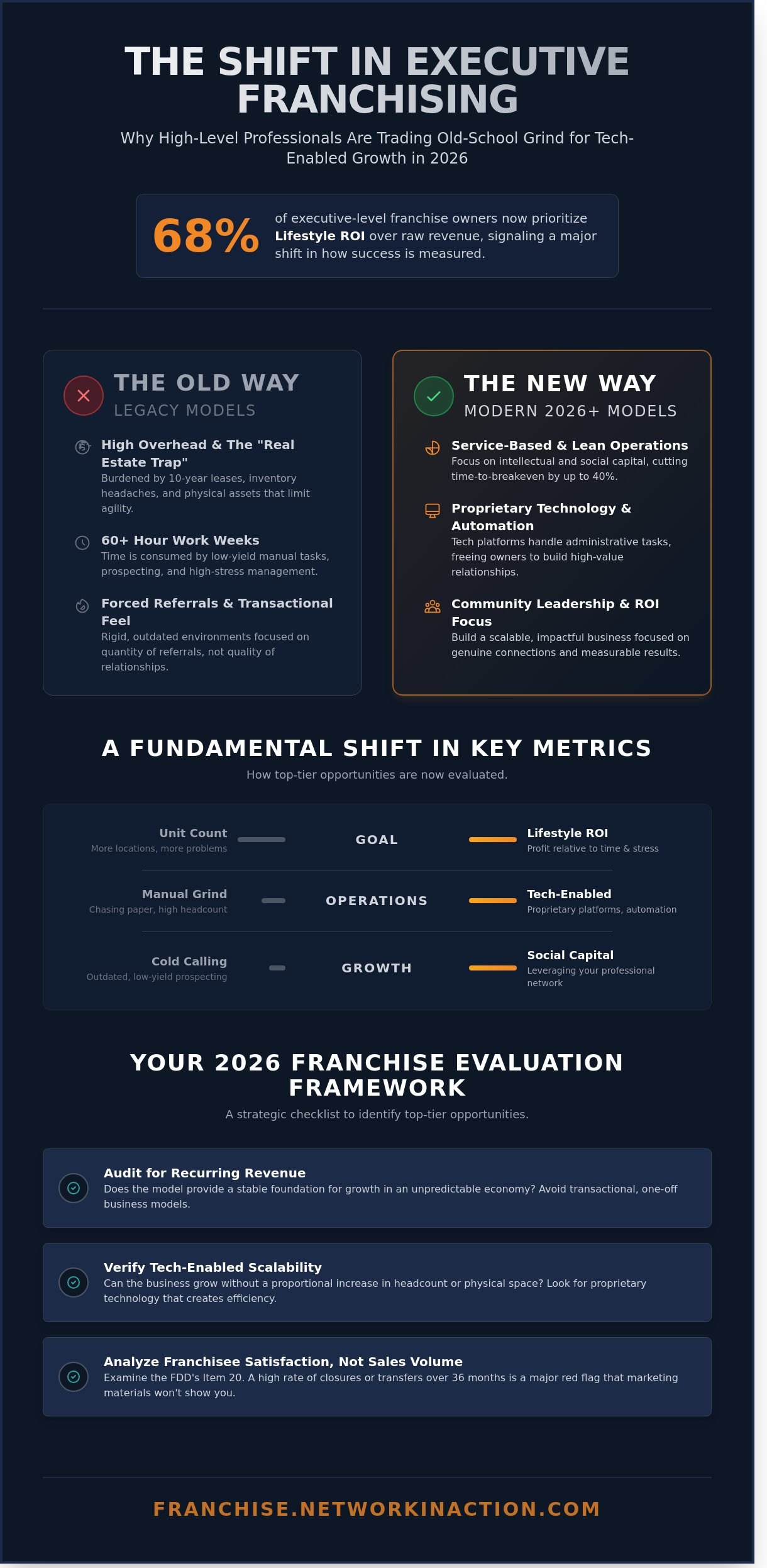
The era of chasing massive unit counts is over. In 2026, the best rated franchise opportunities are defined by operational efficiency, not just a physical footprint. Legacy networking organizations often boast thousands of locations, yet their franchisees frequently struggle with 60 hour work weeks and stagnant growth. A 2025 franchise sentiment report indicated that 68% of executive level owners now prioritize Lifestyle ROI over raw revenue. This shift measures success by profit relative to hours worked and stress levels, rather than just the size of the annual top line.
Before committing to a brand, it's vital to understand the foundational mechanics of the model. What is franchising? At its core, it's a vehicle for rapid, systems-based expansion; however, the 2026 version requires a tech-forward approach. Modern leaders demand proprietary technology platforms that automate administrative tasks. This separation allows owners to focus on high-value relationship building rather than chasing paper. Recurring revenue models provide the necessary floor for stability in an economic environment that remains unpredictable, ensuring that your business builds equity every month.
The 2026 Executive Franchise Scorecard
Top-tier opportunities in 2026 focus on scalability without proportional increases in headcount or physical square footage. High-level professional services rely on brand equity to open doors, but the actual growth comes from lean, tech-enabled systems. You don't need a massive staff to run a powerhouse business if your tools do the heavy lifting. Modern Franchise Excellence is the intersection of tech-enabled efficiency and relationship-driven growth.
Why Satisfaction Scores Matter More Than Sales Volume
High-growth brands frequently fail the franchisee satisfaction test because they prioritize expansion over support. Identifying the best rated franchise opportunities requires a deep dive into peer-to-peer validation. If existing owners aren't thriving, the brand's sales volume is a distraction. When you review a Franchise Disclosure Document (FDD), look beyond Item 19 financial representations. Examine Item 20 to track the rate of closures and transfers over the last 36 months. This data reveals the long-term health of the system better than any marketing brochure ever could.
Traditional networking models often feel transactional and rigid. To find a modern, superior alternative, you must look for brands that value your time and professional reputation. If you're ready to move beyond outdated networking models, you can check available territories to see where this disruption is taking hold. True success in 2026 isn't about being the biggest; it's about being the most efficient and impactful leader in your community.
The Rise of Service-Based Executive Franchises
High-level professionals are abandoning the "bricks and mortar" dream. It's too slow. It's too expensive. In 2026, the best rated franchise opportunities focus on intellectual capital over physical assets. Executives are pivoting away from food, retail, and hospitality because they're tired of the "real estate trap" and the endless inventory headaches that come with physical goods. By removing the need for a 10-year lease and a warehouse full of depreciating stock, you gain immediate agility. This lean approach allows for rapid market entry, often cutting the time to break even by 40% compared to traditional retail models.
Your most valuable asset isn't a storefront; it's your professional network. Modern service-based models allow you to monetize decades of social capital instantly. You don't need to wait for foot traffic when you already have a list of high-level contacts ready to engage with a sophisticated business solution. Before committing your capital, smart investors utilize Evaluating Your Options: A Strategic Decision Framework to ensure the underlying economics support their long-term lifestyle goals. The goal is to build a business that works for you, rather than becoming a prisoner to a commercial landlord.
White-Collar vs. Blue-Collar Franchise Models
The management demands of a professional service model are fundamentally different from labor-intensive industries. You aren't managing a shift or worrying about hourly turnover; you're operating as a Visionary Architect. This role involves leading a community of peers rather than supervising a crew. While blue-collar franchises focus on execution, white-collar models prioritize strategy and high-level relationship building. For a deeper dive into which models suit your specific background, check out our guide on the Top Ten Franchises for Executives.
Recurring Revenue: The Holy Grail of 2026 Ownership
Transactional sales are exhausting. If you have to start every month at zero, you don't own a business; you own a high-pressure job. The best rated franchise opportunities in 2026 utilize membership-based models to create predictable, scalable cash flow. This shift from one-off sales to recurring revenue provides the stability required for aggressive business planning. It transforms your role from a salesperson into a community leader, where the value you provide compounds over time. This structure is exactly what allows for genuine lifestyle autonomy. When you're ready to see how this model scales, you can download our franchise kit to explore the specific ROI metrics of modern networking.
- Low Overhead: Eliminate the burden of high-rent storefronts and utility costs.
- Scalability: Grow your territory through proprietary technology rather than more headcount.
- Professional Credibility: Leverage your existing executive status to lead high-level business groups.
- Efficiency: Focus on high-margin services that don't require complex supply chains.
Legacy vs. Modern: Why Traditional Networking Models Are Fading
Traditional networking is a relic. It relies on high-frequency, low-value interactions that drain an executive's most precious resource: time. Legacy networking organizations often prioritize attendance over impact, forcing members into a cycle of repetitive meetings that yield diminishing returns. This transactional approach feels forced and outdated in a business world that moves at the speed of light. Modern business owners demand ROI, not just donuts and business cards. They're looking for the best rated franchise opportunities that respect their professional standing and their calendars.
The Inefficiency of Outdated Networking Models
The opportunity cost of weekly, 7:00 AM meetings is staggering. For a professional billing $300 per hour, a year of mandatory weekly meetings represents over $15,600 in lost production time. Top-tier business owners are walking away from these rigid rules. They prefer monthly, high-impact interactions that respect their schedules and focus on substantial business growth. This shift toward "informed disruption" focuses on value exchange rather than meeting a referral quota. When you're evaluating franchise opportunities, you'll find that legacy models rarely account for the true cost of an owner's time. Modern executives don't need a social club; they need a strategic engine that delivers results without the fluff of forced referrals or mandatory attendance sheets.
Technology as the Great Differentiator
Manual tracking and paper-based referral systems are historical footnotes. The best rated franchise opportunities today leverage proprietary platforms to streamline connections and measure social capital with surgical precision. Data-driven matching ensures that professionals aren't just meeting; they're connecting with intention. AI now identifies potential synergies that the human eye might miss in a crowded room. This technology acts as a force multiplier for the franchise owner, allowing for a scalable business model that doesn't require constant manual oversight. Technology should facilitate relationships, not replace the human element of trust. It provides the necessary infrastructure for a modern community to scale while maintaining the elite, curated feel that high-level professionals expect. By replacing clunky, old-school methods with sleek digital interfaces, modern models offer a sophisticated alternative for those ready to lead their local business communities.
- ROI-driven: Every interaction is measured by its impact on the bottom line.
- Curated Membership: High-level professionals only, ensuring quality over quantity.
- Time Freedom: Monthly meetings replace the grueling weekly grind of legacy groups.
- Proprietary Tech: Data and AI streamline the referral process for maximum efficiency.
Evaluating Your Options: A Strategic Decision Framework
Selecting from the best rated franchise opportunities requires more than a casual glance at a brochure. It demands a rigorous, five-step analytical process designed to filter out legacy models and identify high-growth engines. Decisions made in 2026 must be rooted in data and technological scalability rather than emotional appeal or brand recognition alone.
- Step 1: Audit your professional capital. Identify your "zone of genius." Successful franchisees align their existing leadership skills with the business model. If you've spent 15 years in executive management, don't buy a model that requires you to manage hourly retail staff. Leverage your high-level relationship capital instead.
- Step 2: Analyze the revenue architecture. Compare total investment costs against the potential for recurring revenue. Transactional models are exhausting; they require constant customer acquisition. Focus on models where 70% or more of your monthly income is predictable and recurring.
- Step 3: Assess the technology stack. A franchisor's commitment to proprietary technology is a litmus test for future-proofing. Outdated networking models still rely on manual spreadsheets. Modern leaders use integrated platforms that automate member tracking and ROI reporting.
- Step 4: Verify territory availability. Market saturation in legacy networking organizations is a real threat to your growth. Look for brands offering "open territories" in high-growth metropolitan areas where professional service demand is rising.
- Step 5: Conduct validation calls. Talk to the top 10% of performers. Don't ask if they're happy; ask about their specific timeline to profitability and the quality of corporate support during market fluctuations.
Due Diligence for the Skeptical Executive
Discovery Day is your opportunity to pressure-test the system. Ask the questions most people miss: What is the annual churn rate of members? How much of the corporate budget is dedicated to R&D versus marketing? Look for red flags in the franchise agreement like "unspecified marketing fees" or restrictive exit clauses. You need a partner, not a landlord. For a deeper dive into these metrics, read our full guide on How to Evaluate Available Franchise Opportunities.
The Importance of Territory Selection
Geography is destiny in professional services. Analyze local demographics for high concentrations of white-collar professionals and small business owners. In 2026, Tier 2 cities are seeing a 22% increase in professional service startups, creating a vacuum for sophisticated networking solutions. Secure an open territory in a high-growth metro to ensure you aren't fighting for scraps in a saturated market. It's about owning the room before the room gets crowded. Check Available Territories to see where the next growth phase is happening.
Don't settle for a legacy model that limits your potential. Explore available territories and secure your market today.
Network In Action: A Results-Driven Alternative for High-Level Professionals
Traditional networking is fundamentally broken. For the high-level executive, the weekly, rigid structures of legacy networking organizations represent a massive drain on time with diminishing returns. Network In Action (NIA) serves as an informed disruption to this outdated model. It consistently ranks among the best rated franchise opportunities for professionals who value efficiency and measurable results over social hour antics. This isn't just another networking group; it's a sophisticated business asset designed for the modern economy.
The NIA Advantage centers on a streamlined monthly meeting cadence. This shift respects the sophisticated calendar of a modern business owner. There are no forced referrals. There are no mandatory, transactional rituals that prioritize quantity over quality. Instead, the focus remains strictly on ROI and high-caliber relationship building. This model provides the lifestyle-friendly autonomy that seasoned entrepreneurs crave, allowing for a business that scales without requiring constant, manual oversight. It’s a turnkey solution for those ready to trade the corporate grind for community leadership.
Proprietary Tech and Modern Referral Systems
Technology is the engine behind NIA's success. The brand utilizes a proprietary platform that keeps members connected and accountable 24/7, removing the clunky feel of manual tracking. This tech-forward approach ensures that the referral process is seamless, transparent, and data-driven. Members don't have to wait for a meeting to pass a lead; the system facilitates immediate connection. With a footprint that spans over 150 global locations, the NIA community offers a massive network that transcends local boundaries, providing franchise owners with a powerful, scalable asset from day one. This infrastructure ensures every member remains productive and every referral is tracked for maximum impact.
Your Path to Community Leadership
Launching an NIA franchise positions you as the Visionary Architect of your local business ecosystem. You don't just run a group; you curate a high-performance inner circle of professionals. The comprehensive training and support systems are specifically tailored for the seasoned entrepreneur, moving beyond basic logistics to focus on strategic growth and group dynamics. Most owners follow a structured path designed to achieve recurring revenue within 90 days of their group launch. This is a strategic move for those seeking professional prestige and a significant role in their city's economic development. You aren't just joining a franchise; you're leading the future of professional connection.
Ready to lead your local market? Download the NIA Franchise Kit to begin your strategic transition.
Take Command of Your Professional Legacy
The landscape of executive growth has shifted. Brand recognition alone no longer guarantees success in 2026; instead, the market demands efficiency and measurable results. You've seen how legacy networking organizations struggle with rigid, time-consuming structures that fail to deliver a true return on investment. The transition toward service-based executive models isn't just a trend. It's a necessary evolution for high-level professionals who value their time and social capital.
Network In Action stands at the forefront of this shift, boasting over 150 locations worldwide and a proprietary technology platform that streamlines every connection. This is why it's consistently recognized among the best rated franchise opportunities for those seeking scalability and recurring revenue. By redefining ROI in the networking industry, NIA offers a sophisticated alternative to the transactional nature of traditional models. It's time to leverage your influence and build a business that aligns with your lifestyle goals.
Download the NIA Franchise Kit and explore the future of networking
The path to high-impact leadership is ready when you are.
Frequently Asked Questions
What is the most profitable franchise to open in 2026?
High-margin B2B services and tech-enabled networking models currently lead the market in profitability due to low overhead and recurring revenue structures. According to 2024 industry data, professional service franchises often see profit margins exceeding 40 percent because they bypass the high costs of inventory and physical storefronts. The best rated franchise opportunities in 2026 prioritize scalability through proprietary technology rather than manual labor. This shift ensures your time generates maximum ROI.
How much does a professional service franchise owner typically make?
Professional service franchise owners typically target six-figure incomes, though actual earnings depend on territory density and operational efficiency. Top-tier performers in the networking sector often manage multiple groups, generating monthly recurring revenue that scales without a proportional increase in hours. Unlike legacy networking organizations that demand constant oversight, modern models use automation to protect your margins. Success is measured by your ability to curate high-value connections rather than volume.
What are the common red flags when evaluating franchise opportunities?
A lack of proprietary technology and a reliance on rigid, outdated networking models are major red flags for modern executives. If a franchisor requires 40 hours of manual administrative work or uses "forced referral" systems, the model is likely inefficient and prone to member churn. Investigate the litigation history in the Franchise Disclosure Document; more than 3 cases per 100 units often signals systemic issues. Avoid brands that prioritize quantity over the quality of professional relationships.
How do I fund a franchise purchase if I am leaving a corporate role?
Most executives utilize a Rollover for Business Startups (ROBS) to fund their purchase using 401(k) or IRA funds without incurring early withdrawal penalties. This strategy provides immediate liquidity while maintaining your retirement assets' tax-deferred status. Alternatively, SBA 7(a) loans remain a standard choice, typically requiring a 10 to 20 percent down payment. Transitioning from a corporate role allows you to leverage your existing professional credit and vested assets to secure a strategic path to ownership.
Is it better to buy a new franchise or an existing territory?
Buying a new territory offers the highest growth potential and the ability to build a culture from the ground up, while existing territories provide immediate cash flow. Data from 2025 franchise transfers shows that existing units often sell for 3 to 5 times earnings, requiring a higher upfront investment. New territories allow you to capture the full upside of a disruptive model. Choose the path that aligns with your timeline for ROI and your desire for lifestyle autonomy.
How much time per week is required to run a networking-based franchise?
Running a modernized networking franchise typically requires 10 to 15 hours per week once your initial groups are established. This efficiency is possible through technology-enabled platforms that automate the administrative "heavy lifting" found in traditional networking. You spend your time on high-impact activities like leadership and strategic growth rather than manual tracking. It's a model designed for the executive who values time freedom and professional impact over busy work.
What makes a franchise 'best rated' in the eyes of an executive?
An executive considers a brand among the best rated franchise opportunities when it offers a combination of low overhead, high scalability, and a disruptive market position. The ranking depends on the franchisor's ability to provide a turnkey system that replaces old-school, transactional methods with a sophisticated, ROI-driven approach. Look for a 90 percent or higher franchisee satisfaction rate and a clear technological advantage. These factors ensure the business serves your lifestyle rather than consuming it.
Can I run a service-based franchise while keeping my current job?
You can successfully run a service-based franchise while maintaining a corporate role if the model is built for semi-absentee ownership and high efficiency. Modern networking platforms allow you to lead groups during lunch hours or early evenings, leveraging proprietary technology to handle member engagement. This transition is common for those seeking to build a recurring revenue stream before a full exit. It's about working smarter, using a system that doesn't demand your presence 24/7.