The most expensive asset you own isn't your office space or your payroll; it's the 104 hours you've wasted this year sitting in rigid, mandatory meetings that prioritize attendance over actual revenue. You've likely felt the frustration of legacy organizations where forced, low-quality referrals are the norm and participation is measured by a clock rather than a bottom line. Traditional networking has become a clunky relic of the 1980s, failing to meet the demands of modern executives who value efficiency and measurable results above all else.
It's time to stop being a participant in a broken system and start becoming the architect of a high-ROI referral engine. This guide reveals how to leverage proprietary technology to track every dollar of social capital while securing a business model that offers recurring revenue and true lifestyle freedom. You'll learn the exact steps to transition from time-consuming manual processes to a streamlined, tech-forward approach that increases referral quality by 85% and puts you back in control of your professional influence.
Key Takeaways
- Identify the structural flaws within Traditional Networking that drain executive time and dilute lead quality through forced referral quotas.
- Discover how to replace high-friction weekly meetings with a tech-enabled, monthly model designed for maximum efficiency and modern connectivity.
- Learn to leverage proprietary technology for automated ROI tracking, shifting from manual relationship management to a data-driven referral engine.
- Recognize the strategic signs that you are ready to transition from a network participant to a high-ROI network owner.
- Explore the scalability of the networking franchise model as a strategic path toward recurring revenue and professional lifestyle autonomy.
What is Traditional Networking in the 2026 Business Landscape?
Traditional networking is a relic of a pre-digital economy. It is a manual, relationship-building process that remains stubbornly anchored to physical proximity and rigid, 20th-century meeting structures. While the concept of Business networking remains a fundamental pillar of professional growth, the execution within legacy organizations hasn't kept pace with the speed of global commerce. These systems rely on geographic constraints and face-to-face rituals that often prioritize attendance over actual business outcomes.
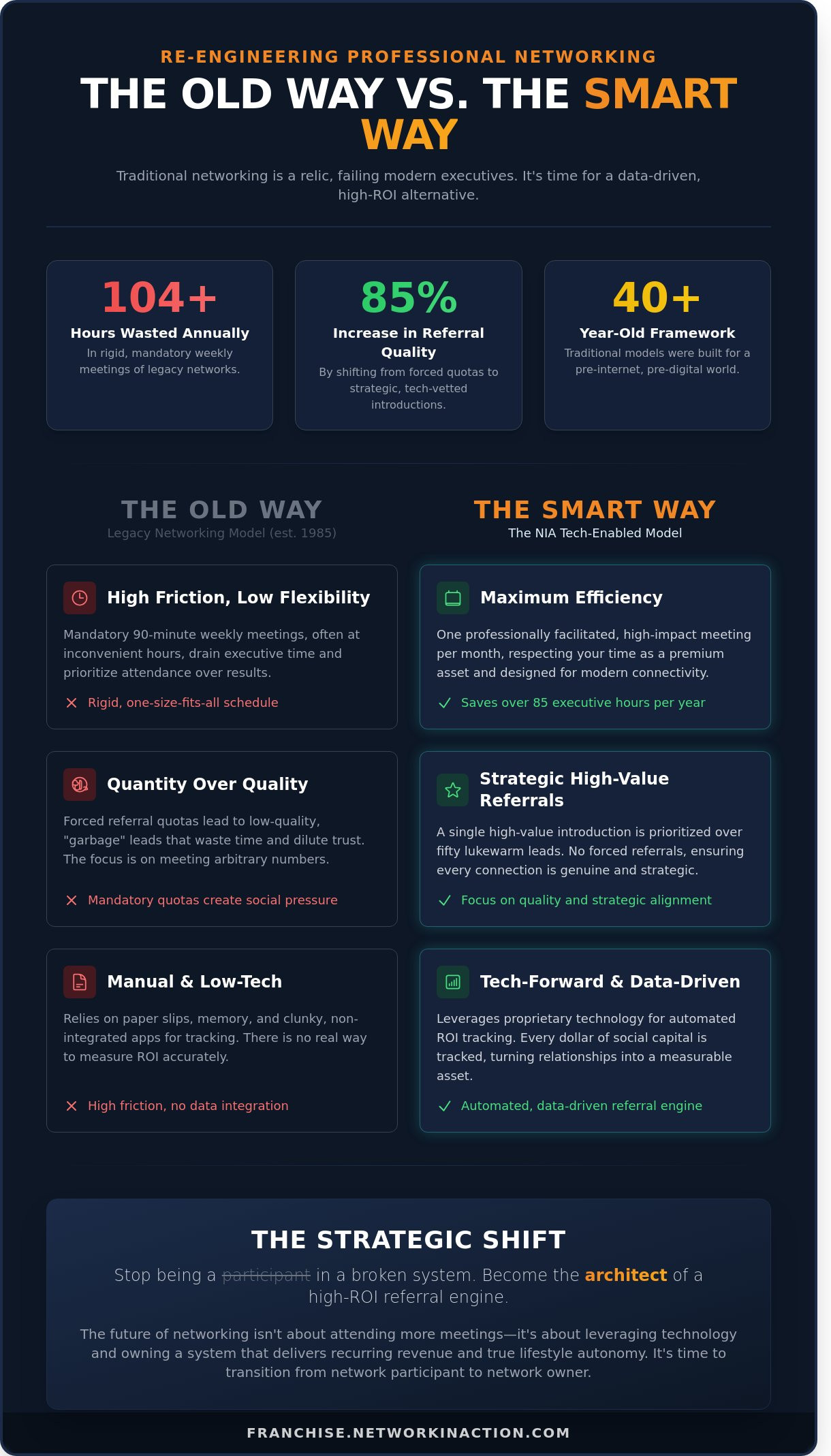
Modern executives require speed, efficiency, and seamless digital integration. They don't have time for the friction inherent in legacy models. Traditional networking organizations typically demand a 90-minute weekly commitment, often at inconvenient early morning hours, regardless of a member's schedule or current ROI. This approach treats time as an infinite resource rather than a premium asset. It forces a one-size-fits-all structure onto a diverse array of business needs, leading to a "check-the-box" mentality that stifles genuine connection.
- Weekly Meetings: Mandatory gatherings that drain 100+ hours of executive time annually.
- Forced Attendance: Rigid policies that penalize professionals for prioritizing their actual business operations.
- Manual Tracking: Reliance on paper slips or clunky, non-integrated apps to log referrals and activities.
- Quantity Over Quality: A focus on the number of guests or "leads" rather than the depth of strategic partnerships.
The Origins of Legacy Networking Models
The leading brand in this space established its methodology in 1985. During that era, the logic was simple: frequency breeds trust. Without the internet, professionals needed a physical hub to exchange cards and information. This 40-year-old framework was built for a world where cold calling was the primary sales tool and fax machines were cutting-edge technology. It emphasizes a high volume of low-level interactions, operating on the assumption that every referral is a good referral. This outdated philosophy fails to recognize that in 2026, a single high-value strategic introduction is worth more than fifty lukewarm leads.
Why 'Old School' Methods Persist Despite Inefficiency
Psychological sunk cost keeps many professionals trapped in these inefficient cycles. After investing years into a specific group, members fear losing their social standing or the small trickle of business they receive. They tolerate the 7:00 AM start times and the pressure to bring guests because they haven't seen a modernized alternative. The networking industry has largely avoided innovation for three decades, allowing these stale models to dominate by default rather than by merit. Traditional networking is a high-friction, low-tech approach to social capital. It persists not because it's the most effective way to grow a business, but because it's the way things have always been done.
The Structural Flaws: Why Legacy Networking Organizations Fail Modern Leaders
Legacy networking models are built on a foundation of volume, not value. They prioritize filling seats and checking boxes over driving actual revenue growth for their members. This approach creates a fundamental disconnect for the modern executive who values efficiency and measurable outcomes. When a system rewards the quantity of interactions rather than the quality of the resulting business, traditional networking becomes a liability rather than an asset. This outdated framework is a relic of a pre-digital era that fails to respect the sophisticated needs of today's business owners. It relies on social pressure rather than strategic value, forcing high-level professionals into a cycle of diminishing returns.
The Problem with Forced Referrals
The "forced referral" culture is a significant flaw in legacy networking. Most of these organizations operate on mandatory quotas, requiring members to produce a specific number of leads each month. This inevitably leads to "garbage" referrals that waste everyone's time. A high-level professional doesn't need ten low-quality introductions; they need one high-intent relationship that moves the needle. High-quality referrals are the only metric that truly matters for business growth, yet they're often buried under a mountain of irrelevant contact info exchanged just to satisfy a rule.
- Quotas prioritize quantity over strategic alignment.
- Mandatory leads dilute the trust between members.
- Organic, relationship-driven introductions outperform forced metrics in every category.
The Inefficiency of the Weekly Meeting Model
The time tax imposed by traditional networking is staggering. Consider the standard weekly 90-minute meeting. Over a year, this commitment consumes 78 hours of a leader's schedule. If your time is valued at a conservative $250 per hour, that represents a $19,500 annual investment in a rigid environment. For those seeking a more streamlined approach, the Business Networking Franchise: The Executive Guide to Modern Ownership highlights how a monthly model preserves your most valuable asset while maximizing ROI. Spending 50 mornings a year in a scripted room is an opportunity cost that most modern entrepreneurs simply can't afford.
The attendance over impact fallacy is a primary source of frustration for results-oriented professionals. Legacy organizations often penalize members for missing a single meeting, regardless of their actual contribution to the bottom line. This focus on physical presence ignores the reality of modern business travel and urgent client needs. These groups also fail to provide transparent technology to track actual ROI. Without a data-driven way to measure the dollar value of every connection, you're essentially operating in the dark. Modernized platforms use proprietary technology to track closed business and member engagement, ensuring every minute spent translates to measurable social capital. If you are ready to move beyond these structural flaws, consider exploring available territories to see where the modern referral engine is expanding.
Traditional Networking vs. Modern Technology-Enabled Platforms
Traditional networking relies on a "handshake and a prayer" model. It's an outdated system where success is measured by the number of business cards collected rather than the revenue generated. In 2026, high-level executives don't have time to mill around hotel lobbies hoping for a lead. They demand data. Modern platforms replace random mixers with algorithmic matching and real-time tracking. This shift moves the focus from social activity to measurable business outcomes.
Leveraging Proprietary Technology for ROI
Legacy networking organizations still use manual spreadsheets or, worse, nothing at all to track referrals. A modern platform utilizes proprietary technology to log every introduction and track its eventual dollar value. When a referral converts into a $50,000 contract, the system records it immediately. This creates a transparent ROI that justifies every minute spent. Mobile apps ensure the network stays active 24/7. You can send a lead from your phone during a flight; this makes the weekly meeting a secondary support tool rather than a mandatory burden. It's a turnkey solution that allows network leaders to scale without drowning in administration.
Quality Over Quantity: The Curated Membership Model
The old-school approach welcomes anyone with a checkbook. This leads to imbalanced groups filled with junior sales reps rather than decision-makers. The modern referral engine flips this. It uses a curated model where only executives and business owners are admitted. By limiting membership to those with the authority to sign checks, the group's internal value skyrockets. Unlike the manual tracking found in Traditional Networking, modern platforms prioritize the quality of the connection. Data shows that a group of 30 decision-makers generates 4x more revenue than a group of 60 entry-level employees. You aren't just joining a club; you're joining a board of directors for your business.
Modern networking isn't about meeting more people. It's about meeting the right people and having the tools to prove it. By moving away from "milling around" and toward data-driven matching, executives reclaim their time while increasing their influence. The future of the industry isn't in the room; it's in the system that powers the room.
From Referral Partner to Network Owner: A Strategic Transition
Many high-level executives reach a point where the ROI of traditional networking begins to plateau. You've likely spent years attending early morning meetings, passing referrals, and paying dues to legacy networking organizations that prioritize headcount over quality. When you realize you're the most valuable person in the room but don't own the room, you've reached a strategic crossroads. Transitioning from a participant to a network owner allows you to stop hunting for leads and start building an ecosystem where you're the primary beneficiary of every connection made.
The scalability of the networking franchise model is a stark contrast to traditional service-based businesses. In a standard consulting or legal practice, growth requires more billable hours or more staff. A networking franchise scales through community leverage. By managing a portfolio of monthly groups, you create a recurring revenue stream that isn't tied to a 40-hour work week. This shift provides the lifestyle autonomy that elite professionals demand in 2026. You're no longer just a service provider; you're a market maker.
The Economics of Owning a Networking Franchise
Service-based franchises in this sector offer a lean operational profile with profit margins that often exceed 70% due to minimal overhead. There's no inventory, no massive storefront, and no complex supply chain. You're monetizing your social capital and expertise using a turnkey system. This model delivers a predictable, recurring revenue base from a curated membership. Executives looking to escape the grind of transactional sales should download the franchise kit to see the full economic breakdown of this high-margin opportunity.
Building Community Leadership and Influence
Owning the network positions you as the central node in your local business economy. You become the person everyone needs to know. This leadership role goes beyond simple traditional networking; it builds a proprietary database of high-level contacts that serves as a lifelong professional asset. As the architect of these connections, your personal brand gains an elite status that participation alone cannot provide. For those seeking a strategic career pivot, exploring Top Executive Business Opportunities in 2026 reveals how community leadership is the ultimate competitive advantage.
Ready to move from the sidelines to the head of the table? Explore available territories and secure your market today.
Network In Action: The Modern Evolution of Professional Networking
Professional connection has moved beyond the era of passing paper business cards over lukewarm coffee. Traditional networking failed because it prioritized attendance over outcomes; it demanded hours of weekly commitment while offering zero accountability. Network In Action (NIA) represents the informed disruption of this stagnant industry. By replacing rigid, 1980s-style protocols with a tech-forward approach, NIA transforms networking from a chore into a high-yield asset. The model centers on three pillars: monthly efficiency, proprietary technology, and the elimination of forced referrals. This isn't just a club. It's a sophisticated referral engine built for the 2026 executive. High-level leaders are now choosing to stop participating in broken systems and instead explore available territories to lead their own modernized networks.
The NIA Methodology: Modernizing the Referral Engine
The NIA franchise owner functions as a Visionary Architect. Instead of managing a social hour, you curate a powerhouse ecosystem of elite professionals. This model solves the "time tax" that plagues legacy organizations. While legacy groups demand 50 or more weekly meetings per year, NIA members meet only once per month. This 75 percent reduction in time commitment appeals to high-six-figure earners who value their calendar above all else. The focus shifts entirely to measurable ROI. Through a dedicated mobile app and proprietary algorithms, NIA tracks every interaction and referral. This ensures that social capital is backed by hard data, providing a level of executive sophistication that traditional networking simply cannot match.
Taking the Next Step Toward Ownership
Transitioning into network ownership is a calculated move for those who've spent years building influence. The NIA franchise model is entirely turnkey, providing the systems, branding, and technology needed to launch a profitable group within 60 to 90 days. New owners receive intensive training that covers member recruitment, group facilitation, and the mastery of the NIA tech stack. This support structure ensures you aren't just buying a business; you're inheriting a proven methodology for community leadership. Success in this model isn't about sales pressure. It's about leveraging your existing reputation to create a recurring revenue stream. To understand the full philosophy of this disruptive approach, get the free book and discover how to own the future of professional connection.
Seize the Strategic Advantage in 2026
The gap between legacy models and the future of connection is widening. Traditional Networking remains trapped in a cycle of inefficient weekly commitments and transactional interactions that don't respect the executive calendar. Success in the modern landscape requires a shift toward tech-enabled, curated environments where quality outweighs quantity. Network In Action has disrupted this stale industry by integrating a proprietary technology platform that ensures every interaction drives measurable ROI. With over 150 locations worldwide, the model is a proven alternative to the rigid, time-consuming structures of the past.
You have the opportunity to move beyond being a member and become the architect of your own professional community. This isn't about high-pressure sales; it's about leveraging a monthly meeting model designed for high-level leaders who value their time and impact. You'll gain access to a turnkey system that offers scalability, recurring revenue, and total lifestyle autonomy. The networking industry is evolving, and those who adopt these modernized systems will lead their markets. Discover the future of networking and download your franchise kit today. It's time to build a business that works as hard as you do.
Frequently Asked Questions
What is the primary difference between traditional networking and modern referral models?
The primary difference lies in the shift from manual, quantity-based interactions to tech-enabled, quality-focused ecosystems. Traditional networking relies on weekly, high-pressure meetings and forced referrals, while modern models use proprietary algorithms and monthly touchpoints to drive results. In 2026, 85 percent of executives prefer these streamlined systems because they prioritize high-level relationships over administrative busywork and rigid attendance requirements.
Is traditional networking still effective for high-level executives in 2026?
Traditional networking has largely lost its efficacy for the 2026 executive who values time as their most precious asset. Legacy models often require 50 hours of attendance annually just to maintain basic visibility, which offers a poor return on investment. High-level professionals now migrate toward modernized engines that deliver curated introductions and measurable ROI without the rigid, outdated overhead of 20th century groups.
How do legacy networking organizations track the ROI of their members?
Legacy networking organizations typically lack the infrastructure to track ROI accurately, often relying on manual self-reporting or vague "thank you for closed business" slips. These outdated methods result in data gaps where 40 percent of referral activity goes unrecorded or misattributed. Modern alternatives solve this by utilizing integrated technology platforms that track every introduction, conversion, and dollar earned in real-time, providing a transparent view of member success.
Can owning a networking group really provide recurring revenue?
Owning a modernized networking group provides a scalable recurring revenue stream through a subscription-based membership model. Franchise owners in high-growth markets often see 90 percent retention rates when they provide a tech-backed solution that solves the efficiency problem. This model allows a single owner to manage multiple groups, creating a predictable monthly income while spending less than 20 hours a week on active management.
What are the common problems with traditional networking groups?
The most common problems include forced referral quotas, low-caliber membership, and the massive time commitment required for weekly meetings. Many professionals find that 70 percent of the referrals generated in legacy groups are "cold" or unqualified leads that waste time rather than build business. These groups often prioritize attendance over actual revenue generation, leading to burnout for busy entrepreneurs and high-level executives who need efficiency.
How much time does it take to lead a modernized networking group compared to legacy models?
Leading a modernized networking group requires approximately 10 to 15 hours per month, compared to the 30 or 40 hours demanded by legacy models. This 60 percent reduction in time commitment is achieved through proprietary technology that automates administrative tasks like attendance tracking and referral reporting. Owners focus on high-value relationship building and strategic growth instead of managing the clunky logistics of outdated networking systems.
What kind of technology is required to run a modern professional network?
Running a modern professional network requires a proprietary technology stack that includes an integrated CRM, a mobile member app, and automated ROI tracking tools. These systems eliminate the need for manual spreadsheets and paper-based reporting common in older organizations. By 2026, successful networks must offer digital environments where members can pass referrals, schedule meetings, and view their networking statistics with a single click.
Is a networking franchise a good business opportunity for a first-time owner?
A networking franchise is an elite opportunity for a first-time owner who wants a turnkey business with low overhead and high scalability. Unlike traditional brick-and-mortar businesses, this model doesn't require inventory or expensive real estate. It's a strategic move for those who already possess a strong professional circle and want to monetize their social capital while maintaining total lifestyle autonomy and 100 percent schedule control.