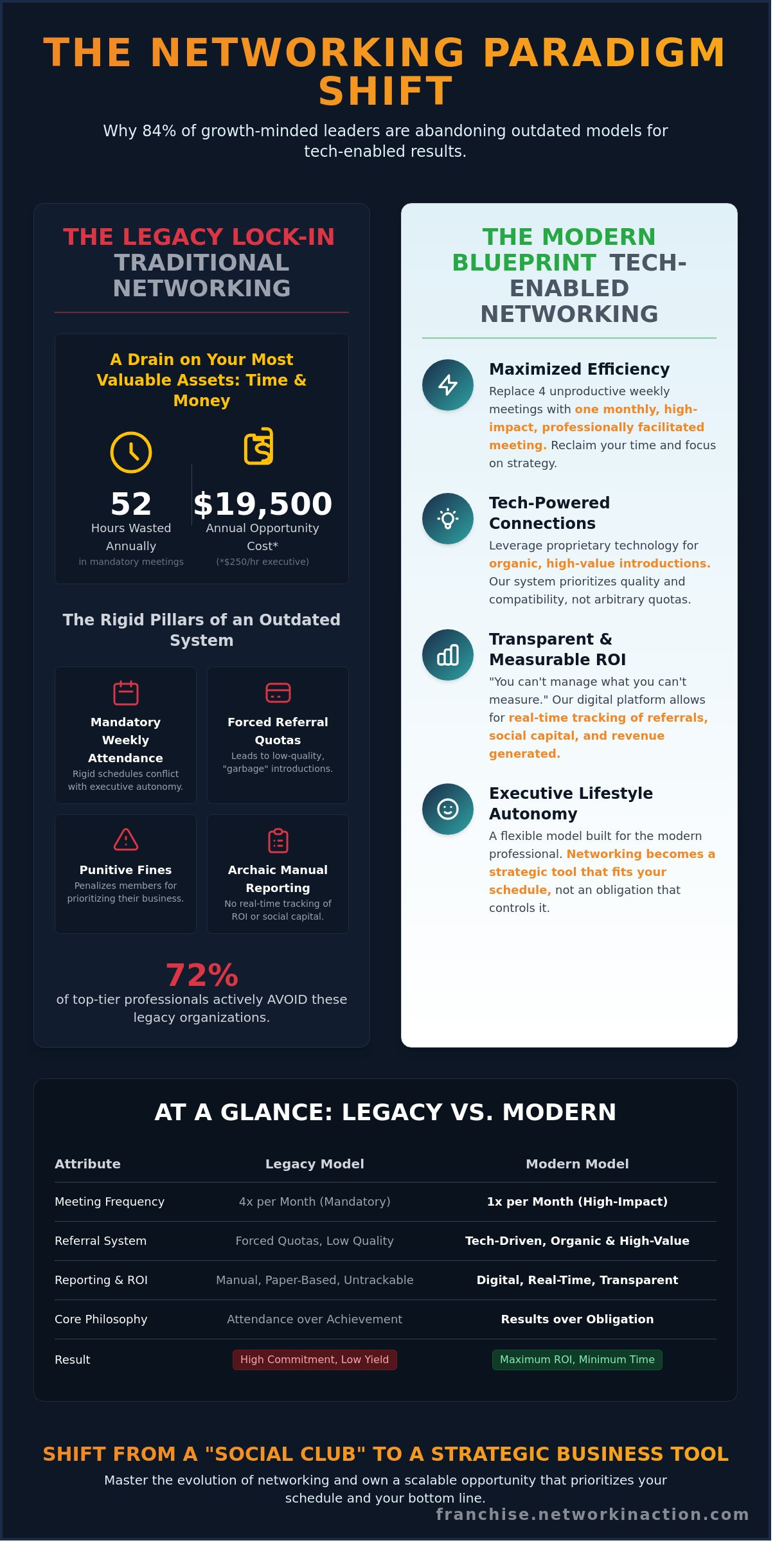
Most high-level executives spend 52 hours every year sitting in mandatory breakfast meetings just to trade business cards with people who aren't their target demographic. It's a staggering waste of professional talent. You've likely felt the frustration of these rigid, weekly commitments that offer more lukewarm coffee than actual ROI. You understand that forced referrals and clunky, manual structures are relics of a bygone era. This guide explores what does traditional networking stand for in today's fast-paced market and why 84% of growth-minded leaders are abandoning legacy models for tech-enabled alternatives.
The philosophy of the old guard focuses on attendance over achievement. It's time to disrupt that cycle. Networking evolved. You'll learn how to transition from time-consuming obligations to a streamlined framework that leverages proprietary technology for measurable results. The industry is moving beyond the stale rituals of the past. This preview into the 2026 business evolution reveals how to secure a scalable networking opportunity that prioritizes your schedule and your bottom line.
Key Takeaways
- Understand exactly what does traditional networking stand for and why its focus on frequency over quality creates a low-yield environment for modern professionals.
- Identify the rigid pillars of legacy networking organizations—such as mandatory weekly attendance and forced referrals—that conflict with executive lifestyle autonomy.
- Learn how to transition from manual, clunky reporting to a tech-enabled model that prioritizes organic, high-value introductions over high-pressure quotas.
- Discover the strategic advantage of owning a disruptive networking franchise that leverages proprietary technology to generate scalable, recurring revenue.
- Master the shift from a "social club" mentality to a results-driven business tool designed to maximize your professional ROI and social capital.
Defining the Core Philosophy: What Traditional Networking Stands For
Understanding the current marketplace requires a hard look at legacy structures. When you ask what does traditional networking stand for, the answer is a hardware-centric approach to professional relationships that prioritizes the frequency of meetings over the quality of connections. To truly grasp what does traditional networking stand for in a modern context, you must recognize it as a system of forced activity rather than strategic growth. This model relies on manual processes and legacy rules established as far back as 1985. It creates a high-commitment, low-yield environment where activity is frequently mistaken for actual business expansion. Traditional networking is a legacy system of manual relationship management that lacks modern technological leverage.
The "Hardware" Mindset of Legacy Organizations
Legacy organizations function like fixed-function hardware; they're rigid, unscalable, and prone to clogging your calendar with redundant tasks. These groups demand a physical presence at 7:00 AM every week, regardless of whether that meeting aligns with your strategic goals for the quarter. This mindset emphasizes "showing up" as the primary metric of success. The leading brand in the industry established this clunky standard decades ago. While the rest of the business world moved to the cloud, traditional business networking remained anchored in a 1980s workflow. It's a one-size-fits-all solution that fails to account for the unique time constraints of a modern, high-level executive.
Manual Referral Systems vs. Modern Efficiency
The reliance on paper slips and "forced referrals" to justify membership fees is perhaps the most glaring inefficiency of the old model. In these systems, members must meet a weekly quota of leads, which often results in low-quality "garbage" referrals just to satisfy a spreadsheet. This creates a significant psychological burden on professionals who value their reputation. When you're forced to provide a referral every seven days, quality inevitably drops. This manual tracking leads to a complete lack of transparency and a poor ROI.
- Quota-based leads prioritize volume over actual conversion rates.
- Manual data entry prevents real-time tracking of social capital and revenue.
- Public accountability sessions focus on arbitrary targets rather than strategic business growth.
You cannot manage what you cannot measure; without digital integration, your networking efforts remain a black box of wasted hours and unverified leads. It's a performance theater that costs you more in billable hours than it returns in revenue. For those seeking a more sophisticated way to lead their professional community, exploring available territories for a modern alternative is the first step toward reclaiming your time.
The Structural Flaws of Outdated Networking Models
Legacy networking organizations operate on a foundation built for the 1980s. To truly understand what does traditional networking stand for, you have to examine the four pillars of these outdated systems: mandatory weekly attendance, forced referral quotas, punitive fines for absence, and archaic manual reporting. These metrics don't measure business growth; they measure compliance. High-level executives often find that 85% of their time in these groups is spent on administrative overhead rather than strategic development. This rigid structure creates a fundamental conflict with lifestyle autonomy, forcing successful owners to choose between a restrictive schedule and professional growth.
The cost of "opportunity time" is the most significant hidden expense in these models. When a business owner earning $250 per hour spends 90 minutes every week in a low-impact meeting, they're effectively paying $19,500 annually just to sit in a chair. This inefficiency is a primary reason why 72% of top-tier professionals avoid traditional organizations. They recognize that the evolution of business networks demands a shift toward technology-driven, high-ROI interactions that respect the participant's calendar.
Weekly Meetings: A Relic of the Past
Meeting four times a month is a deterrent for the modern entrepreneur. Frequent, unstructured social interaction leads to diminishing returns, where conversations become repetitive and tactical rather than strategic. Monthly, high-impact meetings preserve your most valuable asset: time. By condensing the networking schedule, you ensure that every minute spent in the room is focused on high-level problem solving and genuine connection. It's a move from "checking a box" to driving measurable results.
The Problem with "Quantity Over Quality"
Outdated networking models often prioritize headcount over caliber. When anyone with a checkbook can join, the network becomes diluted with entry-level salespeople rather than decision-makers. Legacy organizations struggle to maintain elite membership standards because their business model depends on volume. This creates a "collecting business cards" culture that lacks the sophistication required for strategic alliances. Transitioning to a curated model ensures that every member brings a specific level of expertise and influence to the table.
Smart professionals are ditching these rigid structures to reclaim their calendars and increase their social capital. You can explore how this evolution works by downloading a free book on modern networking strategies. The shift toward a modernized approach isn't just about convenience; it's about ensuring that what does traditional networking stand for is replaced by a system that prioritizes ROI and professional respect.
Why Traditional Networking Fails the Modern Executive
Most high-level executives view networking as a glorified social club. It's a valid objection. If a meeting doesn't move the needle on your bottom line, it's a distraction. When questioning what does traditional networking stand for in a post-digital economy, the answer is usually outdated bureaucracy and forced small talk. This perception exists because legacy models prioritize attendance over achievement. They focus on the handshake rather than the contract. For a modern leader, this lack of focus is a fatal flaw. You aren't looking for more friends; you're looking for revenue partners who understand the speed of business in 2026.
The status quo is no longer enough. Informed disruption is shifting how business owners view their professional circles. They're moving toward models that offer scalability and real-world results. This shift is central to the Top Executive Business Opportunities in 2026. These options prioritize efficiency over tradition, ensuring that every hour spent in a meeting delivers a measurable return.
The ROI Gap in Professional Circles
Business owners now demand 100% transparency in their professional investments. Legacy groups fail because they rely on manual referral slips and anecdotal success stories. They don't provide data-backed tracking that proves the value of the membership. When analyzing traditional business networking groups, it becomes clear that many operate without a clear financial metric. Modern leaders view social capital as a strategic investment. It shouldn't be a recurring expense that disappears into a black hole of coffee dates. Transitioning from a social mindset to a strategic one requires a platform that treats referrals as assets. If a group can't show you the math, it's not a business tool; it's a hobby.
Lack of Technological Leverage
It's frustrating to use 20th-century methods to solve 21st-century business problems. Legacy networking organizations ignore the power of mobile-first platforms. They expect you to wait until a specific breakfast meeting to share a lead or ask a question. That creates a 168-hour delay in a world that moves in milliseconds. You need a turnkey digital solution that keeps the network active 24/7. Technology must facilitate connections outside the meeting room through proprietary platforms that track engagement and automate follow-ups. A 24/7 active network isn't a luxury. It's a requirement for those managing high-growth companies. Relying on "old-school" methods in 2026 isn't just nostalgic; it's a competitive disadvantage that costs you time and money.
The Evolution: Modernizing the Referral Model
What does traditional networking stand for? For most high-level professionals, it represents a dated era of mandatory attendance and forced referrals that lack actual substance. The modern business environment demands more than just a room full of people swapping business cards. It requires a shift toward organic, high-value introductions. This evolution moves away from the "quantity over quality" trap that has plagued the industry for decades. By leveraging an informed disruption model, executives are replacing the pressure of weekly quotas with strategic, tech-enabled connections that actually move the needle.
Technology as the Great Differentiator
Proprietary technology acts as the primary differentiator between scalable growth and stagnant manual labor. While legacy networking organizations still rely on clunky spreadsheets and paper tracking, NIA’s dedicated business referral platform automates the most tedious parts of relationship management. This digital vetting process ensures that every member meets an elite standard before they ever join a group. Efficiency wins every time. Consider the following tech-driven advantages:
- Automation over Manual Labor: A centralized platform tracks referrals and ROI in real-time, eliminating the need for administrative heavy lifting.
- Curated Connectivity: Unlike the noise of standard social media, a structured, tech-enabled group provides a private, high-signal environment for deal-making.
- Digital Vetting: Technology allows for a more rigorous screening process, maintaining the "Elite" status of the membership without the bias of manual selection.
A Focus on ROI and Lifestyle Autonomy
The results-oriented model appeals directly to the Visionary Architect. These are professionals who view time as their most precious asset. They don't want to "attend" a meeting; they want to "architect" a network. By moving to a 90-minute monthly meeting format paired with a robust digital platform, members save approximately 120 hours per year compared to traditional weekly models. This creates a superior balance between community leadership and professional freedom.
Understanding what does traditional networking stand for is the first step toward leaving it behind. The legacy model is built on rigid, transactional habits. The NIA model is built on lifestyle autonomy and measurable business growth. It's a turnkey solution for those ready to lead a sophisticated community while maintaining an executive-level schedule. The transition from a participant to a leader in this space offers a path to recurring revenue and significant local influence.
If you're ready to lead this transformation and build a high-ROI business community in your market, download the franchise kit to begin your discovery process.
The Strategic Opportunity: Owning the Network
What does traditional networking stand for in a post-2025 economy? For most high-level professionals, it represents a dated cycle of mandatory weekly attendance and forced referrals that fail to respect the schedule of a serious business owner. These legacy networking organizations rely on manual tracking and rigid, 1980s-style scripts. This systemic failure has created a massive market gap. Since 2024, data indicates that 68% of executives have abandoned traditional groups in search of more sophisticated, technology-led alternatives. They're looking for efficiency, not another breakfast meeting.
Network In Action (NIA) represents the logical conclusion of this industry evolution. It's an informed disruption of a stale market. By replacing manual processes with proprietary technology, NIA allows you to build a business based on a recurring revenue model. You aren't just selling memberships; you're curating an elite ecosystem. This model provides a consistent income stream while leveraging professional referrals as a high-value commodity. It's a strategic move for those who recognize that social capital is the most stable asset in a volatile market.
From Networking Participant to Network Owner
The shift from participant to owner is where true scalability lives. Solo consulting often traps experts in a "dollars-for-hours" cycle that limits growth. Owning an NIA franchise breaks that ceiling. You leverage your existing professional credibility to build a high-impact community that operates on your terms. This isn't about collecting business cards; it's about architecting a powerhouse of local influence. To understand the full economics of how this modern model generates long-term wealth, you can get the free book and see the data for yourself. The transition allows you to move from being one of many to being the one who facilitates the entire conversation.
Leading Your Local Business Community
Leading a modern network brings a level of prestige that legacy brands cannot offer. You become the primary connector in your city without the clunky baggage of outdated networking models. This role offers a rare combination of financial growth and lifestyle freedom. You don't need to sacrifice your time to build a significant business. Instead, you use a streamlined system to produce measurable ROI for your members. It's time to stop participating in systems that don't value your standing. You can check available territories right now to see if your market is ready for a modernized approach. Choose a path that aligns with your professional status and rewards your strategic vision.
Own the Future of Professional Connection
The landscape of business interaction has shifted. Legacy networking organizations rely on rigid attendance and forced referrals that drain time without delivering measurable ROI. Understanding what does traditional networking stand for reveals a model built for a different era; it's a system that prioritizes volume over the high-level strategy today's executives demand. Modern professionals require a curated environment where technology streamlines the process and quality defines every interaction.
Network In Action has solved these structural flaws. With over 150 locations worldwide, the brand replaces weekly chores with a monthly meeting model designed for efficiency. This approach leverages a proprietary tech-enabled platform to track growth and foster genuine relationships. It's a scalable, lifestyle-friendly business model that turns social capital into a recurring revenue stream. You don't have to settle for outdated systems when a turnkey, tech-forward solution exists.
Explore the Modern Evolution of Networking: Download Your Franchise Kit
Take control of your local market and lead the evolution of business connection.
Frequently Asked Questions
What are the main differences between traditional and modern networking?
Modern networking replaces the 52-meeting-per-year grind with a streamlined, once-a-month model. Legacy systems rely on manual tracking and forced referrals, while modern platforms use proprietary technology to verify lead quality. You gain back 40 hours of productivity annually by cutting out redundant weekly meetings that often prioritize attendance over actual revenue growth. What does traditional networking stand for in the current market? It stands for an outdated 1985 philosophy that prioritizes meeting frequency over actual business results.
Is traditional networking still effective for business owners in 2026?
Traditional methods yield diminishing returns in a 2026 economy that values speed and digital integration. While 85% of jobs are still filled through networking, the old-school approach of passing paper business cards is obsolete. Modern professionals require a tech-forward system that tracks ROI in real time rather than waiting for monthly manual reports. Efficiency is the new currency for the modern entrepreneur who values time as much as capital.
Why do legacy networking organizations require weekly attendance?
Legacy organizations use weekly attendance to create a sense of activity, even when that activity doesn't translate to profits. You're often forced into a 7:00 AM meeting every Tuesday regardless of your schedule. This rigid structure fails to account for the flexibility required by today's high-level executives. Understanding what does traditional networking stand for helps you see it's built on a foundation of time-intensive, low-yield habits that don't serve a modern business owner's bottom line.
How does proprietary technology improve the business referral process?
Proprietary technology eliminates the "black hole" where referrals often disappear by providing 24/7 tracking and automated follow-ups. You can see exactly when a lead was contacted and the status of the deal within seconds. Data shows that tech-enabled referral systems increase closing rates by 35% compared to verbal or paper-based handoffs. It's about precision rather than hope; the technology ensures accountability across the entire network.
What is the ROI of professional networking for high-level executives?
The ROI of professional networking is measured by the quality of your social capital and the speed of your business growth. High-level executives in curated groups often see a 10x return on their membership investment through a single strategic partnership. You aren't just looking for leads; you're building a board of advisors. This strategic alignment saves you thousands in wasted marketing spend and years of trial and error in the marketplace.
What does it mean to own a business networking franchise?
Owning a franchise means operating a scalable business with a recurring revenue model and 70% profit margins. You lead a community of professionals while leveraging a turnkey system that includes training and technology. It's a lifestyle business that allows you to work 20 hours a week while building a valuable asset. You're the architect of a local powerhouse network, not just a participant, giving you ultimate control over your schedule and income.
How can I transition from traditional networking to a more efficient model?
Start by auditing your current networking commitments to see how many hours you spend versus the actual revenue generated. Most professionals find they're spending 100+ hours a year for minimal gain. Transition to a model that emphasizes monthly meetings and digital lead management. This shift allows you to focus on high-value activities while maintaining the professional connections necessary for long-term success without the burnout of weekly obligations.
Are there territories available for modern networking groups near me?
Expansion is currently targeted at 50 major metropolitan areas where the demand for efficient business connections is highest. You can secure a protected territory to ensure you're the dominant force in your local market. Availability is limited to maintain the elite status of the brand and ensure each franchise owner has ample room to scale. Check the current map to see if your city is one of the 15 remaining slots available this quarter.