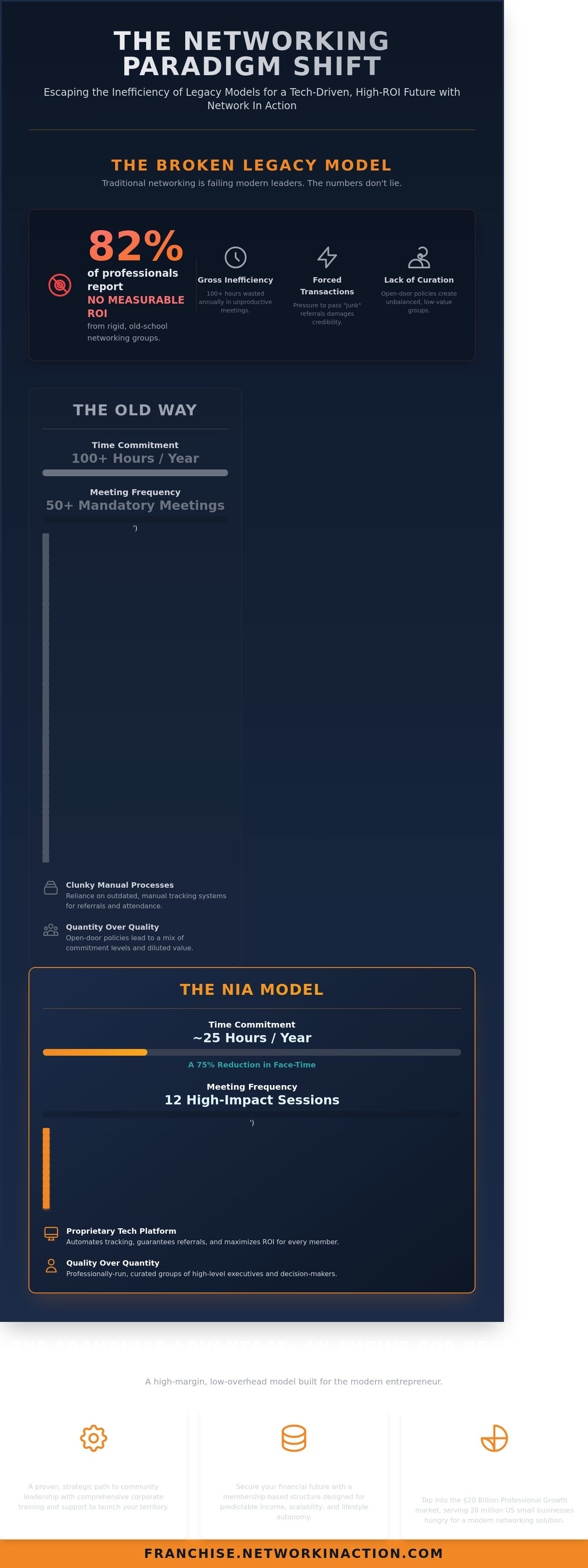
The traditional networking model isn't just stale; it's a systematic drain on the one resource an executive can't manufacture: time. While legacy networking organizations still rely on manual tracking and mandatory 7:00 AM meetings, 82% of high-level professionals report that these rigid structures fail to produce a measurable return on investment. You shouldn't have to choose between community leadership and personal freedom. It's clear that the old way of connecting is broken, and the market is desperate for a sophisticated, tech-forward alternative.
This executive guide shows how to leverage a modern business networking franchise to build a high-margin enterprise without the typical overhead of a brick-and-mortar business. You'll discover how proprietary technology and curated membership tiers transform social capital into a scalable engine for recurring revenue. This exploration covers the specific path to achieving lifestyle autonomy while positioning yourself as the premier connector in your city. It's time to move beyond the clunky methods of the past and embrace a model built for the modern professional.
Key Takeaways
- Stop sacrificing 50+ mornings a year to outdated networking models and learn how to achieve greater impact with just 12 high-level monthly sessions.
- Discover how to launch a high-ROI business networking franchise that leverages proprietary technology to automate the clunky manual processes of legacy organizations.
- Secure your financial future with a membership-based model designed for predictable recurring revenue, low overhead, and maximum scalability.
- Master the art of "Informed Disruption" by replacing forced referrals with a curated environment that attracts high-level executives and modern entrepreneurs.
- Follow a strategic, turnkey path to community leadership with comprehensive training and corporate support to identify your founding members.
The Evolution of the Business Networking Franchise
Networking isn't what it used to be. The era of the high-frequency social club is dead. Modern business leaders don't seek "coffee buddies" or casual acquaintances; they demand strategic assets that move the needle. A business networking franchise today must justify every minute spent on a calendar with measurable growth. The industry is pivoting from high-volume, low-value interactions to high-impact ecosystems designed for the executive tier.
Traditional, rigid models are failing the modern, tech-savvy professional. These outdated systems rely on manual tracking and mandatory attendance, which feel like a second job rather than a growth strategy. There's a massive gap in the market for a sophisticated referral environment that prioritizes quality over quantity. This is where informed disruption takes hold. Entrepreneurs are no longer settling for "showing up." They're looking for a platform that leverages technology to streamline connections and maximize ROI.
The $20 Billion Professional Growth Market
The demand for structured referral environments is surging across the 28 million small businesses currently operating in the United States. A significant "Employee to Entrepreneur" shift is driving this interest. As high-level corporate talent exits the 9-to-5 grind, they're seeking service-based franchises that offer professional autonomy. By 2026, social capital will be the primary currency for business success. These new owners aren't looking for a hobby; they're looking for a business networking franchise that functions as a high-performance engine for recurring revenue. You can explore this potential by checking available territories in your region.
Why Legacy Networking Models are Outdated
Legacy networking organizations are struggling to remain relevant in a results-oriented world. Their reliance on weekly, high-pressure meeting requirements is a relic of the past. High-level executives are leaving these groups because they're tired of "forced referrals" and transactional-only relationships. These old-school methods create a "quantity over quality" culture that wastes time and dilutes professional credibility. The flaws are clear:
- Inefficiency: Weekly meetings consume over 100 hours a year without guaranteed returns.
- Forced Transactions: Pressure to pass leads results in low-quality, "junk" referrals.
- Lack of Curation: Open-door policies often lead to unbalanced groups with varying levels of business maturity.
Modern professionals don't want to be policed; they want to be empowered. They're gravitating toward curated experiences that value their expertise and respect their schedule. The future belongs to those who can provide a turnkey, technology-led solution that turns networking from a chore into a competitive advantage.
The NIA Model: Informed Disruption in Professional Networking
Network In Action operates as the Visionary Architect of the professional connection world. It doesn't just host meetings; it engineers environments where high-level growth is inevitable. While outdated networking models cling to rigid, weekly schedules that drain executive calendars, NIA introduces a sophisticated monthly rhythm. This isn't a reduction in value. It's an optimization of time. By cutting mandatory face-time by 75%, NIA attracts the caliber of decision-makers who are too busy running successful companies to attend a weekly breakfast club. This shift respects the executive's schedule while maintaining a high-energy environment that drives real growth.
This business networking franchise model prioritizes curated membership over sheer volume. Every person in the room is vetted to ensure they possess the authority to make deals and the influence to move markets. It's a turnkey opportunity designed for those who want to lead a community rather than just participate in one. You aren't just selling memberships; you're building a high-powered board of advisors for local business owners. The focus remains on quality, efficiency, and the undeniable logic of professional leverage. It's a modern solution for a legacy industry that has stayed stagnant for too long.
A Proprietary Business Referral Platform
Technology is the catalyst that makes the NIA model scalable and effective. The business referral platform ensures that the connection doesn't stop when the monthly meeting ends. This digital ecosystem facilitates high-quality introductions 24/7, allowing members to pass leads and track ROI with a few clicks. It eliminates the "black hole" of traditional referrals where opportunities are lost in messy email chains. By 2026, the standard for professional networking will be defined by this level of data-driven transparency. The platform provides a clear, documented trail of every dollar generated through the network, making the value proposition impossible to ignore for any serious entrepreneur.
The ROI-Driven Culture
Legacy networking organizations often focus on attendance-based metrics, penalizing members for missing meetings regardless of their contribution. NIA disrupts this by focusing entirely on results-based metrics. The culture is built on "positive engagement" rather than "forced obligation." When members aren't pressured to provide a quota of low-quality leads, the quality of referrals skyrockets. Data shows that members who feel empowered rather than policed are 60% more likely to engage deeply with their peers. This psychological shift ensures a tangible return on membership investment. If you're looking to lead a group that values profit over protocol, you should explore available territories to see where you can make an impact.
Efficiency vs. Frequency: Why Legacy Models Fail Modern Leaders
Legacy networking organizations operate on a 1980s playbook. They demand 50 or more meetings every year. That's a staggering commitment for any serious business owner. Network In Action (NIA) disrupts this outdated cycle by mandating only 12 monthly meetings. This shift isn't just about saving time; it's about maximizing the ROI of every minute spent. High-level executives don't need more social hours. They need strategic connections that move the needle. A business networking franchise built on this model respects the schedule of the modern leader.
The Hidden Cost of Weekly Meetings
The math behind traditional networking is brutal. If a member spends 90 minutes at a meeting plus 30 minutes of travel every week, they lose over 100 hours annually. For a consultant billing $250 per hour, that's $25,000 in lost billable time. The 7 AM breakfast model further alienates top-tier talent who value their morning routines or manage global operations. This constant grind leads to meeting fatigue. Retention rates in weekly models often plummet by 40% after the first year because the "transactional tax" becomes too high for the results delivered.
Curating High-Caliber Circles
Success in a business networking franchise depends on the caliber of the room rather than the quantity of the seats. Legacy brands often accept anyone with a valid credit card, resulting in groups filled with junior sales reps rather than decision-makers. NIA uses a rigorous vetting process to ensure every member is a "Power Partner" capable of high-level referral exchange. You can evaluate these standards yourself using the Turnkey Business Opportunities Checklist to see how modern models compare. This focus on quality ensures that one monthly meeting produces more value than four weekly sessions of "elevator pitches" from vendors.
Skeptics often ask if a group can truly thrive meeting only once a month. The answer lies in the marriage of technology and intention. Between monthly sessions, members utilize a proprietary platform to pass referrals and maintain momentum. This removes the need for "filler" meetings designed solely to justify a membership fee. For the franchise owner, this model is the ultimate scalability tool. You can manage six or more groups without the burnout associated with a daily 7 AM grind. It's a professional community built for the way business happens today, not forty years ago.
The Economics of Ownership: Recurring Revenue and Scalability
Modern business success isn't just about what you know; it's about the systems you own. The NIA model transforms the business networking franchise into a high-margin, technology-led powerhouse. Unlike traditional networking models that rely on volunteer labor and inconsistent attendance, this structure focuses on predictable, monthly recurring revenue. You aren't chasing one-time sales. You're building a community of committed professionals who pay for access to a superior, ROI-driven platform.
Profitability arrives faster when you strip away the baggage of legacy industries. This model requires no $200,000 storefront build-outs, no massive inventory stockpiles, and no bloated payroll. You operate with lean overhead, often managing multiple groups with zero full-time employees. This efficiency creates a clear path to lifestyle autonomy. You dictate your schedule. You scale by adding groups or expanding into new territories without a linear increase in costs.
Franchise Fees and ROI Potential
The initial license fee represents a strategic entry into the business networking franchise space, offering a foothold in a high-margin service sector. Unlike food service or retail, where margins are often razor-thin, frequently falling between 3% and 6%, the service-based networking model allows for significantly higher retention of revenue. You benefit from a predictable royalty system, ensuring your monthly expenses remain fixed or percentage-based. This transparency allows for aggressive growth planning. To understand the specific financial benchmarks and investment tiers, you should download the franchise kit for full economic details.
Building an Asset, Not Just a Job
Many professionals fall into the trap of "buying a job" when they enter franchising. NIA offers an exit-ready asset. You build long-term equity through community influence and proprietary technology. These are Executive Business Opportunities designed for those who want to lead, not just facilitate. A mature, revenue-generating networking territory is a sellable commodity. When you decide to move on, you aren't just closing a door; you're selling a thriving ecosystem of 50, 100, or 200 plus paying members. This is how you transition from an active operator to a visionary architect of your own wealth.
Ready to secure your future in a high-growth market? Explore available territories today and start building your legacy.
Launching a Strategic Territory: Your Path to Community Leadership
Transitioning into ownership of a business networking franchise is a calculated move for the professional who values efficiency over activity. You aren't just buying a business; you're securing a position as the premier connector in your local economy. This role demands a sophisticated approach to relationship capital, moving away from the transactional nature of traditional networking. You'll leverage a system built for ROI, designed to replace the clunky, manual processes of legacy models with streamlined, tech-enabled growth. This is about becoming the visionary architect of your own professional ecosystem.
Training and Onboarding Support
Success begins with a rigorous 40-hour certification process. This comprehensive training transforms your existing executive skills into specialized expertise in professional community building. You'll receive ongoing coaching from the NIA corporate team, ensuring you master the proprietary technology that sets this model apart. A critical first step involves territory reservation and data-driven market analysis. You can check local availability right now by viewing the available territories map. This ensures you launch in a market with the highest potential for high-level professional density and recurring revenue.
The 90-Day Launch Roadmap
The path from signing your Franchise Disclosure Document (FDD) to hosting your first high-impact meeting is structured for speed. Within the first 90 days, you'll execute a strategic recruitment plan to identify your founding members. These are the high-level professionals who will form the core of your first group. You won't do this alone. Corporate support systems provide the tools and brand equity needed to attract top-tier talent quickly. Unlike outdated networking models that rely on high-pressure sales, NIA uses a curated approach that appeals to busy, successful individuals who value their time.
Your goal is to establish yourself as the go-to authority in your community. By positioning yourself at the center of a high-value network, you create a scalable business while maintaining lifestyle autonomy. This is the modern evolution of business ownership. It's time to stop cold prospecting and start leading. To deepen your understanding of how this model disrupts the status quo, claim your free book today and prepare for your next professional chapter as a community leader.
Claim Your Position in the Networking Evolution
Legacy networking organizations have failed the modern professional by demanding too much time for too little return. The transition to a sophisticated business networking franchise model solves this by replacing rigid, weekly commitments with an executive-friendly monthly structure. Network In Action has proven this disruption works, expanding to over 150 locations across 4 countries. Success here isn't left to chance. You'll leverage proprietary ROI-tracking technology to provide members with the transparency they've been missing in traditional circles.
This model prioritizes recurring revenue and long-term scalability, allowing you to build a high-impact business without the grind of cold prospecting. You aren't just buying a territory; you're architecting a community where high-level professionals thrive under your leadership. The status quo is outdated. The systems are ready. It's time to claim your place at the forefront of this industry evolution.
Download the Network In Action Franchise Kit to Explore Your Potential
The path to professional freedom and community impact starts with your next strategic move.
Frequently Asked Questions
How does a business networking franchise generate revenue?
A business networking franchise generates revenue primarily through recurring monthly membership dues and one-time enrollment fees. Franchisees typically manage multiple groups of 20 to 30 professionals; each paying a consistent fee for access to the NIA platform and community. This model creates a predictable, scalable income stream without the overhead costs of physical office space or inventory.
What is the difference between NIA and traditional legacy networking organizations?
The primary difference lies in efficiency and professional standards. Legacy networking organizations often rely on rigid, weekly meetings and forced referral quotas that prioritize volume over value. NIA disrupts this by hosting monthly meetings led by a professional leader, utilizing proprietary technology to track real-time ROI and ensuring members are high-level decision makers rather than entry-level sales reps.
Do I need prior experience in sales to run a networking franchise?
You don't need a background in aggressive sales to excel as a franchise owner. Successful owners are typically community leaders and relationship architects who understand the value of a curated network. NIA provides a 3-day intensive training program and ongoing support systems that allow executives to leverage their existing professional credibility rather than relying on cold-calling tactics.
How much time does it realistically take to manage a networking group?
Managing a single NIA group requires approximately 10 to 15 hours of active work per month. This streamlined schedule includes facilitating one 90-minute monthly meeting and spending a few hours on member recruitment and community management. It's a high-leverage model designed for 100% lifestyle autonomy, allowing you to scale to 5 or more groups while maintaining a part-time workweek.
What kind of technology platform does NIA provide to its franchisees?
NIA provides a proprietary technology platform that serves as the central nervous system for your business. The mobile app allows members to track referrals, calculate their specific ROI, and communicate instantly without the clutter of email. This data-driven approach replaces the manual, paper-based tracking systems used by outdated networking models, giving you a distinct competitive advantage in the market.
Is a networking franchise a good investment for a semi-retired executive?
A networking franchise is an ideal vehicle for semi-retired executives looking to monetize their professional contacts and industry expertise. It offers a low-overhead, high-margin business model that rewards your years of relationship building. With a 90% retention rate in many territories, it provides a stable platform for staying active in the business community while enjoying significant time freedom.
What are the initial startup costs for a business networking franchise?
The initial investment for a business networking franchise typically ranges from $40,000 to $60,000 depending on the territory size. This covers the franchise fee, initial training, and access to the proprietary technology suite. Because there's no requirement for a physical storefront or specialized equipment, owners can achieve a faster path to profitability compared to traditional brick-and-mortar models.
How many members does a typical NIA group have?
A typical NIA group consists of 20 to 30 high-caliber business owners and decision makers. This size is intentional; it's large enough to provide diverse referral opportunities but small enough to maintain the deep, personal connections that drive real business growth. Every group is industry-exclusive, ensuring that each member has a protected seat and a clear path to maximizing their social capital.