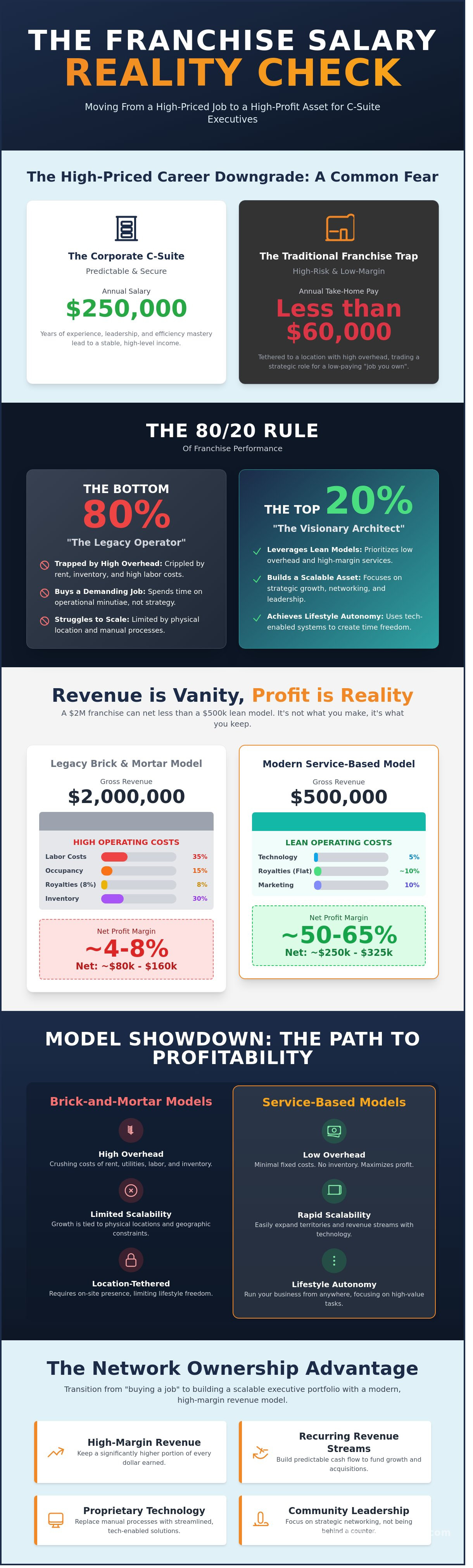
Trading a $250,000 corporate salary for a franchise that nets less than $60,000 isn't entrepreneurship; it's a high-priced career downgrade. Most executives fear that leaving the C-suite for franchise ownership means trading a predictable paycheck for a low-margin "job" they happen to own. It's a valid concern when 2024 industry reports indicate that nearly 40% of traditional retail franchisees struggle to clear $50,000 in annual take-home pay after royalties and overhead. You've spent years mastering efficiency and leadership, so the prospect of being tethered to a brick-and-mortar location with razor-thin margins feels like a step backward. Understanding the true franchise owner salary landscape for 2026 requires looking past vanity gross revenue figures and focusing on the net profit left after the costs of legacy networking organizations and retail models.
This article provides a data-driven reality check on earnings while showing you how to identify high-margin opportunities that prioritize ROI over crushing overhead. You'll discover the specific metrics that separate scalable assets from time-intensive traps. The following analysis explores how modern, technology-led models allow for lifestyle autonomy without sacrificing the executive-level income you've worked so hard to achieve. It's time to validate a strategic path toward time freedom and professional impact.
Key Takeaways
- Move beyond the skewed average franchise owner salary by leveraging the 80/20 rule and shifting focus from individual labor to high-margin network ownership.
- Avoid the "Legacy Model Trap" of high overhead and labor costs by identifying service-based models that prioritize rapid profitability over brick-and-mortar limitations.
- Evaluate the impact of flat-fee versus percentage-based royalties to ensure operating expenses fuel growth through proprietary technology rather than draining net income.
- Transition from "buying a job" to building a scalable executive portfolio by using recurring revenue streams to fund territory acquisitions and achieve true lifestyle autonomy.
The Reality of Franchise Owner Salaries: 2026 Data and Trends
The average franchise owner salary in the United States currently sits at approximately $112,000. While this figure suggests a comfortable middle-class existence, it is a mathematical abstraction that masks the true earning potential of the industry. This average is heavily weighted by single-unit operators in low-margin sectors who have essentially purchased a demanding full-time job. For the executive looking to transition into ownership, the goal isn't to hit the average; it's to bypass it entirely by understanding the franchise model as a scalable investment vehicle rather than a retail chore.
By 2026, the divide between legacy operations and modern, service-based models has widened. High inflation and rising commercial rents have squeezed the margins of traditional storefronts. Meanwhile, lean, technology-driven franchises are thriving. These modern models prioritize recurring revenue and low overhead, allowing owners to keep a significantly higher portion of every dollar earned. Success in this environment requires a shift in perspective. You aren't just buying a brand; you're acquiring a proprietary system designed to generate professional-grade ROI.
The 80/20 Rule in Franchise Performance
The franchising world operates on a strict 80/20 distribution. The bottom 80% of owners often struggle with high-overhead legacy models, trapped by the "clunky" logistics of inventory and hourly labor management. They are bogged down by the daily grind of operational minutiae. In contrast, the top 20% of performers are building expansive empires. These individuals possess a "Visionary Architect" mindset, leveraging multiple territories and professional management teams to scale their influence.
The top tier focuses on high-margin opportunities that offer lifestyle autonomy. They don't spend their time behind a counter; they spend it on strategic networking and community leadership. These elite owners favor disruptive models that replace manual, "old-school" processes with streamlined, tech-enabled solutions. To understand how these high-performers identify the best paths forward, explore Top Executive Business Opportunities in 2026: Beyond the C-Suite. This strategic approach is what separates a modest franchise owner salary from true executive-level wealth.
Gross Revenue vs. Net Profit: The Real Math
Revenue is a vanity metric; profit is the only reality that matters. A franchise generating $2 million in gross sales might yield less take-home pay than a service-based model doing $500,000 if the costs aren't controlled. Standard deductions quickly eat into the top line. You must account for:
- Labor Costs: Often the largest expense, especially in high-turnover retail sectors.
- Occupancy Expenses: Rent, utilities, and maintenance for physical storefronts.
- Royalties and Ad Funds: Typically 5% to 10% of gross sales paid to the franchisor.
- Inventory: The hidden killer of cash flow in product-based businesses.
The true metric of success is Owner’s Discretionary Earnings (ODE). This is the total cash flow available to the owner after all essential operating expenses are met. Net profit margin is the percentage of revenue that remains after all business expenses and taxes are paid. In 2026, the most successful executives are gravitating toward service models where margins are protected by low fixed costs and high-value professional relationships. This shift ensures that your "salary" is a reflection of your strategic leadership, not just the hours you spend on the clock.
Profitability by Industry: Service-Based vs. Brick-and-Mortar Models
Your potential franchise owner salary isn't just a product of hard work; it's a direct result of the business model you choose to command. In 2026, the gap between brick-and-mortar and service-based profitability has widened into a chasm. While traditional retail and food franchises often struggle with razor-thin margins, professional service models are thriving by eliminating the heavy anchors of physical overhead. According to the 2026 Franchising Economic Outlook, service-based sectors are projected to lead in total economic output as they bypass the logistical constraints that plague physical storefronts.
The math is simple. A brick-and-mortar location requires a massive initial investment, often exceeding $500,000 for build-outs, equipment, and inventory. This creates a long "runway" to profitability. Conversely, a service-based franchise allows for a faster ROI because your capital goes toward growth and technology rather than plumbing and property taxes. If you want to maximize your franchise owner salary, you must prioritize models that scale through human capital and proprietary systems rather than square footage.
The High Cost of Traditional Networking and Retail
Legacy models often trap owners in a cycle of high overhead and low autonomy. Food and retail sectors are currently facing the "Legacy Model Trap," characterized by 15 percent year-over-year increases in labor costs and skyrocketing commercial rents. These businesses require constant physical presence and a large staff count, which eats into the bottom line before the owner ever takes a draw.
A similar inefficiency exists in outdated networking models. These legacy networking organizations often demand weekly, three-hour commitments for low financial returns. They prioritize rigid attendance over actual business growth, forcing members into transactional relationships. This "old-school" approach is the retail equivalent of a dusty storefront; it's expensive, time-consuming, and increasingly irrelevant. You can analyze the financial strain of these models in the Networking in Social Media vs. Structured Groups: The 2026 ROI Guide.
High-Margin Professional Service Opportunities
Modern service franchises leverage informed disruption to eliminate the bloat of the previous decade. By using proprietary technology to replace manual labor and expensive storefronts, savvy owners capture significantly higher profit margins. Professional networking, when modernized, operates on a recurring revenue model that provides predictable monthly cash flow. This creates a foundation of stability that transactional retail sales simply cannot match.
- Recurring Revenue: Membership-based models ensure income is not reset to zero at the start of every month.
- Scalability: Technology-enabled platforms allow you to manage multiple groups without a proportional increase in effort.
- Time Efficiency: Monthly meeting models replace weekly time-wasters, allowing you to act as a high-level consultant rather than a micro-manager.
Instead of chasing new leads every morning, you're building a professional community that pays you to lead. This efficiency allows you to focus on high-level strategy and relationship-driven growth. If you're ready to see where this modernized model fits your professional goals, explore the available territories in your region to secure your market.
Analyzing the Impact of Royalties and Operating Expenses on Net Income
Revenue is a vanity metric; net income is the only number that dictates your lifestyle and professional freedom. To understand your potential franchise owner salary, you must look past the top-line growth and scrutinize the overhead. In the franchising world, royalties and operating expenses are the primary variables that either accelerate your wealth or anchor your progress. Traditional networking models often hide the true cost of doing business behind complex fee structures that penalize high performers.
Flat Fee vs. Percentage Royalties
Percentage-based royalties act as a tax on your ambition. If you scale your revenue from $250,000 to $600,000, a standard 7% royalty fee balloons from $17,500 to $42,000 annually. This model forces you to work harder just to maintain the same margin. For the Visionary Architect, this is an unacceptable friction point.
Flat-fee models offer a superior alternative by providing a predictable cost of goods sold. When your monthly royalty remains fixed at a set amount, every dollar of growth beyond your break-even point flows directly to your bottom line. This structure creates a massive ROI advantage as you scale. For example, an owner with a fixed $1,500 monthly fee sees their effective royalty rate drop from 15% to 3% as their monthly revenue climbs from $10,000 to $50,000. This predictability allows for aggressive reinvestment into local marketing or additional territories.
- Percentage Royalties: These create a "success penalty" where the franchisor takes more as you work harder.
- Flat Fees: These reward efficiency and allow for exponential profit growth.
- Legacy Burdens: Outdated networking models often add a 2% or 3% national advertising fund on top of royalties, further eroding margins.
The ROI of Proprietary Technology
Operating expenses in legacy networking organizations are often bloated by manual labor. Managing member attendance, tracking referrals, and coordinating monthly meetings via spreadsheets requires significant administrative hours. Modern technology changes this math. Proprietary platforms aren't just a cost; they're a staff replacement strategy.
A sophisticated tech stack automates the 15 to 20 hours of weekly administrative work that usually requires a part-time assistant earning $35,000 to $45,000 annually. By leveraging automated referral tracking and member engagement tools, you protect your margins during the critical first 12 to 24 months of operation. You can download the franchise kit to see how this modern tech enables a lean, high-margin business model. Efficient systems ensure that your franchise owner salary reflects your leadership rather than your ability to manage paperwork. Focus on high-value relationship building while the software handles the logistics.
Strategic Scalability: Moving from a Single Unit to an Executive Portfolio
Transitioning from a corporate VP role to a franchise owner requires a fundamental shift in perspective. Most people "buy a job" by choosing franchises that require constant oversight, inventory management, and high-turnover hourly staff. Smart executives don't do that. They invest in scalable business assets. By 2026, the gap between traditional owner-operators and strategic portfolio managers will widen. Your franchise owner salary should reflect the value of the community you build, not the hours you log behind a desk.
High-level professionals are uniquely suited for relationship-driven growth models. You’ve spent decades mastering the art of the deal and the nuance of professional influence. In the Network In Action model, you leverage this social capital to drive organic growth. Because you're positioned as a community leader, your marketing spend remains low while your authority remains high. This isn't about cold calling; it's about curated connection.
Building a Recurring Revenue Engine
Stability in business comes from predictability. Membership-based income offers a stark contrast to the feast-or-famine cycle of one-off sales found in retail or service franchises. When you maintain a 90% member retention rate, you can forecast your 2026 earnings with surgical precision. Recurring revenue is the lifeblood of a scalable business because it provides predictable cash flow and reduces the cost of customer acquisition.
This model allows you to focus on quality over quantity. Instead of chasing a thousand low-value transactions, you manage a high-value community of elite professionals. The proprietary technology provided by NIA automates the administrative "heavy lifting," allowing you to scale your income without doubling your workload. It’s a modernized approach that values your time as much as your ROI.
Territory Expansion Strategies
The path to a true executive-level income lies in multi-unit ownership. Identifying and securing available territories early allows you to dominate a local market before competitors can plant a flag. Managing three to five territories doesn't mean working five times as hard; it means using centralized technology systems to maintain oversight across your entire portfolio.
- Centralized Efficiency: Use one tech platform to monitor engagement and growth across multiple groups.
- Market Impact: Control the professional narrative across an entire metropolitan area.
- Lifestyle Autonomy: Build a business that runs on systems, giving you the freedom to step away without revenue dropping.
Securing multiple locations transforms you from a local business owner into a regional powerhouse. This strategic expansion is what separates those earning a standard wage from those generating significant wealth. If you're ready to move beyond the limitations of a single location, explore available territories and start building your executive portfolio today.
The Network Ownership Advantage: High-Margin Revenue for High-Level Leaders
Participation is a job; ownership is an asset. While most professionals spend their careers operating inside someone else's infrastructure, the visionary executive builds their own. Owning a networking franchise shifts the focus from the exhaustion of cold prospecting to the precision of curated relationship management. It's the difference between hunting for individual leads and owning the forest. For those evaluating a potential franchise owner salary in 2026, the high-margin nature of this model provides a clear path to scalability without the overhead of heavy inventory or massive staff rosters.
Modern networking franchises offer a turnkey solution for time-starved leaders. You aren't inventing a system; you're deploying a proven, tech-enabled platform. NIA’s model represents a fundamental evolution in the industry. It replaces the clunky, manual processes of the past with proprietary technology that tracks ROI and automates administrative tasks. This allows you to focus on high-level strategy and community leadership rather than chasing attendance sheets or managing logistics. It's a sophisticated play for those who value efficiency as much as income.
Quality Over Quantity: The Elite Networking Model
Legacy networking organizations prioritize volume over value, leading to transactional environments and member fatigue. These outdated models often suffer from high churn rates, sometimes exceeding 45 percent annually. NIA disrupts this cycle by focusing on an ROI-driven approach. By curating a high-quality membership of established business owners, you create a self-sustaining ecosystem where retention is built into the culture. You become the Visionary Architect of your local business community, a position that commands respect and drives long-term profitability through recurring revenue.
Next Steps for the Aspiring Business Owner
Transitioning from employee to entrepreneur requires a strategic mindset. You've already built success for others; now it's time to build a legacy for yourself. If you're ready to move beyond the limitations of a corporate paycheck and explore how a franchise owner salary aligns with your lifestyle goals, take the next step. Explore the methodology behind this disruptive model by reading this free book. It's time to stop participating in the market and start leading it with a results-oriented system designed for the modern era. Move with confidence toward a future where you control your time and your impact.
Claim Your Stake in the Future of Networking
The landscape of 2026 demands a shift from high-overhead retail to high-margin, service-oriented models. You've seen that a competitive franchise owner salary isn't just about gross revenue; it's about net efficiency and the ability to scale without the anchor of physical real estate. Legacy networking organizations rely on outdated, manual processes that drain your time. Network In Action disrupts this cycle by leveraging a proprietary technology platform to streamline operations, allowing you to focus on high-level community leadership. With over 150 successful locations worldwide, the model is proven. It's designed for the executive lifestyle, utilizing a monthly meeting structure that respects your calendar while maximizing recurring revenue. You don't need more busy work. You need a strategic asset that delivers measurable ROI. It's time to transition from a corporate role to owning a high-growth portfolio that reflects your professional value.
Download the NIA Franchise Kit to explore your potential ROI
Your expertise is the most valuable asset you own; start putting it to work for your own bottom line today.
Frequently Asked Questions
What is the average franchise owner salary in 2026?
The average franchise owner salary in 2026 is projected to range between $88,000 and $125,000 for single-unit operators. High-performing executives in the professional services sector often see earnings exceed $250,000 annually. These figures depend on your ability to scale and leverage efficient, technology-driven systems. Success isn't guaranteed by a brand name alone; it's driven by your commitment to high-growth strategies and modern business logic.
How much of a franchise’s gross revenue goes toward royalties?
Royalties typically consume 4% to 12% of a franchise's gross monthly revenue. Some legacy networking organizations demand these high percentages regardless of your actual take-home pay or local market conditions. Modern, disruptive models often favor flat monthly fees to keep your incentives aligned with growth. You should always calculate how these recurring fees impact your bottom line before signing a long-term Franchise Disclosure Document.
Is it possible to own a franchise while keeping a full-time job?
You can certainly own a franchise while maintaining a full-time executive role through semi-absentee ownership models. This approach allows you to build a recurring revenue stream without sacrificing your current career stability. It requires a turnkey system and a reliable team to handle daily operations. Many professionals use this strategy to transition into full-time entrepreneurship once the business reaches a specific income milestone.
Which franchise industries have the highest profit margins?
Professional services and technology-driven franchises currently boast the highest profit margins, often reaching 35% to 50%. Unlike traditional retail, these models don't struggle with high rent or expiring inventory. They focus on high-value intellectual capital and specialized networking. This efficiency translates directly into a higher franchise owner salary and faster ROI for the strategic investor who values time as much as money.
How long does it typically take for a new franchise to become profitable?
Most new franchises reach the break-even point within 6 to 18 months of active operation. Service-based businesses often hit this mark faster because they lack the heavy build-out costs of brick-and-mortar locations. Your specific timeline depends on lead generation speed and local market penetration. A results-oriented owner focuses on aggressive networking to compress this timeframe and achieve profitability well ahead of the industry average.
What are the most common hidden costs in a Franchise Disclosure Document (FDD)?
Common hidden costs in an FDD include mandatory technology fees, local marketing fund contributions, and software renewal charges. These can add $500 to $2,500 to your monthly overhead unexpectedly. Item 6 and Item 7 in the document detail these expenses, but they're often overlooked by inexperienced buyers. Savvy entrepreneurs scrutinize these numbers to ensure the business model remains lean, scalable, and focused on actual profit.
How does a recurring revenue model affect a franchise owner’s take-home pay?
A recurring revenue model provides a predictable monthly income floor that significantly boosts your take-home pay. Instead of starting every month at zero, you build on a foundation of existing memberships or contracts. This structure reduces the stress of constant prospecting and increases the overall valuation of your business. It's the most efficient way to achieve lifestyle autonomy while maintaining a high-level professional income.
Why are service-based franchises often more profitable than retail ones?
Service-based franchises are often more profitable because they eliminate the massive overhead of physical storefronts and inventory management. You aren't paying for a 2,500-square-foot lease or dealing with complex supply chain disruptions. These businesses focus on relationship capital and expertise, which are significantly easier to scale. This lean structure allows more of the gross revenue to flow directly to your bottom line instead of to a landlord.