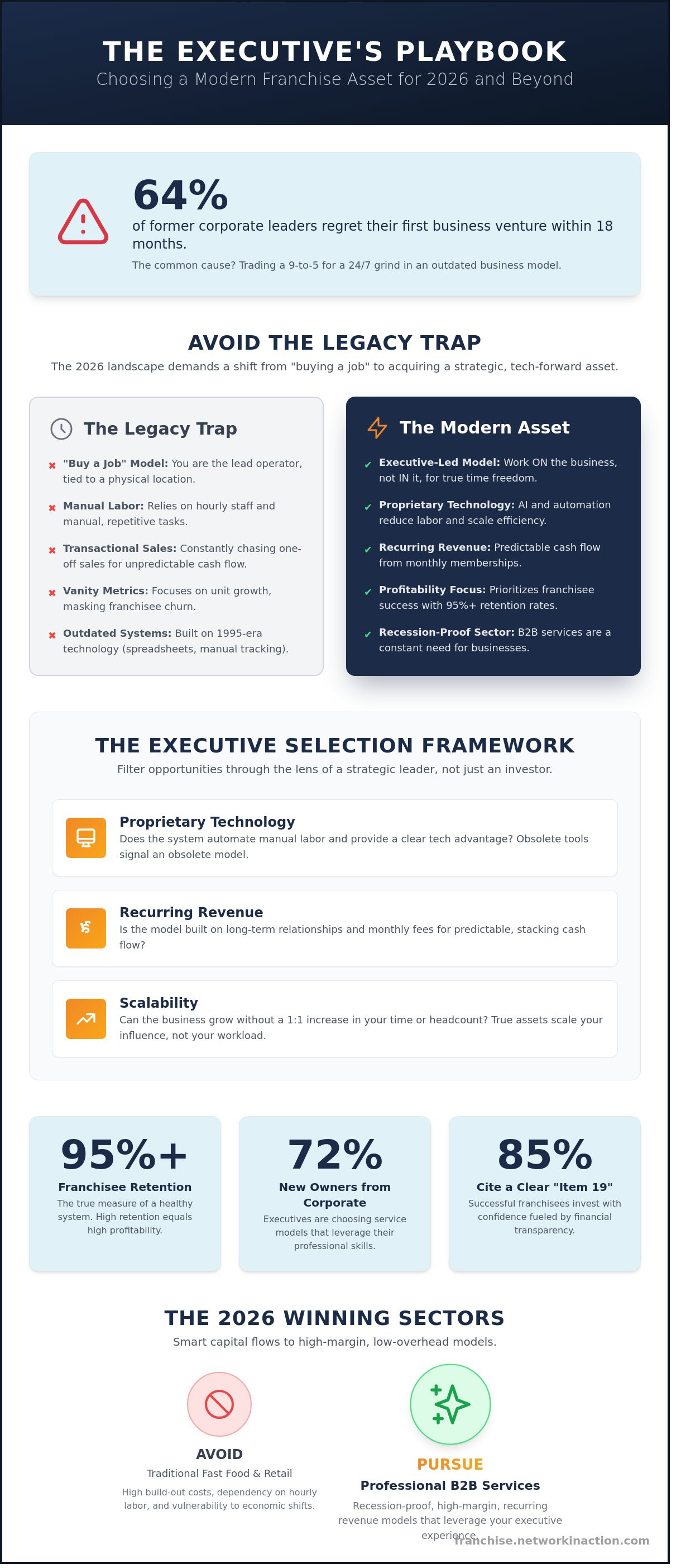
Why do 64% of former corporate leaders regret their first business venture within 18 months of leaving their executive roles? It's usually because they traded a 9-to-5 for a 24/7 grind in a business model that hasn't evolved since 1995. You've earned your seat at the table through strategic leadership and high-stakes decision-making. You don't need a franchise that requires you to manage hourly staff or flip burgers; you need a sophisticated, ROI-driven asset. Finding the right fit among the top ten franchises requires a lens that prioritizes scalability, recurring revenue, and modern efficiency over legacy systems.
You recognize that the 2026 economic landscape demands more than just a brand name. It requires a turnkey operation that leverages your existing network and professional credibility. This selection guide identifies the most profitable opportunities tailored for high-level professionals seeking a strategic exit from the corporate world. You'll learn how to secure a business that offers time freedom through proprietary technology rather than manual labor. We'll examine the specific sectors that remain recession-proof while providing the lifestyle autonomy you've spent your career pursuing.
Key Takeaways
- Identify high-margin professional service models that prioritize franchisee profitability and retention over vanity metrics like unit growth.
- Discover why professional networking and tech-enabled home services dominate the 2026 list of the top ten franchises for ROI-driven executives.
- Leverage a modern selection framework to evaluate proprietary technology and recurring revenue streams that ensure long-term scalability and operational efficiency.
- Escape the inefficiencies of outdated networking models by transitioning to curated, high-quality professional communities designed for modern business leaders.
- Execute a precise 90-day launch strategy to secure high-growth territories and achieve a seamless transition from corporate executive to business owner.
Evaluating the 2026 Franchise Landscape: Beyond Unit Growth
The franchise market has undergone a fundamental transformation since 2024. Smart capital is moving away from the $1 million build outs of traditional fast food. It's flowing into high margin professional services. When evaluating the top ten franchises for your portfolio, look past total unit count. This is a vanity metric that often masks systemic churn. High performing systems focus on franchisee profitability and 95% retention rates over sheer volume. Success in 2026 relies on proprietary technology and AI integration to automate low value tasks. This allows you to scale without a massive headcount. This informed disruption separates legacy brands from modern, tech forward assets.
The Death of the "Buy a Job" Model
Traditional franchising often forces you into a "buy a job" scenario where you're the lead operator. Modern executives are rejecting this. They want executive led models that prioritize lifestyle autonomy. By 2026, 72% of new franchise owners are coming from corporate leadership roles. They aren't looking to manage a retail counter. They want to lead communities and build assets. These professionals choose service based models that leverage their existing skill sets rather than requiring them to learn manual labor. It's about working on the business, not in it.
Economic Resilience in Professional Services
B2B service models offer a level of stability that consumer discretionary brands lack. While retail traffic fluctuates with interest rates, businesses always need growth and networking solutions. Recurring revenue models create long term wealth by stacking monthly fees rather than chasing one off sales. This approach builds a recession resistant foundation. For those seeking more depth, explore these Top Executive Business Opportunities in 2026. The top ten franchises in this category utilize lean overhead and high efficiency systems to maximize your ROI from day one. They provide a strategic path to time freedom through meaningful community impact.
- Focus on high margin, low overhead service models.
- Prioritize systems with 90% or higher franchisee satisfaction scores.
- Identify proprietary technology that reduces labor costs.
- Seek out recurring revenue structures for predictable cash flow.
The Executive Selection Framework: How to Rank the Best Franchises
Identifying the top ten franchises requires looking beyond brand recognition to operational efficiency. For high-level professionals, the goal isn't to buy a job; it's to secure a scalable asset. Use this framework to filter opportunities through the lens of an executive leader. Networking evolved, and your investment strategy should reflect that progress.
- Proprietary Technology: Modern brands offer a tech-forward platform that automates manual labor. If a system relies on manual tracking and spreadsheets, it's already obsolete.
- Recurring Revenue: Transactional businesses are exhausting. Seek models built on long-term relationships and monthly membership fees to ensure predictable cash flow.
- Scalability: A superior business grows without a 1:1 increase in headcount. You want a model where your influence expands while your overhead remains lean.
- Training and Support: Seasoned leaders require a turnkey onboarding process. The system should be robust enough to allow you to hit the ground running within 30 to 60 days.
- Community Impact: The best franchises empower you to lead and influence your local business market, positioning you as a central figure in professional circles.
Analyzing the Franchise Disclosure Document (FDD)
The FDD reveals the true health of a franchise system. Look for transparency in royalty fees and technology access costs to ensure there are no hidden drains on your capital. Item 19 is the single most critical section for understanding ROI projections and historical financial performance. In 2024, 85% of successful franchisees cite a clear Item 19 as the primary reason they felt confident in their initial investment. Transparency isn't just a courtesy; it's a requirement for a professional partnership.
The Time-Value Metric for Owners
Traditional ROI calculations often ignore your most precious resource: your time. You must calculate the "Return on Time" alongside traditional financial metrics. Outdated networking models demand rigid, weekly meetings that consume 10 to 15 hours of your week without a guaranteed payoff. Monthly meeting models outperform these legacy structures by respecting your calendar and focusing on high-level connections. This efficiency allows you to manage multiple territories or maintain other professional interests simultaneously. To see a modern model in action, you can download the franchise kit and evaluate how technology drives results. Selecting from the top ten franchises means choosing a path that prioritizes your lifestyle freedom and your bottom line.
The Top Ten Franchise Categories and Brands to Watch in 2026
The landscape for the top ten franchises in 2026 has shifted away from high-overhead retail toward lean, tech-enabled service models that prioritize recurring revenue. Investors are no longer looking for "jobs" they own; they're looking for scalable platforms that leverage professional influence. Success in the current market requires a move away from legacy networking organizations that demand time without delivering a clear ROI. Instead, the focus is on sectors that solve modern business and lifestyle friction.
- Professional Networking and Referral Organizations: This sector is leading the B2B service industry by replacing the "coffee and donuts" approach with sophisticated, technology-led membership models.
- Home Services and Maintenance: With 50% of the U.S. housing stock now over 40 years old, high-demand maintenance franchises are utilizing AI-driven dispatching to dominate local markets.
- Health and Wellness: Boutique fitness and specialized medical franchises, particularly those focusing on longevity and recovery, are projected to see a 15% compound annual growth rate through 2026.
- Business Consulting and Coaching: High-level executives are increasingly pivoting to consulting, using established franchise systems to turn decades of corporate experience into local community leadership.
Professional Services: The ROI Leader
Modern networking franchises are disrupting the business development industry by treating social capital as a measurable asset. You aren't just joining a club; you're building a high-margin business where you own the referral network. This model eliminates the "grind" of traditional networking. By curating a room of high-level professionals rather than accepting anyone with a checkbook, you create an exclusive environment that justifies premium membership fees. The overhead is minimal, often requiring no physical office, which allows for a faster path to profitability compared to high-cost retail or food franchises.
Tech-Enabled B2B Solutions
The most successful B2B franchises in 2026 provide proprietary platforms that solve digital marketing or operational efficiency for small business owners. These systems are essential because they provide a competitive edge that a solo consultant cannot replicate. For those ready to transition into this space, it's vital to understand the metrics of success. You can learn more by reviewing the guide on How to Evaluate Available Franchise Opportunities. These tech-enabled models ensure that your value proposition is backed by data, making the sales process a logical consultation rather than a high-pressure pitch.
Avoiding the Legacy Trap: Modern vs. Outdated Networking Models
Networking evolved, but legacy networking organizations stayed frozen in the past. They cling to forced referrals and transactional requirements that alienate the modern executive. When you analyze the top ten franchises for first-time owners, the most successful models prioritize efficiency over tradition. Legacy groups operate on a quantity-over-quality basis. They demand weekly commitments that feel like an exhausting second job rather than a strategic asset. You don't build influence through mandatory "busywork"; you build it through results. Real growth requires a system designed for the 21st-century professional.
The Flaws of Traditional Networking
Traditional networking models are fundamentally broken for the high-level professional. They enforce a rigid schedule of 52 in-person meetings per year. This is a significant barrier for business owners managing multiple locations or demanding travel schedules. This "old-school" approach relies on manual tracking systems that are prone to error. Key inefficiencies include:
- Loss of data: Manual logs result in a 22% drop in referral accuracy.
- Time waste: 7:00 AM weekly meetings exclude 65% of top-tier executives who prioritize their morning productivity.
- Transactional focus: Forced referrals prioritize quantity over genuine business value, leading to referral fatigue.
These legacy structures focus on the "club secretary" mentality. The leader spends more time on administrative tasks than on high-level business development. It's an inefficient use of social capital that leads to professional burnout and stagnant growth.
The Modern Evolution: Quality Over Quantity
Modern networking is built on informed disruption. A 2023 industry analysis revealed that 74% of modern executives prefer monthly, high-impact engagements over weekly commitments. By shifting to a once-a-month meeting model, you attract sophisticated members who value their time. This tech-enabled approach uses proprietary platforms to facilitate connections between sessions. It moves away from the inefficiency of cold prospecting and toward relationship-driven growth. It's a key reason why this model stands out among the top ten franchises for professionals. You position yourself as a community leader who provides a 100% ROI-driven environment. This focus on quality ensures every interaction is a strategic move toward growth rather than a box to check. It's networking evolved for the high-growth business environment.
Ready to see how technology is redefining the industry? Check available territories today.
Securing Your Territory: From Executive to Network Owner
Transitioning from a corporate executive role to business ownership is a calculated move that requires a high-growth vehicle. When analyzing the top ten franchises for 2026, the most successful candidates prioritize low overhead and high scalability. The Network In Action (NIA) model is designed for this specific transition. It moves you from the corporate grind to a position of local influence within a 90-day launch window. This isn't about starting from scratch; it's about monetizing the professional equity you've built over decades.
Assessing territories for 2026 requires looking at markets where professional services are densifying. Recent data indicates a 15 percent increase in executive-level professionals seeking localized, high-quality business communities. By securing a territory now, you position yourself at the center of this migration. NIA’s proprietary technology and ROI-driven systems ensure that your launch is efficient and your revenue is recurring. You don't need a storefront or a massive staff. You need a laptop, a phone, and the drive to lead a sophisticated group of business owners. This model represents the future of the top ten franchises because it values your time as much as your income.
Steps to Launching a Successful Franchise
Success begins with a rigorous due diligence process. This starts with the initial discovery call and progresses through a detailed review of the Franchise Disclosure Document before signing the license agreement. You'll need to shift your mindset from a task-oriented employee to a visionary business owner. This transition is supported by a turnkey system that eliminates the guesswork. You should check available territories immediately to determine if your market is still open for development.
Your Strategic Move Starts Here
Building an immediate return on investment is achieved by leveraging your existing professional network. Instead of cold calling, you're inviting high-level peers into a modernized ecosystem that rejects the rigid, transactional nature of legacy networking organizations. You can begin building your influence today by downloading a free book on networking that outlines the NIA methodology. This is the ultimate leadership play for those ready to disrupt a stale industry. 2026 is the year to own the network, not just work it.
Own the Network and Control Your 2026 ROI
Selecting from the top ten franchises for 2026 requires a shift in perspective. You must look past surface-level unit counts and focus on models that respect your time and professional pedigree. Legacy networking organizations often force executives into rigid, manual processes that feel outdated and inefficient. Modern leadership demands a tech-forward approach that emphasizes quality relationships over forced referrals. Success in the next decade belongs to those who trade the corporate ladder for a scalable, recurring revenue model built on community influence.
Network In Action has already established over 150 global locations by perfecting this transition. The brand's proprietary tech-enabled platform and monthly meeting model are specifically engineered for the executive lifestyle. You don't have to settle for the "old-school" grind when you can leverage a system that prioritizes efficiency and measurable social capital. It's time to stop managing someone else's vision and start securing your own territory with a business built for the future.
Download the NIA Franchise Kit and Discover the Future of Networking
Your expertise is your greatest asset. Use it to build something that lasts.
Frequently Asked Questions
What are the top ten franchises with the lowest startup costs in 2026?
The top ten franchises with the lowest startup costs in 2026 typically fall within the $40,000 to $75,000 range, focusing on service-oriented models that eliminate expensive real estate overhead. These low-capital entries allow entrepreneurs to achieve a faster break-even point by prioritizing digital infrastructure over brick-and-mortar storefronts. By 2026, home-based professional services will dominate this list because they leverage proprietary technology to scale without the 10-year leases required by traditional retail.
How much can a professional service franchise owner expect to earn?
Professional service franchise owners can expect to earn between $150,000 and $450,000 in gross annual revenue once their territory reaches maturity after 24 months of operation. Unlike retail models with thin 5% margins, service franchises often boast profit margins exceeding 40% due to low variable costs. Success depends on your ability to cultivate high-value relationships and utilize automated systems that replace manual administrative tasks, ensuring your time is spent on revenue-generating activities.
What is the most profitable franchise category for former executives?
Business-to-business (B2B) networking and consulting is the most profitable franchise category for former executives who want to monetize their existing professional capital. These models allow leaders to exit the 60-hour work week while maintaining an executive-level income through recurring membership fees. While legacy networking organizations focus on volume, modern B2B models prioritize high-caliber memberships, resulting in a 25% higher retention rate for owners who understand sophisticated market dynamics and professional efficiency.
Is it better to buy a new franchise or an existing territory?
Buying a new franchise territory is better for those seeking maximum scalability and lower initial buy-in costs, while existing territories offer immediate cash flow at a premium price. New territories allow you to build a culture from the ground up, often requiring 30% less upfront capital than a resale. For a strategic professional, the blank slate of a new market provides the freedom to implement modern, tech-driven systems without fighting the outdated habits of a previous owner's staff.
How do I evaluate a franchise's proprietary technology platform?
You evaluate a franchise's proprietary technology platform by measuring its direct impact on member ROI and your own operational efficiency. A superior platform must automate 80% of routine tasks like scheduling, billing, and referral tracking to ensure you aren't stuck in administrative hell. Demand to see real-time data integration; if the system feels like a clunky 2010-era CRM, it will likely hinder your growth and frustrate the high-level professionals you aim to serve.
Can I run a top-rated franchise while maintaining my current job?
You can run a top-rated franchise while maintaining your current job if you select a model specifically designed for 10 to 15 hours of weekly commitment. Approximately 40% of top ten franchises in the professional networking space utilize fractional ownership structures that rely on technology to handle the heavy lifting. This allows you to build a recurring revenue stream during your evening hours, eventually providing a seamless transition from corporate employee to full-time business owner.
What are the common mistakes to avoid when selecting a top ten franchise?
The most common mistake is choosing a legacy brand that relies on rigid, manual referral systems rather than modern, relationship-driven technology. First-time owners often get seduced by a famous name, only to realize the model is transactional and requires 40 hours of manual busy work every week. Avoid franchises that force participation through mandatory attendance or quotas, as these old-school methods drive away the high-quality professionals who build your long-term wealth.
How does a service-based franchise handle recessionary periods?
A service-based franchise handles recessionary periods by providing essential business growth tools that companies need most when the economy tightens. During the 2008 and 2020 downturns, B2B service models saw increased demand as businesses pivoted away from expensive traditional advertising toward more cost-effective, relationship-based lead generation. Because these models carry zero inventory and minimal overhead, they can maintain a 35% profit margin even when consumer spending in the retail sector drops significantly.