Why do 75% of high-level executives fail to achieve their projected ROI within the first 18 months of launching a private venture? The transition from the boardroom to the founder's chair often reveals a hard truth: the corporate safety net didn't just provide resources; it masked the need for a specific set of new business owner skills. You've likely felt the weight of the jack-of-all-trades requirement, watching your calendar fill with low-leverage tasks while legacy networking groups offer nothing but stale coffee and zero accountability.
You already know that success isn't about working harder; it's about building more efficient systems. This guide promises to reveal the high-leverage strategic, technological, and relational skills required to turn your professional background into a scalable, recurring revenue engine. We'll preview a roadmap that ditches cold prospecting for high-level community leadership and proprietary technology. You'll learn how to leverage your existing network to secure lifestyle autonomy without the friction of outdated business models. It's time to move beyond the grind and master the architecture of ownership.
Key Takeaways
- Shift your mindset from a task-oriented executive to a visionary architect who builds and owns high-performance business ecosystems.
- Master strategic financial literacy by transitioning from simple budget management to deploying capital for aggressive, ROI-driven growth.
- Replace inefficient, traditional networking models with engineered referral networks that focus on curated, high-quality professional connections.
- Leverage proprietary technology to automate administrative tasks and master the new business owner skills required to scale a modern operation.
- Accelerate your path to ownership by utilizing a proven turnkey blueprint that offers the scalability and recurring revenue of a professional community.
The Psychological Pivot: Shifting from Corporate Executive to Business Architect
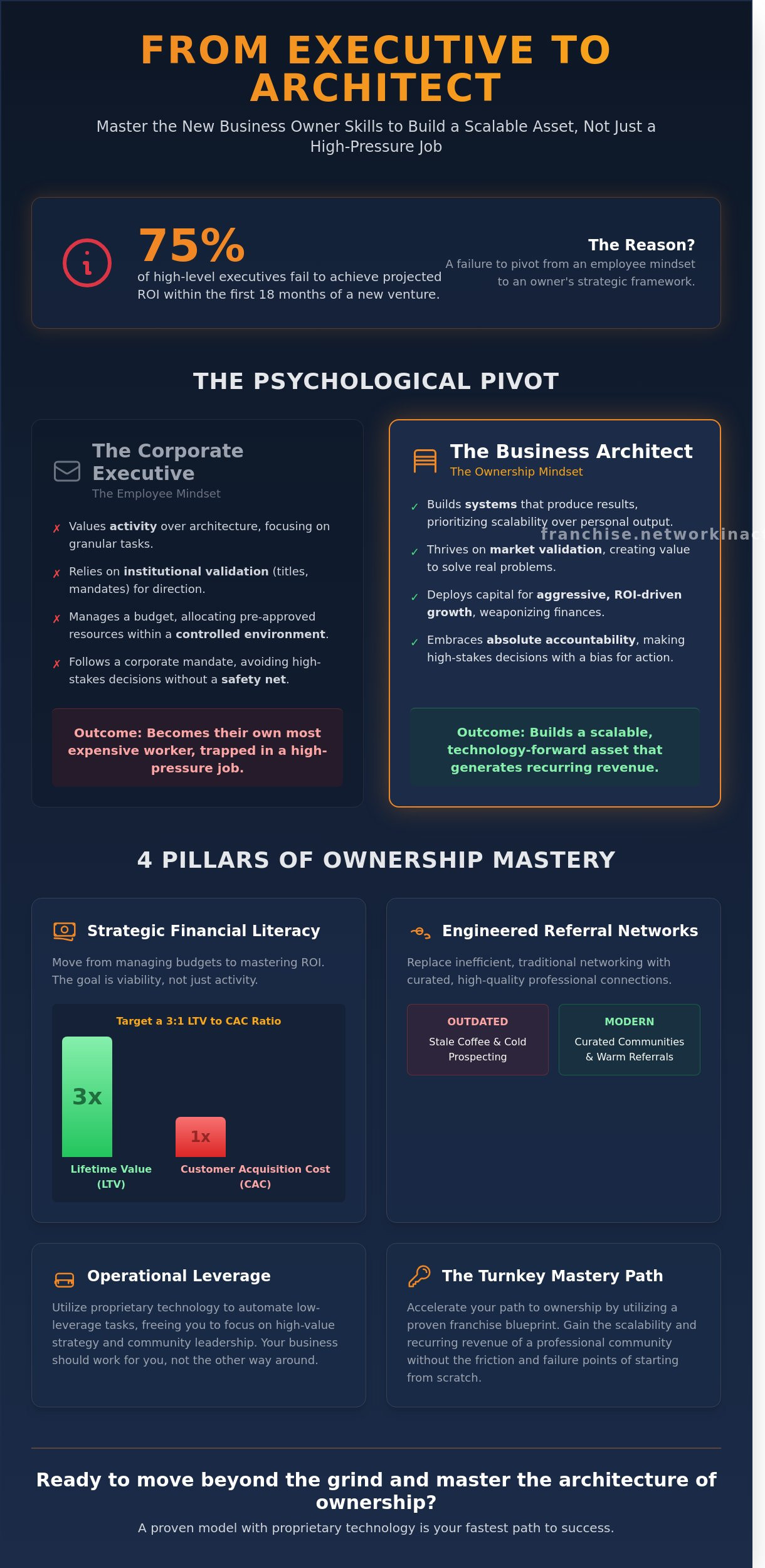
Managing a department is a controlled exercise in resource allocation; owning an ecosystem is a raw act of creation. The shift from corporate leader to business owner represents the most significant hurdle during the first 12 months of operation. Data from 2024 indicates that 20 percent of new businesses fail within their first year, often because the owner remains trapped in an "employee mindset" that values activity over architecture. You aren't just a manager anymore. You're the designer of an entire professional environment.
The Employee to Entrepreneur Evolution
Corporate success usually relies on institutional validation. In the executive suite, you have a title, a budget, and a predefined mandate. In the open market, those safety nets vanish. Developing an entrepreneurial mindset requires shedding the need for external approval to find true market fit. Many founders fall into the "employee trap" by becoming their own most expensive workers, focusing on granular tasks instead of high-level leverage. A Business Architect builds systems that produce results rather than performing the labor that generates them. Mastering these new business owner skills means moving from a task-oriented schedule to a results-driven vision that prioritizes scalability over personal output.
Decision-Making Under Absolute Accountability
Legacy networking organizations often rely on rigid, slow-moving structures that stifle growth. Your business cannot afford that stagnation. You must master high-stakes decision-making without the safety net of a board of directors or a legal department. Success in 2026 demands a bias for action. Analysis paralysis kills momentum and drains capital. You'll need to balance long-term strategic vision with the immediate reality of operational survival. This isn't about following a corporate mandate; it's about leading a community with precision. Efficiency and ROI are your only metrics. You're building a scalable, technology-forward asset that serves a purpose, not a high-pressure job that consumes your life. For those ready to leave the corporate structure behind, the first step is often exploring available territories to see where your local influence can be built.
- Systemic Thinking: View your business as a machine with inputs and outputs, not a list of chores.
- Radical Responsibility: Accept that every failure and success starts and ends with your choices.
- Value Creation: Focus on how your ecosystem solves problems for others rather than how much time you spend working.
The transition requires resilience. Leading a community of professionals means you're no longer a cog in a machine; you're the engine itself. This psychological pivot is the foundation upon which all other new business owner skills are built. Without it, you aren't an owner. You're just a worker with a very expensive title.
Strategic Financial Literacy: Beyond Basic Accounting to ROI Mastery
Strategic financial literacy isn't about balancing a checkbook; it's about weaponizing capital. Modern new business owner skills must evolve from basic accounting to ROI mastery. You need to understand your unit economics. This means knowing exactly how much profit each individual customer generates after all variable costs. If your Customer Acquisition Cost (CAC) exceeds your Lifetime Value (LTV), your business is a ticking clock. Successful owners focus on a 3:1 LTV to CAC ratio to ensure long-term viability. Mastery of these new business owner skills ensures you aren't just buying a job, but building an asset.
When following a standard guide to starting a business, you'll learn the basics of registration and tax IDs. To properly handle these crucial first steps, many entrepreneurs seek guidance from legal experts like Nanda & Associate Lawyers Professional Corporation. However, true ownership requires deploying capital for growth rather than just managing a budget. This shift allows you to build recurring revenue streams. These streams provide the predictability needed to scale without constant manual intervention. It’s the difference between chasing the next sale and architecting a self-sustaining ecosystem.
ROI-Driven Resource Allocation
Stop wasting time on low-impact activities. Your social capital is as valuable as your cash. Prioritize investments with the highest return. Avoid the sunk cost fallacy at all costs. If a marketing channel hasn't produced a quality lead in 90 days, cut it immediately. Evaluate every hour spent on business development. If an hour doesn't move you closer to a 20% growth target, reallocate it. Efficiency is the only metric that matters for the modern leader who values time freedom.
Cash Flow Management for the Modern Owner
Cash flow is your lifeblood. Profit is a theory; cash is a fact. 82% of small businesses fail due to cash flow issues, according to a 2023 study by U.S. Bank. Build a war chest that covers at least six months of operating expenses. This liquidity lets you make informed disruptions in your local market while legacy networking organizations struggle to adapt. Use financial data to predict seasonal dips. This foresight transforms a reactive manager into a visionary architect. If you're ready to apply this financial logic to a scalable model, explore available territories that offer high-margin potential and recurring revenue.
Modern Relationship Management: Engineering High-Quality Referral Networks
Traditional networking is an obsolete time-sink. Legacy networking organizations often force members into a rigid, transactional grind that yields low-quality leads and high-volume frustration. For the modern executive, spending 50 hours a year on mandatory weekly breakfasts is a poor use of capital. You need a superior alternative that prioritizes "curated connection" over simple presence. This involves selecting members based on professional synergy and proven track records rather than just filling a seat in a room. To succeed in 2026, you must position yourself as a community leader who engineers high-level opportunities rather than a salesperson chasing a lead.
The Science of Strategic Referrals
Building a referral-based empire eliminates the need for cold prospecting; a tactic that fails 98% of the time in B2B environments. You must develop "super-connector" status to increase your professional credibility. This isn't a soft skill; it's a calculated strategy. By utilizing Network In Action principles, you maximize the ROI of every meeting through proprietary technology and structured efficiency. Integrating essential skills for new business owners, such as strategic relationship mapping, ensures that your network becomes a predictable revenue driver. Data from 2024 indicates that businesses built on curated referrals see a 70% higher retention rate because trust is established before the first pitch.
Curating a High-Level Professional Circle
Networking evolved means fewer meetings with higher-level participants. You must vet business partners for alignment with your brand's sophistication. This vetting process turns "social capital" into a measurable asset on your balance sheet. Unlike the forced-referral models of the past, modern systems rely on genuine professional respect. These new business owner skills allow you to build a circle of influence that functions as an external board of directors. Every member is a high-achiever, ensuring that the 12 meetings you attend annually provide more value than 52 weekly sessions in an outdated model. It’s about efficiency, scalability, and results-oriented growth. This is the future of networking: a tech-forward, elite ecosystem designed for those who value time as much as revenue.
Operational Leverage: Utilizing Proprietary Technology for Scalability
Modern business owners don't hire a dozen administrative assistants. They leverage code. Operational leverage means getting more output for every hour of input. One of the most vital new business owner skills in 2026 is the ability to audit your tech stack for true ROI. Legacy networking organizations rely on manual sign-in sheets and clunky email chains. That's a waste of potential. You need systems that act as an invisible workforce, managing the mundane tasks so you can focus on high-level relationship building. This shift creates informed disruption. It solves the 40 percent attrition rates seen in old-school industries by replacing friction with seamless digital experiences.
Tech-Enabled Networking and Management
Proprietary platforms allow you to maintain member engagement without 20 hours of weekly manual labor. Sophisticated tools track referral data and social capital in real time. This provides concrete evidence of value to your community. When you can show a member they achieved a 5x return on their investment through your platform, the "sell" becomes a logical conclusion. Streamlined digital tools remove the friction from the customer journey, ensuring that every interaction feels elite and professional.
Building Scalable Systems from Day One
Scalability is built into the architecture of your business, not added later. You must document processes so the machine runs without your constant intervention. Selecting a turnkey business opportunity allows you to bypass the expensive trial and error phase that kills 20 percent of new businesses in their first year. Software isn't an expense; it's a multiplier of your personal effort. By automating billing, member communication, and reporting, you protect your time. This ensures your business model supports lifestyle autonomy rather than chaining you to a desk.
Ready to lead a high-tech professional community? Explore available territories and see how NIA technology drives growth.
The Turnkey Mastery Path: Why Franchising Accelerates Skill Acquisition
Starting a venture from zero is a low-ROI move for seasoned executives. It's an inefficient use of professional capital. Why spend 1,000 hours building a back-end framework when you can acquire a perfected blueprint on day one? High-level professionals understand that time is the only non-renewable resource. In the current market, 20% of new businesses fail within their first year because they lack the structural integrity to survive operational friction. Franchising eliminates this vulnerability by providing a proven roadmap for community leadership.
Leveraging corporate training and ongoing support allows you to master new business owner skills at a pace that independent startups can't match. You aren't guessing which technology stack to use or how to structure a meeting. You're implementing a system designed for high-velocity growth. This established framework creates a strategic path to time freedom, allowing you to act as a Visionary Architect rather than a technician buried in administrative tasks.
The Low-Risk Transition to Ownership
A franchise provides the essential structure that most new business owners lack. It's the difference between building a house without a plan and walking into a finished estate. By removing the need to reinvent the operational wheel, you focus your energy on growth and high-level networking. This model ensures your business aligns with your desired lifestyle from the start. You're investing in a scalable asset that produces recurring revenue, not just another high-pressure job. Legacy networking organizations often rely on rigid, transactional models that drain time; NIA offers a modernized alternative built on efficiency and measurable ROI.
Taking the Next Step Toward Leadership
Mastering new business owner skills requires a shift from executing tasks to leading ecosystems. NIA's proprietary technology and curated membership model provide the tools to dominate your local market. You can explore available territories to find where your leadership is needed most. To dive deeper into the methodology that has disrupted the networking industry, download the free book today. Your immediate action step is simple: evaluate your current professional skill set against the NIA model and decide if you're ready to lead the future of networking. Don't settle for outdated systems when you can own the solution.
Architect Your Path to Local Leadership
Success in 2026 hinges on your ability to transition from a corporate operator to a visionary architect. You've identified that the most critical new business owner skills involve mastering ROI-driven networking and utilizing operational leverage. Traditional networking models are failing because they rely on manual, high-friction processes that don't respect your time. Modern ownership requires a pivot toward systems that guarantee efficiency and recurring value. It's about moving beyond the transactional to build a scalable, professional legacy.
Network In Action has already modernized this landscape across over 150 locations worldwide. By integrating a proprietary technology platform with a sophisticated relationship-management framework, the brand removes the clunky inefficiency found in legacy organizations. This isn't just about making connections; it's about engineering a scalable asset that delivers measurable results for every member. You don't need to reinvent the wheel when a turnkey, tech-forward solution is ready for deployment. The tools for disruption are already in place.
The transition to business ownership is a strategic move toward lifestyle autonomy and professional influence. Take the next step to secure your territory and redefine how your city does business. Explore strategic franchise opportunities and lead your local business community. Your future as a community catalyst starts today.
Frequently Asked Questions
What are the most critical skills for a first-time business owner?
The most critical new business owner skills include financial fluency, strategic networking, and the ability to leverage automated systems. You must master the 82 percent of business failures attributed to poor cash flow management by tracking ROI on every marketing dollar spent. Building a high-quality referral engine replaces the need for expensive, cold prospecting. This shift allows you to focus on high-level growth rather than daily survival.
How can I transition from a corporate job to business ownership safely?
Secure a transition by choosing a business model with a proven 90 percent success rate, such as a structured franchise. You should maintain a minimum of six months of operating capital before resigning from a corporate role. Use your existing professional network to build a foundation of 20 to 30 core contacts. This strategy ensures you don't start from zero when you launch your new venture.
Why is networking considered a strategic business skill in 2026?
Networking is a strategic skill because 85 percent of high-value business deals originate through trusted referrals. In 2026, the marketplace rewards those who build curated ecosystems rather than those who collect business cards. It's about moving away from the "spray and pray" method of legacy networking organizations. You're building an asset that generates recurring revenue through high-level social capital and professional influence.
What is the difference between traditional networking and modern referral groups?
Traditional networking relies on weekly, time-consuming meetings and forced referrals that often lack quality. Modern referral groups utilize proprietary technology to track real-time ROI and facilitate monthly, high-impact gatherings. This evolution saves you over 40 hours of unproductive meeting time per year. You'll find that modern models prioritize the quality of the connection over the quantity of the business cards exchanged.
How much financial knowledge do I really need to start a business?
You need a functional understanding of three core financial documents: the balance sheet, the profit and loss statement, and the cash flow forecast. Successful owners track their customer acquisition cost and ensure it remains 3 times lower than the lifetime value of a client. Financial literacy isn't about being an accountant; it's about making data-driven decisions that protect your margins and fuel your scalability.
Can I learn business ownership skills through a franchise model?
A franchise model provides a turnkey system to master new business owner skills without the 5 to 10 years of trial and error typical of independent startups. You gain access to proprietary technology and established operational workflows from day one. This structure allows you to act as a community leader while the franchisor manages the backend development. It's the most efficient way to scale influence and income simultaneously.
What is the "Visionary Architect" mindset in entrepreneurship?
The Visionary Architect mindset focuses on building scalable systems rather than performing manual labor. You design the framework where others succeed, ensuring the business operates independently of your constant physical presence. This approach targets a 30 percent higher efficiency rate by automating repetitive tasks. It's about moving from a "worker" role to a "builder" role, where your primary asset is the infrastructure you've created.
How does proprietary technology help a new business owner scale?
Proprietary technology eliminates the clunky, manual processes found in legacy networking organizations, allowing you to manage 50 to 100 members with minimal effort. Automated tracking provides instant visibility into referral conversion rates and member engagement levels. This data-driven approach ensures you spend your time on high-value relationships rather than administrative tasks. It's the difference between running a hobby and scaling a professional enterprise.