Your 5,000 digital connections are likely worth less than five minutes with a single vetted decision-maker. You've likely spent hours networking in social media only to be met with automated spam and low-tier outreach that drains your calendar. It's frustrating to watch your screen time climb while your actual conversion rates remain stagnant. This is the reality of the digital noise era where quantity has officially killed quality.
You deserve a strategy that respects your time and your bottom line. This 2026 ROI guide reveals why digital reach is only half the battle and shows you how to transition from social media noise to high-ROI professional networks. We're moving past the clunky, legacy networking organizations of the past to embrace a modernized, tech-forward approach that values measurable results over mere participation.
You'll discover how to leverage proprietary technology to secure high-quality, vetted referrals and reclaim 15 hours of monthly productivity. This is the Future of Networking. It's time to stop scrolling and start scaling with a streamlined strategy designed for high-level professional growth.
Key Takeaways
- Stop confusing digital activity with professional achievement by evolving your approach to networking in social media from broad friend-finding to targeted ecosystem building.
- Analyze the hidden opportunity costs of performative engagement and learn why structured referral quality consistently outperforms the daily social media maintenance grind.
- Implement a two-step strategic framework that utilizes broad digital visibility for research while prioritizing curated environments for high-ROI professional synergies.
- Identify how modern technology and structured groups disrupt the inefficiencies of legacy networking organizations to deliver superior, measurable results.
- Discover the economics of owning a results-driven networking franchise to transform community leadership into a scalable, high-margin revenue model.
The Evolution of Networking in Social Media in 2026
Networking in social media has transitioned from a passive activity into a high-stakes digital storefront. By 2026, the era of "friend-finding" is extinct for serious professionals. You aren't just maintaining a profile; you're engineering a professional ecosystem. This shift demands a move away from transactional digital interactions that feel scripted and hollow. In a market saturated with AI-generated noise, your digital presence must function as a beacon of credibility. If your profile doesn't project authority within three seconds, you've lost the opportunity before the first message is even sent.
Modern networking evolved to prioritize targeted ecosystem building over broad outreach. Sophisticated entrepreneurs now treat social platforms as validation engines. They use these spaces to signal their market position and filter out low-value interactions. This isn't about who you know in a general sense. It's about who recognizes your expertise when a high-ticket problem arises. The goal in 2026 is to leverage digital tools to facilitate real-world ROI, not to accumulate vanity metrics that don't impact your bottom line.
The Reach Paradox: Why More Connections Mean Less Value
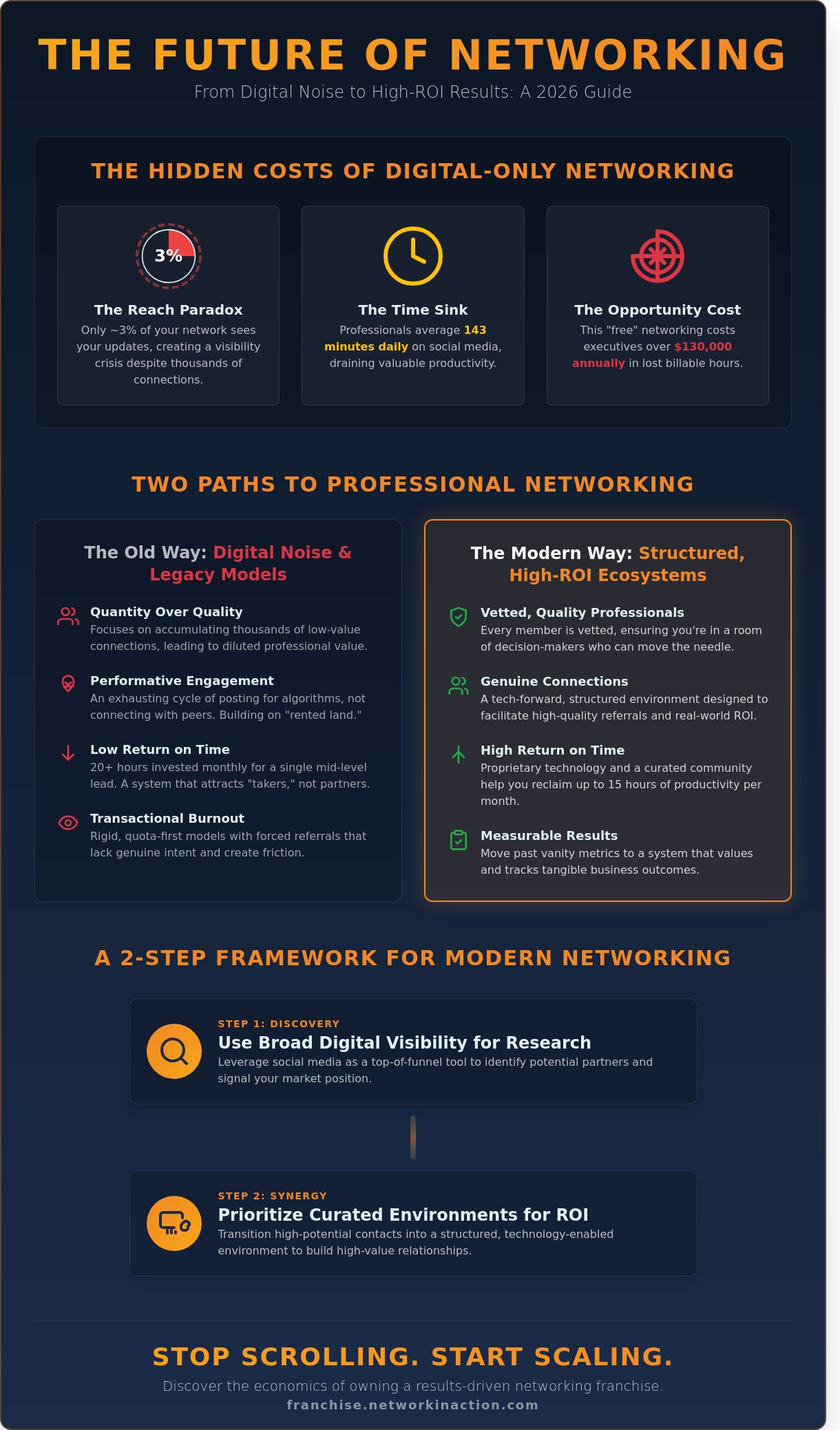
The "Dunbar’s Number" limitation remains a hard reality in a hyper-connected age. Research shows humans can only maintain roughly 150 stable relationships. When you cross the threshold of 5,000 digital connections, your professional value begins to dilute. A thousand digital connections rarely equal a single high-quality referral because trust doesn't scale linearly. Algorithmic feeds now suppress organic reach, ensuring only 3% of your network sees your updates. This creates a visibility crisis. Legacy networking organizations often fall into this trap, prioritizing quantity while ignoring the diminishing returns of a bloated, uncurated list of contacts.
Social Media as a Top-of-Funnel Discovery Tool
Use social platforms for initial discovery and brand positioning rather than deep closing. In 2026, the noise floor has risen by 45% due to automated content proliferation. To stand out, you must transition a "follower" into a "professional acquaintance" through strategic, high-value interactions. Social media is the handshake, not the contract. It's a tool to identify potential partners before moving them into a structured, technology-enabled environment. Effective professionals use these platforms to filter the noise, ensuring that by the time a face-to-face meeting occurs, the groundwork for a high-ROI relationship is already laid.
The Hidden Costs of Traditional Digital-Only Networking
Networking in social media often feels like a high-octane growth strategy until you audit the clock. A 2024 report by GWI shows professionals spend an average of 143 minutes daily on social platforms. For an executive billing $250 hourly, that’s over $130,000 in lost productivity every year. This "free" engagement is actually a massive tax on your most finite resource. It's an expensive hobby masquerading as a business development plan.
Digital platforms demand "performative networking." It’s an exhausting cycle of posting for an algorithm rather than connecting with a peer. Relying solely on networking in social media means you’re building your professional reputation on rented land. When a platform shifts its code, your reach can vanish overnight; many users saw organic visibility drop by 30% in the last 18 months alone. Legacy networking organizations and open-door digital groups suffer from the same dilution. They prioritize volume over value, leaving high-level leaders drowning in noise.
Transactional Burnout: The Flaw in Legacy Models
Traditional networking models are often rigid, requiring weekly attendance and "forced referrals" that lack genuine intent. This "quota-first" mentality creates a transactional environment where quality is sacrificed for a spreadsheet entry. High-level executives avoid these open-door digital groups because they lack curation. They don't want a 500-person Slack channel; they want a room of ten people who can actually move the needle. The noise-to-signal ratio in these legacy environments is simply too high for anyone managing a seven-figure P&L.
The ROI Gap: Measuring Social Capital Properly
Calculate your Return on Time Spent (ROTS) by dividing your total revenue from networking by the hours invested in outreach. If you’re spending 20 hours a month for one mid-level lead, your system is failing. Free networking is the most expensive option for serious business owners because it lacks a filter. It attracts "takers" who consume your time without offering reciprocal value. High-stakes growth requires a curated environment where every participant is vetted and invested.
Modern networking isn't about how many people you know; it's about the caliber of the people who will take your call. If you're ready to stop shouting into the digital void, you can explore available territories to lead a more efficient community. Focus on these three metrics to evaluate your current groups:
- Member Density: The percentage of members who are decision-makers versus entry-level sales reps.
- Referral Integrity: The ratio of closed deals to total leads exchanged.
- Time Efficiency: The total monthly hours required to maintain the network versus the revenue generated.
Social Media vs. Structured Professional Groups: A Comparison
Social media is a digital town square where everyone shouts but few listen. Structured professional groups operate like high-stakes boardrooms where every word carries weight. While networking in social media often demands a 60-minute daily grind to stay relevant, modern structured groups focus on a single 90-minute monthly meeting. This shift in efficiency recovers over 20 hours of productive time every month. It's the difference between shouting into a void and engaging in a targeted strike. Structured groups replace the "hope and pray" method of digital posting with a predictable system for revenue generation.
- Referral Quality: Social media leads are often cold and require extensive nurturing. Structured groups deliver warm introductions with pre-established trust.
- Accountability: Algorithms don't care about your bottom line. A curated group of peers holds you accountable to your specific business growth targets.
- Time ROI: You swap the daily social media maintenance grind for a streamlined, tech-enabled process that respects your schedule and prioritizes your results.
Referral Velocity and Quality Control
Closing ratios define the success of any business development strategy. Leads generated through networking in social media typically close at a rate of 3% to 7% because they lack the social proof of a direct endorsement. In contrast, NIA members report closing ratios as high as 50% for internal referrals. This happens because the room is curated. You aren't pitching to strangers; you're collaborating with vetted peers. Legacy networking organizations often focus on quantity, but the modern approach prioritizes a strict vetting process to ensure every introduction is a high-probability opportunity. This moves you from cold prospecting to warm introductions instantly.
Technology as the Great Connector
The primary flaw of a generic social feed is its lack of focus. It's built for dopamine-driven engagement, not for revenue. NIA uses proprietary technology to bridge the gap between monthly meetings. This isn't a social wall; it's a referral tracking engine. The platform provides real-time data on your ROI, ensuring your membership remains a profit center rather than an expense. By leveraging this dedicated tech stack, you maintain connection without the distractions of a public forum. If you're ready to see how this technology scales, you can download the franchise kit to explore the backend systems that drive these results.
A Strategic Framework for Modern Professional Networking
Success in 2026 requires a multi-layered approach that treats your professional network like a high-yield investment portfolio. Networking in social media serves as your top-of-funnel discovery engine, but it often lacks the depth required for closing six-figure deals. To maximize ROI, you must follow a disciplined five-step transition from digital noise to high-trust environments.
- Step 1: Use social media platforms to establish broad visibility and conduct granular research on target industries.
- Step 2: Filter your digital connections based on professional synergy; focus only on those who offer reciprocal value.
- Step 3: Migrate high-value prospects into a structured, high-trust environment where commitment is measured by more than a "like" or a "follow."
- Step 4: Leverage proprietary technology to automate the administrative side of networking, such as tracking referrals and scheduling monthly meetings.
- Step 5: Focus on community leadership to cement your professional authority and move from a seeker to a gatekeeper.
This framework ensures you aren't wasting 10 hours a week on unproductive coffee chats. Recent 2024 industry data shows that 82 percent of B2B buyers prefer working with professionals who demonstrate clear industry leadership within a vetted community. You don't just need more contacts; you need a system that converts attention into revenue without the friction of manual follow-ups.
Curating Your Inner Circle
The transition from a casual follower to a core partner requires strict criteria. A connection should only move into your high-ROI network if they possess a proven track record and a shared client demographic. Category exclusivity is vital here. In legacy networking organizations, bloated groups often lead to internal competition, which dilutes your influence. Modern models protect your territory. Referral synergy is the alignment of non-competing professionals serving the same client base. This alignment ensures that every introduction is warm, relevant, and likely to close.
From Participant to Network Owner
The ultimate networking strategy isn't joining a group; it's owning the network itself. While most professionals spend their careers searching for leads, elite entrepreneurs host the elite. This shift from participant to owner changes the power dynamic instantly. You stop asking for permission and start setting the standard for excellence in your market. Owning the platform allows you to scale your influence while generating recurring revenue. It's the difference between being a guest at a party and being the one who holds the guest list. If you're ready to lead a sophisticated community of high-level professionals, you can explore available territories to see where your leadership is needed most. Stop playing the game and start building the arena.
Ready to lead your own high-ROI professional community? Download the NIA franchise kit to see how we've modernized the networking industry.
The Future of Networking: Owning a Results-Driven Franchise
Most professionals view networking as a secondary task. They waste hours on unoptimized networking in social media platforms that offer vanity metrics instead of closed deals. Network In Action (NIA) flips this script. It transforms networking from a time-drain into a scalable, tech-backed business asset. By 2026, the demand for curated, high-level connections will outpace generic digital interactions. This creates a massive opportunity for those ready to lead.
The NIA model disrupts the industry by replacing manual tracking with proprietary technology. This isn't just a club; it's a turnkey empire. You can scale a franchise to multiple groups while maintaining a high-profit margin. The economics are simple. You benefit from recurring revenue streams and a business model that requires only five to ten hours of monthly commitment. It's a professional's path to lifestyle autonomy. You get to build a high-impact business without sacrificing your personal freedom.
- Proprietary Tech: Automated referral tracking and member engagement tools.
- Scalability: Add new groups in your territory with minimal overhead.
- Efficiency: Replace the 40-hour work week with a high-value monthly schedule.
A Modern Alternative to Legacy Organizations
Traditional networking models often trap members in rigid, weekly requirements that feel more like a second job than a business strategy. NIA offers a streamlined alternative. Meetings occur just once a month for 90 minutes. This focus on monthly efficiency caters to the modern executive who values time as their most precious resource. Every group operates with a sophisticated ROI Guarantee. This ensures that the 100% professional membership remains focused on measurable growth rather than just social pleasantries. It's networking evolved for the 2026 economy.
Your Path to Community Leadership
Owning a franchise positions you as a central economic engine in your city. You aren't just a member; you're the architect of local business growth. While networking in social media can feel anonymous and fleeting, NIA ownership provides tangible authority. You receive comprehensive training designed for high-level professionals to ensure your success from day one. You can download the franchise kit to see the full business model and start your journey toward owning the future of professional connection. Stop participating in the old way of doing business and start leading the new one.
Own the Evolution of Professional Connections
The landscape of 2026 demands more than the passive noise of networking in social media. While digital platforms provide reach, they often lack the measurable ROI and structured accountability found in modern professional groups. Legacy networking organizations rely on outdated, manual processes that drain your schedule; Network In Action disrupts this cycle. It combines a proprietary technology platform with a high-efficiency, ROI-driven membership model. This isn't just about making contacts. It's about building a scalable business asset. With over 150 locations worldwide, the system is proven to deliver results. It's time to move beyond the clunky, transactional methods of the past. High-level professionals are trading surface-level interactions for curated, tech-forward communities that value impact over volume. You've seen the data. Now, choose the framework that turns social capital into a predictable revenue stream. The future belongs to those who lead the room. Your path to community leadership and lifestyle autonomy starts with a single strategic decision.
Discover the future of networking and claim your territory today
The opportunity to redefine your professional influence is waiting for you.
Frequently Asked Questions
Is networking in social media effective for B2B lead generation?
Networking in social media remains a vital top of funnel strategy; LinkedIn alone accounts for 80% of B2B leads generated on social platforms as of 2024. However, it often lacks the conversion depth found in curated environments. While it's effective for initial visibility, the noise of public platforms often dilutes lead quality. Smart professionals use these platforms for reach but move high-value prospects into structured groups to secure a 40% higher closing rate.
How much time should a business owner spend on social media networking?
Business owners should limit their active networking in social media to 30 or 45 minutes per day to avoid the trap of busy work. Data shows that spending more than 5 hours weekly on social platforms without a structured funnel results in a 22% decrease in operational productivity. Efficiency is the priority. Focus on high-impact interactions that transition digital connections into real-world business relationships within a structured, ROI-driven framework.
What are the main differences between social media groups and professional networking franchises?
The primary difference lies in vetting and accountability. Social media groups are often unmoderated pools of 5,000 plus members where pitch-slapping is common. Professional networking franchises like NIA utilize a 100% curated membership model. Legacy networking organizations often focus on attendance, but modern structured groups prioritize business growth and monthly meetings. This structure ensures you're in a room with decision-makers, not just job seekers or low-level sales reps.
Can structured networking groups coexist with a social media strategy?
Structured networking and social media strategies work best as a synchronized system. Use public platforms for brand awareness and broad outreach while leveraging structured groups for deep relationship building and referral generation. This hybrid approach allows you to cast a wide net digitally while closing deals through the high-trust environment of a curated group. It's about using technology to start the conversation and structure to finish the deal.
Why do high-level executives prefer curated groups over public social platforms?
High-level executives prioritize curated groups because they eliminate the noise and 90% of the spam found on public platforms. Time is an executive's most valuable asset; they can't afford to sift through thousands of unqualified connections. Curated groups offer a 1 to 1 ratio of decision-makers, ensuring every conversation has potential ROI. These elite environments provide the informed disruption leaders need to stay ahead of market shifts without wasting hours on digital scrolling.
What is the average ROI of a structured professional networking group?
Members of modern structured groups typically see a return of 5 to 10 times their annual investment within the first 12 months. Unlike traditional networking models that rely on hope marketing, these groups use data-driven tracking to measure every referral and closed deal. By focusing on quality over quantity, a single high-level introduction often pays for the entire membership. This makes the ROI of structured groups significantly higher than the fragmented results of social media.
How does proprietary technology improve the networking experience?
Proprietary technology transforms networking from a manual chore into a streamlined business process. NIA's internal platform allows members to track referrals, schedule meetings, and measure ROI in real-time. This tech-forward approach removes the clunky administrative hurdles found in legacy networking organizations. When technology handles the logistics, members spend 100% of their time building relationships and closing business, rather than filling out paper referral slips or navigating outdated websites.
Is owning a networking group a viable business model in 2026?
Owning a networking franchise is a highly viable model in 2026, offering 70% or higher profit margins through recurring revenue. As the business world becomes more digital and isolated, the demand for curated, high-trust professional communities has spiked by 35% since 2022. This model provides the lifestyle autonomy and scalability that modern entrepreneurs crave. It's a turnkey solution for those ready to lead their local business community while building a recession-proof asset.