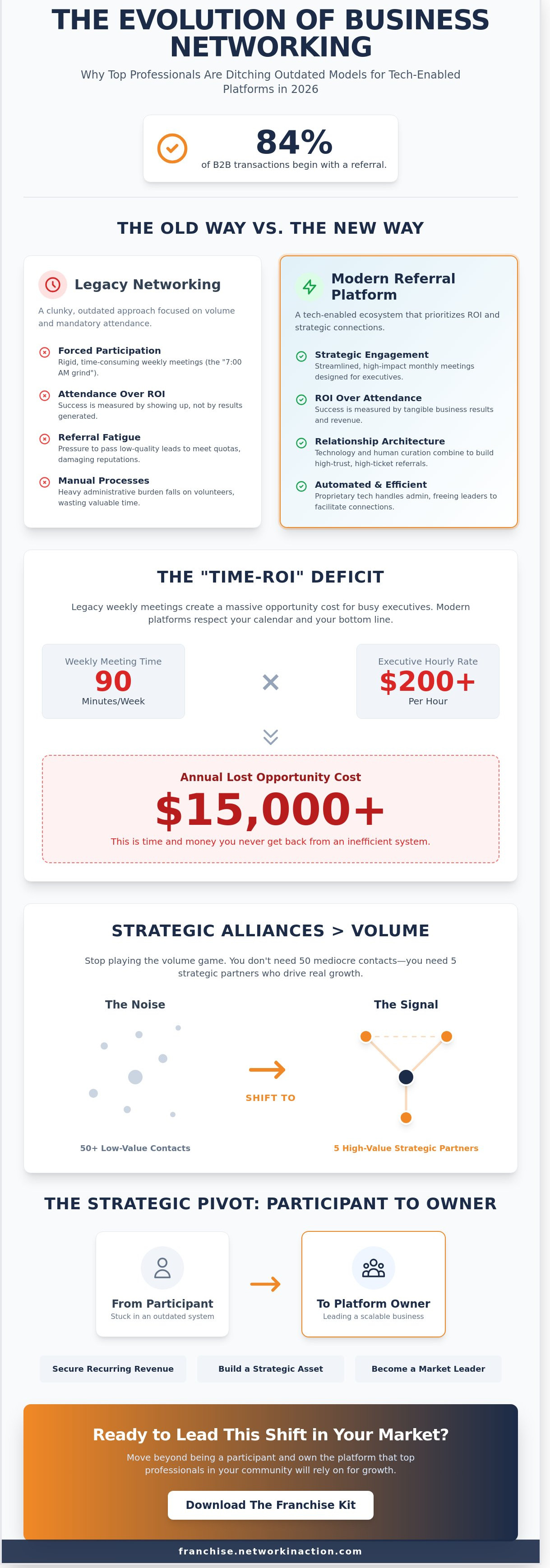
The era of the automated lead-bot is dead. While 84% of B2B transactions start with a referral, high-level executives are finding that automated software alone fails to build real trust. You've likely felt the frustration of legacy networking organizations that force you into rigid weekly schedules; it's a clunky, outdated approach that treats your professional network like a volume game rather than a strategic asset. This article reveals why top-tier professionals are pivoting toward a tech-enabled business referral platform that prioritizes ROI over attendance.
You deserve a system that respects your schedule and your bottom line. You'll discover how to leverage proprietary technology to lead a high-caliber community, generating recurring revenue without the 7:00 AM grind. The following sections break down the shift from manual outreach to a scalable, modernized model that turns social capital into a measurable business result for 2026. It's time to move beyond software and step into a leadership role that actually scales.
Key Takeaways
- Shift from rigid software to a tech-enabled business referral platform that prioritizes curated B2B connections over high-volume, low-value automated noise.
- Maximize your "Time-ROI" by replacing the forced participation of legacy networking organizations with a streamlined, monthly engagement cadence designed for the executive schedule.
- Avoid the "referral fatigue" of pure automation by implementing relationship architecture that balances proprietary technology with professional facilitation for high-ticket growth.
- Identify the strategic roadmap to transition from a mere participant to a platform owner, securing recurring revenue through a scalable professional franchising model.
Defining the Modern Business Referral Platform: More Than Just Software
A business referral platform is not a simple dashboard or a digital Rolodex. It is a sophisticated, structured ecosystem that fuses proprietary technology with high-level professional community management. By 2026, the divide between basic automation and executive-led growth will be absolute. While B2C models often rely on high-volume, low-trust lead generation, a true business referral platform focuses on the extraction of value from elite professional circles. It's a system built for those who value time as their most precious asset. It moves beyond the limitations of "automated referral software" by prioritizing the quality of the connection over the quantity of the data points.
The 2026 market demands a hybrid approach. Technology provides the speed; human curation provides the trust. This synergy allows social capital to be measured and liquidated like any other asset. Research from 2024 indicates that 84% of B2B decision-makers start their buying process with a referral. For high-ticket service providers, a digital-only approach is insufficient. You need a platform that facilitates Referral marketing through structured accountability and professional vetting. This isn't just networking; it's a precision-engineered growth engine.
The Evolution of Professional Connectivity
Physical business cards are relics of a 1995 mindset. Legacy networking organizations continue to fail the modern executive because they prioritize attendance over ROI. These outdated models rely on rigid, time-consuming weekly meetings that offer little value to a busy professional. Networking evolved. The shift toward digital-first referral architectures allows for curated circles where quality is the only metric that matters. In these elite environments, 90% of the noise is filtered out, leaving only high-value opportunities and strategic alliances.
Software Tools vs. Integrated Platforms
Standalone referral apps are often nothing more than "cold lead" generators for high-ticket services. They lack the context and credibility required to close a $100,000 contract or a complex partnership. Integrated platforms solve this by facilitating "warm" introductions backed by professional community leaders. These platforms ensure that every referral is pre-qualified and relevant to your specific business goals. A business referral platform is a force multiplier for professional credibility. If you are ready to lead this shift in your own market, you can download the franchise kit to see how this model scales. It's time to replace clunky, manual processes with a streamlined, technology-led solution that delivers measurable results.
The ROI of Connectivity: How Technology Disrupts Traditional Networking
Networking evolved. It's no longer about how many business cards you can collect in a crowded room; it's about how much revenue you can generate through a streamlined business referral platform. Legacy networking organizations rely on a 52-week-a-year grind that treats attendance as the primary metric of success. This forced participation creates a massive "Time-ROI" deficit for high-level executives. If your time is worth $200 per hour, a weekly 90-minute meeting costs you over $15,000 annually in lost opportunity costs alone. Modern platforms disrupt this cycle by shifting the focus from quantity to quality, replacing weekly obligations with high-impact monthly engagements that respect your calendar.
Proprietary technology now handles the heavy lifting that used to fall on group volunteers. Automation eliminates the administrative burden of tracking attendance, guest lists, and follow-ups. This allows group leaders to focus on what matters: facilitating high-value introductions and driving business logic. By using a tech-forward business referral platform, members gain access to real-time data that tracks referral velocity and ensures every participant remains accountable to the group's collective growth.
Solving the Inefficiency of Outdated Models
Outdated networking models often fall into the trap of "forced referrals." This happens when members feel pressured to pass any lead, regardless of quality, just to satisfy a weekly quota. This practice isn't just inefficient; it's damaging to your professional reputation. Modern platforms prioritize curated membership through rigorous screening processes. By limiting groups to seasoned professionals and business owners, the "open-door" chaos of traditional groups is replaced by a sophisticated environment where every conversation has a clear path to ROI. You don't need 50 mediocre contacts; you need five strategic partners who understand your value proposition.
Measuring Social Capital and Referral Value
Data is the bridge between a casual conversation and a closed deal. A Wharton study on customer value highlights that referred customers are 16% to 25% more loyal and have a higher lifetime value. NIA members leverage proprietary technology to monitor these metrics with surgical precision. The platform tracks exactly who is providing the most value, allowing you to identify your most productive referral partners instantly. This transparency ensures long-term relationship health by removing the guesswork from networking. If you're ready to see how this data-driven approach scales, you can explore available territories to lead a group in your market.
Referral Automation vs. Relationship Architecture: Choosing Your Growth Engine
Pure automation is the fastest way to kill a professional reputation by 2026. While software can blast thousands of messages, high-level executives delete automated outreach within 2.5 seconds. This creates "referral fatigue," a state where quality prospects ignore every notification because the signal-to-noise ratio has collapsed. A sophisticated business referral platform doesn't just send data; it facilitates trust. High-ticket B2B deals, often exceeding $100,000, require a "Human-in-the-Loop" approach. Professional facilitation ensures that every introduction carries the weight of a personal recommendation rather than the cold friction of an algorithm.
The distinction between lead generation and referral generation is absolute. Lead generation is a volume game based on raw data and cold prospecting. It's a race to the bottom that yields a 2% conversion rate on average. Referral generation is about transferred trust. By 2026, the most successful firms will stop chasing leads and start architecting relationships. They'll use technology to identify the right connections while relying on human intelligence to bridge the gap. This hybrid model ensures that 91% of B2B sales influenced by referrals actually close, compared to the dismal rates of automated funnels.
The Case for Relationship Architecture
Relationship architecture is about building a defensive moat around your business. You don't just "network"; you construct deep professional alliances that legacy networking organizations can't replicate. A structured business referral platform provides the framework for consistent, predictable growth without the rigid, time-wasting requirements of outdated models. It allows you to move away from transactional interactions toward strategic partnerships. Find out more in our free book on modern networking to see how this architecture transforms social capital into measurable ROI.
Scalability Through Technology
Scalability doesn't mean removing the human element; it means amplifying it. Modern executives are moving from "one-to-one" networking to "one-to-many" group leadership. This shift allows you to own the network rather than just participating in it. By leveraging proprietary technology and CRM integration, you can manage hundreds of high-value relationships with the same precision you'd use for a single client. It's about efficiency. You gain the ability to track every referral, measure every interaction, and ensure that your time is spent only on the most productive alliances. This is how you scale a professional community while maintaining the elite, personal touch that high-level business demands.
Key Features of a High-Performance Business Referral Platform
Efficiency is the only metric that matters for a modern executive. A high-performance business referral platform must function as a sophisticated profit engine, not a digital Rolodex. The shift toward results-oriented networking requires a foundation built on four critical pillars that prioritize time and ROI. Traditional networking often fails because it lacks the structural integrity to support high-level professionals. By contrast, a modernized system uses proprietary technology to manage member interactions and track every referral with surgical precision.
The monthly meeting cadence is a primary differentiator. Legacy networking organizations often demand 52 meetings a year, resulting in over 100 hours of lost productivity. A streamlined model respects the executive schedule by meeting just once per month. This 75% reduction in time commitment doesn't sacrifice results; it intensifies them. When high-caliber leaders gather less frequently, the quality of interaction increases. Cross-industry exclusivity further protects this environment. By allowing only one professional per niche, the platform eliminates internal competition and ensures 100% of the referral flow in a specific category goes to a single member.
A "turnkey" operational model allows for rapid community building. Instead of spending months guessing at best practices, leaders use a proven framework to launch and scale. This systematic approach ensures that the business referral platform remains a value-add rather than a management burden.
Essential Technology for Modern Referral Groups
Technology shouldn't just record interactions; it must catalyze them. Busy professionals require mobile-first access to track leads while moving between appointments. Automated reporting replaces the manual spreadsheets seen in outdated networking models. Members gain access to real-time ROI dashboards that quantify the exact value of their membership. Download the NIA Franchise Kit to see our tech in action and discover how these proprietary systems drive consistent engagement.
Operational Excellence and Support
Success in this industry isn't accidental. It's the result of professional training that turns a group leader into a community architect. A proven system reduces the risk of community stagnation, which affects nearly 65% of independent networking groups within their first two years. This efficiency creates lifestyle autonomy. Franchisees manage elite communities in roughly 20 to 25 hours per month. This allows for true professional freedom and recurring revenue without the 60-hour workweeks required by legacy business models.
Ready to lead a high-level professional community in your city? Explore available territories to start your journey.
From Participant to Platform Owner: The Strategic Pivot to Professional Franchising
The corporate ladder has a ceiling; platform ownership does not. For the high-level executive, the transition from participant to owner represents the ultimate career pivot. You shift from spending 40 hours a week on cold prospecting to spending a fraction of that time leading an elite community. It's about leverage. By 2026, the demand for curated, high-ROI professional spaces is projected to grow by 22% as business owners flee the noise of unmoderated digital groups. You aren't just running a group; you're managing a high-performance engine that generates value for every stakeholder involved.
Ownership transforms your social capital into a scalable asset. The economics of a modern business referral platform rely on high-margin recurring revenue. Unlike traditional consulting where you trade hours for dollars, a franchise model allows you to build a self-sustaining ecosystem. You identify high-growth zones by analyzing local business density and industry gaps. These available territories are the foundations of your future empire. Successful franchisees often see their first group reach capacity within months because the market is starved for professional structure and real accountability.
Building Your Empire with a Proven Model
Starting a networking group from scratch is a recipe for burnout. You'd have to build the tech, the vetting process, and the brand identity alone. The NIA model eliminates those hurdles. It provides a turnkey system that supports franchisees in cultivating groups of high-earning business owners. You get the proprietary technology and the structural blueprint immediately. This allows you to focus on high-level strategy rather than administrative minutiae. You can explore available territories for your NIA franchise to see where your leadership is needed most.
The Future of Networking: Informed Disruption
Legacy networking organizations are failing because they rely on rigid, 1980s-era rules. The industry is ripe for disruption by tech-forward leaders who value efficiency over ceremony. As a Visionary Architect, you don't just host meetings; you engineer connections that drive real-world ROI. You're the bridge between local talent and global opportunity. The shift to professional franchising is the smartest move for those who want to own the room, not just sit in it. Join the evolution of business networking and claim your seat at the head of the table.
Own the Future of Professional Connectivity
The era of manual, time-intensive networking is over. Legacy networking organizations rely on rigid weekly schedules and forced referrals that drain executive energy without delivering measurable growth. A modern business referral platform demands more. It requires a sophisticated relationship architecture backed by proprietary ROI-tracking technology and a streamlined monthly meeting model designed specifically for high-level leaders. This shift isn't just about efficiency; it's about the strategic pivot from a mere participant to a high-impact platform owner.
With 150+ global locations already operational, Network In Action has successfully disrupted the traditional landscape. It's time to stop settling for outdated models and start leveraging a system built for the 2026 economy. You've seen the data and you understand the scalability of recurring revenue. Now, align your professional influence with a turnkey solution that prioritizes your lifestyle and your bottom line. Success in the next decade belongs to those who control the environment where business happens.
Join the Future of Networking: Explore NIA Franchise Opportunities
The next evolution of your professional legacy is ready when you are.
Frequently Asked Questions
How does a business referral platform differ from a standard CRM?
A business referral platform prioritizes active revenue generation through curated introductions rather than simple data storage. While a CRM tracks existing customers, this platform drives new growth by automating referrals and tracking real-world ROI. Data from 2024 shows that 84 percent of B2B buyers start their process with a referral. A standard CRM is a passive database; this platform is an active engine for high-level business development.
Why are legacy networking organizations considered inefficient for modern executives?
Legacy networking organizations fail because they demand 50 plus hours of attendance annually for low-quality, transactional returns. These outdated models rely on rigid weekly meetings and forced referral quotas that prioritize quantity over genuine professional alignment. Modern executives don't have time for "passing business cards" in a room of entry-level sales reps. They require a streamlined, tech-enabled environment that delivers high-caliber connections without the "old-school" administrative bloat.
Can I use a business referral platform for high-ticket B2B services?
You can absolutely use a business referral platform to scale high-ticket B2B services that require deep levels of professional trust. High-value contracts often involve sales cycles of 6 to 12 months, making warm, vetted introductions critical for closing deals. By leveraging a structured platform, you connect with decision-makers who have the budget and authority to sign. This replaces cold prospecting with high-trust advocacy, ensuring your pipeline remains full of qualified opportunities.
What is the ROI of owning a networking franchise versus just joining a group?
Owning a networking franchise transforms social capital into a scalable, recurring revenue stream with profit margins that often exceed 40 percent. While members gain referrals, owners build a tangible asset that generates monthly income while positioning them as the central authority in their market. It's the difference between being a participant and being the architect of the ecosystem. Franchisees leverage a turnkey system to build influence and equity simultaneously.
How much time does it take to lead a professional referral group effectively?
Effective leadership takes approximately 10 to 15 hours of active management per month when using a technology-enabled platform. This efficiency is possible because proprietary software automates the administrative heavy lifting like attendance tracking and referral reporting. Unlike traditional models that demand 20 plus hours of manual labor, this streamlined approach allows leaders to focus on high-level relationship building. It's designed for professionals who value their time and lifestyle autonomy.
What technology is required to run a modern business referral platform?
Running a modern platform requires a proprietary tech stack that integrates mobile accessibility, ROI tracking, and automated communication tools. You don't need a computer science degree; you need a turnkey solution that handles the data for you. This technology ensures that every referral is documented and every member's participation is quantified. Effective platforms utilize 2024-standard encryption and cloud-based synchronization to keep busy executives connected on the go without manual spreadsheets.
Is a business referral platform better than social media networking?
A business referral platform is superior because it facilitates deep trust that 5,000 LinkedIn connections simply cannot replicate. Social media is a broadcast tool, but a dedicated platform is a conversion tool. Research indicates that 73 percent of executives prefer structured networking over digital-only interactions. While social media offers visibility, a structured platform offers accountability and a closed-loop system where professionals are incentivized to help one another succeed through verified results.
How do I know if a specific territory is available for a networking franchise?
You can verify territory availability by requesting a current market map from the franchise development team. Territories are typically mapped by zip code or population density to ensure each owner has an exclusive market of at least 50,000 to 100,000 business professionals. Securing a territory in 2024 requires a discovery process to ensure alignment between your goals and the brand's vision. Don't wait for your local market to be claimed by a competitor.