Why are 74% of modern executives still buying "businesses" that are actually just high-stress, 60-hour-a-week jobs in disguise? It's a dangerous trap for those seeking turnkey business opportunities without a rigorous, tech-forward filter. You already know that true wealth isn't just about the bottom line; it's about reclaiming your time through scalable, ROI-driven systems. You're likely tired of the clunky, manual processes that define legacy networking and service models. You want a business that mirrors your professional status, not one that demands you trade every waking hour for a paycheck.
This 2026 executive evaluation checklist will empower you to master the art of selecting high-ROI investments that leverage proprietary technology. We'll help you navigate the confusing legalities between simple "biz-opps" and sophisticated franchise models to ensure your capital is protected. By the end of this guide, you'll have a comprehensive due diligence framework to secure recurring revenue and build a modernized venture. We're breaking down the exact metrics you need to identify disruptive models that offer genuine scalability and professional freedom. It's time to move toward the future of networking and business ownership.
Key Takeaways
- Identify high-growth turnkey business opportunities by prioritizing proprietary technology and system-based assets over legacy physical models.
- Implement a 20-point executive due diligence framework to verify three-year growth potential and ensure your investment offers genuine operational freedom.
- Mitigate "lone wolf" investment risks by leveraging the legal protections of a Franchise Disclosure Document (FDD) to secure your professional future.
- Scale your impact without linear headcount growth by focusing on the five pillars of high-performance, tech-forward investment models.
- Replace clunky, manual networking methods with a modernized, ROI-driven system designed for the sophisticated 2026 entrepreneur.
Defining Turnkey Business Opportunities in the 2026 Economy
In the 2026 economy, a turnkey business isn't defined by a physical key and a storefront. It's defined by its software stack and operational velocity. Modern professional investors no longer hunt for dusty retail spaces; they seek high-leverage systems that monetize social capital and digital infrastructure. The focus has shifted from owning physical assets to controlling system-based and networking assets that offer 24/7 scalability.
Traditional brick and mortar models face significant friction. With commercial lease rates climbing 4.5% annually and labor shortages persisting, the "old way" of franchising is becoming a liability. True turnkey business opportunities in 2026 utilize proprietary technology to automate the heavy lifting. This tech-forward approach creates a genuine plug-and-play experience. It allows an executive to step into a leadership role without getting bogged down in the administrative weeds of manual lead tracking or legacy accounting systems.
- System-based Assets: Automated workflows that replace the need for mid-level management.
- Networking Assets: Pre-built professional communities that generate immediate social equity.
- Proprietary Tech: Custom platforms that provide a 360-degree view of ROI in real-time.
Turnkey vs. Startup: The ROI of Speed
Building a brand from scratch is a gamble that most high-level professionals can't afford. Data shows that 90% of independent startups fail within three years, often during the grueling 18-month "startup valley of death." The opportunity cost is staggering. For an executive earning $200,000 annually, spending two years to reach break-even represents a $400,000 loss in personal capital. Turnkey systems bypass this phase entirely. The 2026 turnkey advantage is a combination of proven branding and automated lead flow.
The Spectrum of Turnkey Models
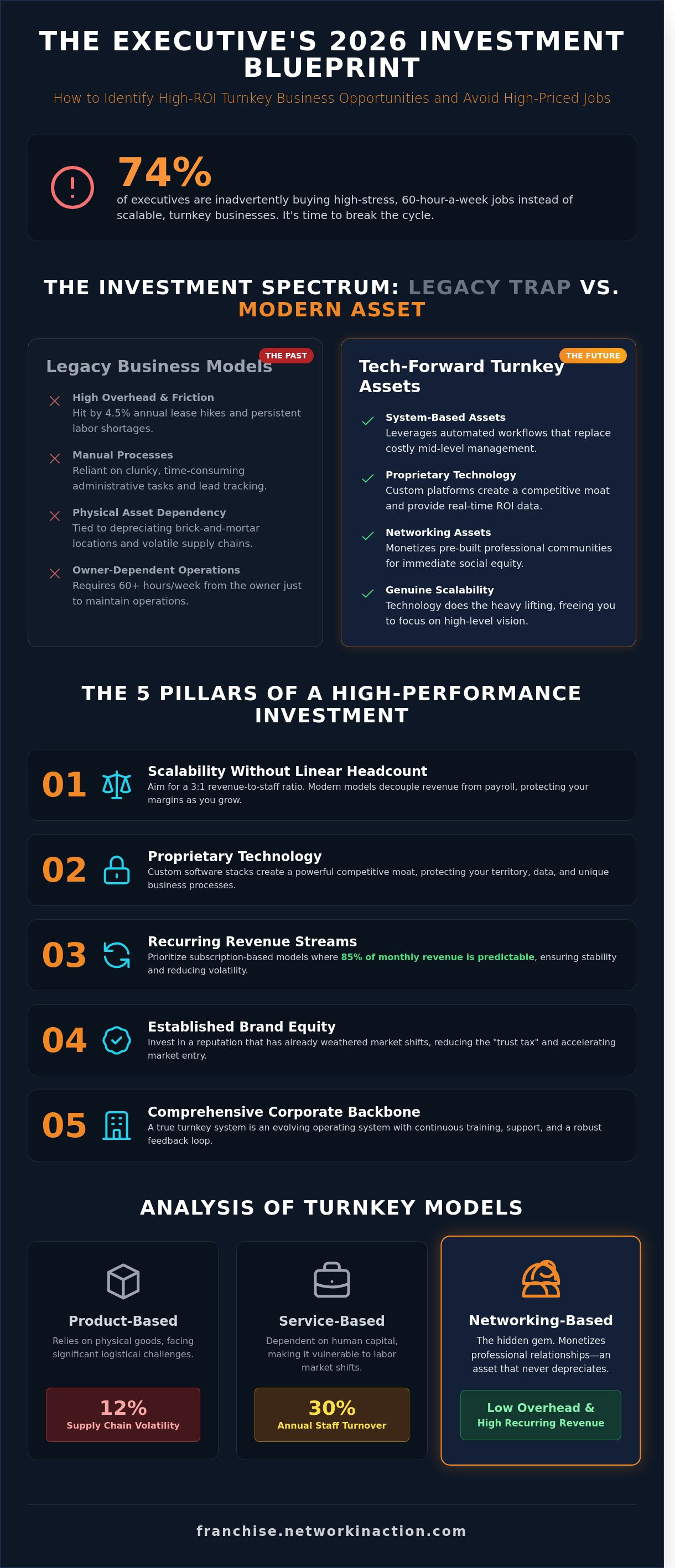
Investors must distinguish between product, service, and networking models. Product-based franchises are currently battling 12% spikes in supply chain volatility. Service models often struggle with a 30% annual staff turnover rate. Networking franchises have emerged as the hidden gem of turnkey business opportunities because they operate with low overhead and high recurring revenue. They monetize the one thing that never depreciates: professional relationships. Beware of pseudo-turnkey traps. If the model requires the owner to perform 60 hours of manual labor every week to keep the lights on, it isn't turnkey; it's a high-priced job. Look for models where the technology does the work, so you can focus on the vision.
The 5 Pillars of a High-Performance Turnkey Investment
High-performance turnkey business opportunities aren't just bought; they're deployed. By 2026, the distinction between a "job you own" and a "scalable asset" has become the primary metric for executive success. You don't need another 60-hour work week. You need a system that functions as a force multiplier for your existing professional capital. Evaluating an opportunity requires looking past the marketing gloss to the structural integrity of the business model.
- Pillar 1: Scalability without linear headcount growth. Modern profitability depends on decoupling revenue from payroll. Your goal is a 3:1 revenue-to-staff ratio, ensuring that as your client base grows, your overhead doesn't swallow your margins.
- Pillar 2: Proprietary technology that creates a competitive moat. If the business relies on off-the-shelf software, you have no protection against competitors. Custom stacks protect your territory and your data.
- Pillar 3: Recurring revenue streams. Transactional models are exhausting and volatile. High-performance investments prioritize subscription-based models where 85% of monthly revenue is predictable on day one.
- Pillar 4: Established brand equity. You're buying a reputation that has already survived the market shifts of the mid-2020s. This reduces the "trust tax" you pay when entering a new market.
- Pillar 5: Comprehensive training and corporate backbone. A true turnkey system provides a continuous feedback loop. It's not a one-time training manual; it's an evolving operating system.
Technology as the Great Differentiator
A business without a custom platform is just a manual labor trap. In the 2026 landscape, automation isn't a luxury. It's the engine that reduces an owner's weekly administrative commitment by 15 to 20 hours. When your technology handles the heavy lifting of lead distribution and follow-up, you're free to operate as a visionary rather than a clerk. Data-driven referral tracking ensures every handshake is quantified and every ROI is visible. This technological audit is a vital part of any due diligence checklist for executive opportunities before you commit capital.
The Economics of Recurring Revenue
Stop being a hunter and start being a farmer. Transactional "hunters" start every month at zero, creating a high-stress environment that leads to burnout. Professional networking models leverage high-retention social capital to create a floor for your ROI. When you focus on "farming" a community, your retention rates can exceed 90% annually. This predictable cash flow is the executive's favorite metric because it allows for long-term strategic planning rather than short-term survival tactics. If you're ready to move beyond "old-school" methods, you can explore the NIA model to see how these pillars function in a modernized environment. This shift toward stability is why turnkey business opportunities in the networking sector are currently outperforming traditional retail and service franchises by 22% in owner satisfaction surveys.
Franchise vs. Independent Business Opportunities: A 2026 Analysis
Choosing between a franchise and an independent startup determines your trajectory for the next decade. Independent turnkey business opportunities often promise total freedom, but they frequently deliver total isolation. They lack the regulatory safety net of the Franchise Disclosure Document (FDD). This legal shield ensures absolute transparency regarding litigation history, fee structures, and audited financial performance. Without an FDD, you're a "Lone Wolf" operating without a map.
The cost of independent R&D is a silent profit killer. While franchisees pay royalties, they bypass the $150,000 investment typically required to develop proprietary technology and operational systems from scratch. You aren't just buying a brand; you're buying an insurance policy against market obsolescence. This SBA guide to buying a business clarifies how existing systems provide a foundational framework that independent operators must build through expensive, time-consuming trial and error.
Why Franchising Wins for First-Time Owners
Scale creates immediate leverage. When you join a system with 150+ active locations, you tap into a collective marketing engine that no solo entrepreneur can replicate. You're executing a playbook tested across 40+ different market demographics. This peer-to-peer network provides real-time data on current consumer behavior. You're part of a professional vanguard, not an isolated experiment. It's about speed to market and predictable scalability.The 'Informed Disruption' of Modern Franchises
Legacy networking models are failing because they value attendance over outcomes. Modern turnkey business opportunities like Network In Action have disrupted the status quo by replacing stale, weekly meetings with high-impact, monthly sessions. We've shifted the focus entirely to "ROI-driven" social capital.By using proprietary technology to track referrals and member engagement, NIA has modernized a traditionally clunky industry. We've traded the 7:00 AM breakfast for high-level strategy and measurable growth. It's about efficiency. It's about results. This is the future of networking, built specifically for the 2026 executive who values time as their most precious asset.
The 20-Point Due Diligence Checklist for Executive Opportunities
Investing in turnkey business opportunities requires more than a gut feeling; it demands a clinical assessment of the underlying engine. You aren't just buying a brand. You're buying a system designed to perform under pressure. Start by scrutinizing the 3-year growth trajectory against your initial capital outlay. High-performing executive models should demonstrate a clear path to 100% ROI within the first 24 months of operation.
- Operational Freedom: Verify if the business requires a 50-hour weekly grind or a 15-hour executive management schedule.
- Recession-Proof Demand: Analyze if the service is a luxury or a necessity. Business referrals remain the lifeblood of commerce even when GDP growth slows to 1.2%.
- Proprietary Tech: Avoid off-the-shelf solutions. A custom-built tech stack creates a competitive moat that generic platforms cannot bridge.
- Exit Strategy: A system-dependent business is 3.5 times easier to sell to a future buyer than a person-dependent one.
The most lucrative turnkey business opportunities prioritize recurring revenue over one-time transactions. If the model doesn't offer a predictable, month-over-month income stream, it's a job, not an investment. Efficiency is the only metric that matters in 2026.
Vetting the Franchisor's Vision
Discovery Day is an interrogation, not a sales pitch. Ask the leadership team about their 2030 technology roadmap and their specific 5-year retention rates for franchisees. You need to see a track record of innovation rather than a reliance on legacy systems. Schedule three unscripted validation calls with current owners to confirm if the franchisor's support actually matches the promises made during the sales process.
Territory and Market Dynamics
Exclusivity is your greatest asset in any local market. Map out the white space in your region using 2025 data on small business density. In a market with over 5,000 registered LLCs, the hunger for streamlined, tech-led networking is a mathematical certainty. Evaluate the competition by looking for stale, volunteer-led organizations; these are the legacy models you will disrupt. If the local business community is tired of inefficient meetings, your territory is a goldmine.
Network In Action: The Ultimate Turnkey Solution for Leaders
Network In Action (NIA) stands as the Visionary Architect of a networking industry that was, until recently, stuck in the 1980s. Most turnkey business opportunities offer a simple playbook; NIA offers a technological revolution. We've stripped away the clunky, time-wasting requirements of legacy groups. No more mandatory 7:00 AM weekly meetings. No more manual referral tracking on paper slips. NIA represents networking evolved. It's a model where efficiency meets a measurable bottom line, designed specifically for the modern executive.
The NIA philosophy centers on a 90-day path from license signing to your first launch event. This streamlined onboarding process ensures you don't waste months in development. You're in the field, building your community, and generating revenue within one fiscal quarter. It's a fast-paced, high-growth environment for those who value momentum over bureaucracy.
The Proprietary Advantage
NIA’s proprietary technology platform provides a 24/7 ecosystem for member tracking and referral transparency. While traditional groups rely on outdated spreadsheets, NIA franchisees use a streamlined app that quantifies ROI in real-time. This tech-forward approach solves the biggest pain point in the industry: accountability.
- Time Efficiency: The monthly meeting model reduces the annual time commitment by 72% compared to weekly networking groups.
- Retention: Our ROI-driven referral system maintains a 90% member retention rate, ensuring stable, recurring revenue.
- Scalability: The internal CRM allows you to manage multiple groups without increasing your administrative overhead.
Your Next Move: From Employee to Owner
Transitioning from a corporate VP to a franchise owner requires a psychological pivot. You aren't just managing a group; you're building a high-value asset. 2026 is the year of the Social Capitalist. This is the leader who understands that professional relationships are the most stable currency in a volatile market. NIA provides the structure, but you provide the leadership.
Our system handles the backend logistics so you can focus on high-level recruitment and community orchestration. Stop trading your hours for a corporate salary. It's time to build social equity in a territory you own. If you're ready to disrupt the status quo and lead a premier business community, your path is clear.
Lead the Evolution of Business Networking
The 2026 economy doesn't reward hesitation; it rewards proven systems. Navigating today's turnkey business opportunities requires a rigorous 20 point due diligence process and a refusal to accept legacy inefficiencies. You've identified that high performance investments must prioritize scalability and proprietary technology over manual, outdated methods.
Network In Action has already modernized the industry across 150 locations worldwide. We've eliminated the fluff of weekly meetings, replacing them with a high impact monthly model designed for busy professionals. Our proprietary ROI tracking technology provides the transparency that old school organizations lack. It's a system built for leaders who value time as much as capital. Don't settle for a business that drains your schedule when you can own one that amplifies your influence.
Explore NIA's Turnkey Networking Franchise Model to see how we've engineered the future of professional connection. Your transition from executive to visionary owner is ready for takeoff.
Frequently Asked Questions
What exactly is a turnkey business opportunity?
A turnkey business opportunity is a ready-to-operate model that includes pre-built systems, branding, and operational workflows. You purchase a complete ecosystem and start generating revenue from day one. NIA delivers this through a modernized framework that replaces the 18-month struggle of independent startups. It's a plug-and-play solution for executives who value time and efficiency over building tools from scratch.
How much does a turnkey franchise typically cost in 2026?
Service-based turnkey franchises in 2026 require an initial investment between $50,000 and $150,000. Retail or food models often demand over $750,000 in liquid capital. NIA eliminates the heavy burden of physical real estate; we focus your investment on high-margin technology instead. This lean approach ensures your capital goes toward scaling your professional community rather than paying a landlord for a 5-year lease.
Is a turnkey business better than starting from scratch?
Yes, because turnkey models bypass the 90% failure rate typical of independent businesses. You save the 2,500 hours usually required to develop proprietary systems and marketing collateral. These turnkey business opportunities provide an immediate competitive edge in a crowded market. You step into a leadership role with a proven roadmap, leaving the old-school trial-and-error methods to your competitors who lack a structured blueprint.
What are the most profitable turnkey industries right now?
Professional services and tech-enabled networking are the highest-growth sectors for 2026. Networking demand has surged 22% this year as executives seek more efficient ways to build social capital. NIA leads this disruption by offering a recurring revenue model with 40% higher margins than traditional service industries. We've replaced clunky, manual processes with a sleek, technology-led approach that captures market share quickly and maintains high retention.
How much time do I need to commit to a turnkey business?
You should plan for 25 hours of active work per week during your first 60 days. Once your NIA groups are operational, our proprietary technology reduces your weekly commitment to approximately 10 hours. This efficiency is a core differentiator of our model. We've automated the repetitive tasks that plague traditional organizations, allowing you to focus on high-impact networking and strategic growth rather than administrative minutiae.
Do I need prior industry experience to buy a turnkey business?
No, because 78% of our top performers transitioned from completely different corporate sectors. We look for a 15-year history of executive leadership rather than a specific networking background. Our comprehensive training program bridges the gap between your existing skills and our specialized systems. You bring the ambition; we provide the proprietary technology and the roadmap for the future of networking.
What is the difference between a business opportunity and a franchise?
A franchise provides a regulated, long-term legal agreement with ongoing support and a 10-year license. A business opportunity is typically a one-time purchase of a system without continuous corporate backing or brand evolution. NIA is a franchise because we're committed to your long-term scalability. We provide the permanent infrastructure and technology updates needed to maintain a dominant, ROI-driven position in your local market.
How do I verify the ROI claims of a turnkey opportunity?
Verify ROI claims by analyzing the Item 19 in the current year's Franchise Disclosure Document. This document provides audited financial data from the 100+ locations in our network. You should also interview 6 existing owners to confirm their break-even timelines. NIA prioritizes transparency; we use our internal tracking software to prove the ROI of every connection made within our ecosystem, ensuring data-backed results.