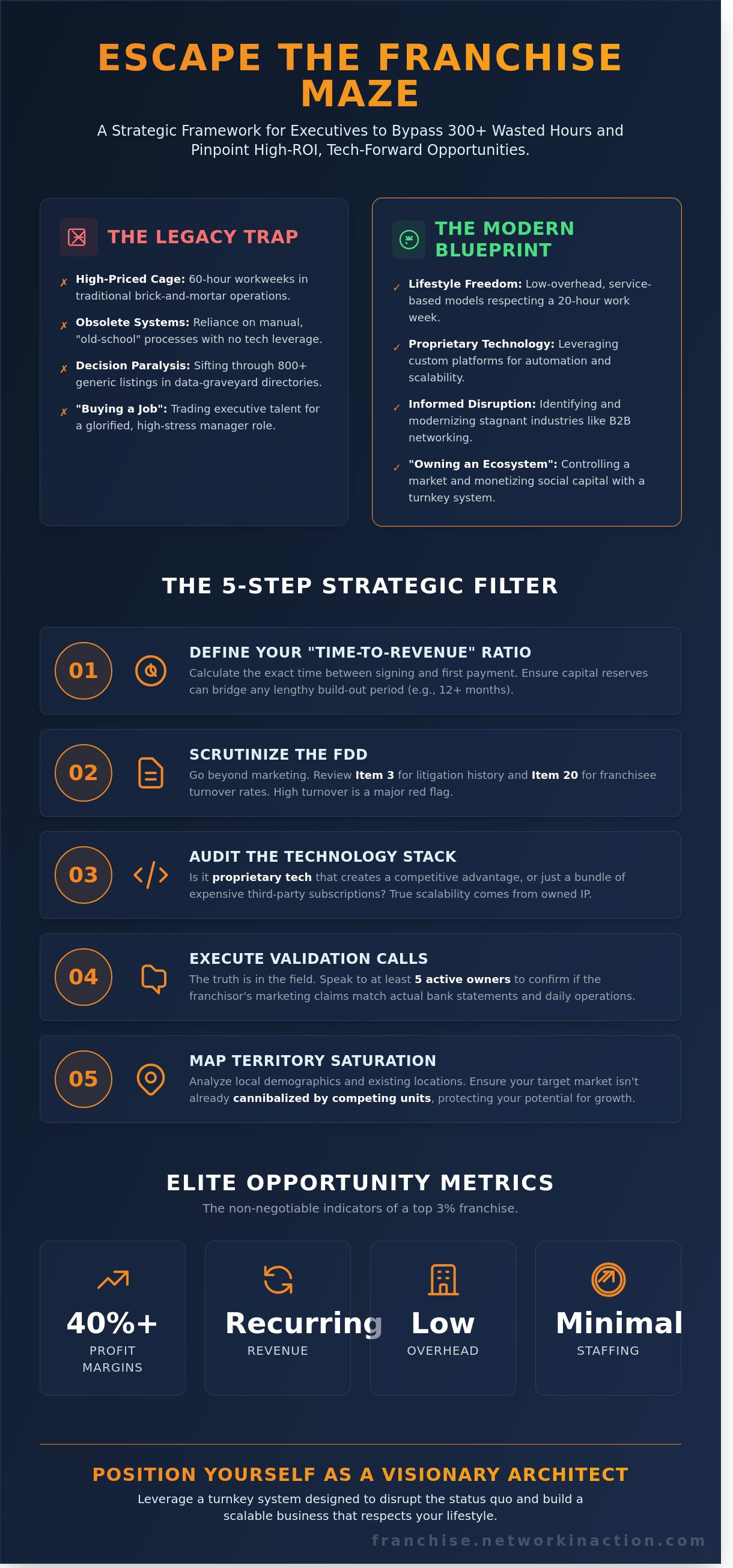
Most high-level professionals spend over 300 hours scouring thousands of available franchise opportunities only to accidentally purchase a legacy business model that’s already obsolete. It's a massive waste of executive talent. You know that a traditional brick-and-mortar operation with 60-hour workweeks isn't the path to freedom; it's just a high-priced cage. You want a model that leverages proprietary technology and recurring revenue rather than one that relies on manual, old-school systems.
We agree that the current franchise landscape is cluttered with stale concepts that demand maximum time for minimum returns. This guide provides the strategic framework you need to filter out the noise and identify the top 3% of opportunities that offer informed disruption in 2026. We'll master the specific metrics for scalability and the tech-forward filters required to secure a high-ROI business that respects your professional lifestyle. It's time to stop browsing and start executing on a model built for the future of networking and business ownership.
Key Takeaways
- Master a strategic 5-step framework to bypass decision paralysis and pinpoint high-ROI businesses that align with your professional lifestyle.
- Learn how to filter thousands of available franchise opportunities by prioritizing "Time-to-Revenue" and vetting FDDs for long-term scalability.
- Discover why low-overhead, service-based models driven by recurring revenue are outperforming legacy retail operations in the 2026 market.
- Identify the critical "Technology Gap" and why a proprietary platform is essential for modernizing professional networking and maximizing social capital.
- Position yourself as a "Visionary Architect" in your community by leveraging a turnkey system designed to disrupt the status quo.
The Landscape of Available Franchise Opportunities in 2026
The 2026 market demands more than just a recognizable logo. It requires a system that scales without the crushing weight of massive real estate or ballooning inventory costs. High-level investors are pivoting toward service-based models that leverage proprietary automation. As of January 2026, 68% of successful new owners prioritize low-overhead structures over traditional retail. This shift defines the current slate of available franchise opportunities. Success now hinges on "informed disruption." This involves identifying stagnant industries, like traditional networking or local marketing, and injecting them with modern efficiency. Understanding the fundamental Franchising business model is just the baseline. Elite entrepreneurs look for metrics that drive real wealth: recurring revenue, 40% plus profit margins, and minimal staffing requirements.
Why Traditional Franchise Lists Fail Executives
Most directories are data graveyards. They prioritize quantity, often dumping 800+ generic listings into a single search result. This creates decision paralysis. Executives don't need more options; they need the right ones. A "Best of" list rarely accounts for your 15-year career trajectory or your desire for a 20-hour work week. These lists often lead people to "buy a job" where they trade 60 hours a week for a modest salary. You shouldn't settle for a glorified manager role. True scalability requires a system that works when you don't. Networking evolved. It's time to transition from a practitioner to a network owner who controls the local market ecosystem.
The Rise of Professional Service Franchises
B2B networking is no longer a hobby; it's a high-margin professional service. Referral marketing grew by 24% in the last 18 months alone. Professional networking has evolved into a high-margin business opportunity because it solves the primary pain point of every business owner: consistent lead generation. Modern owners are monetizing social capital through streamlined, ROI-driven systems. These models focus on high-impact connections rather than manual coordination. A modern franchise replaces manual labor with proprietary technology. This evolution allows for rapid scalability without the friction of "old-school" manual processes. By focusing on available franchise opportunities in the professional services sector, you position yourself at the center of your local economy.
How to Filter Available Franchise Opportunities: A 5-Step Process
Filtering available franchise opportunities requires a surgical approach to due diligence. You aren't just buying a business; you're buying a system that must produce predictable results. Most investors waste 50 to 100 hours chasing brands that don't align with their financial goals. Follow this 5-step filter to separate the high-performers from the laggards.
- Step 1: Define Your "Time-to-Revenue" Ratio. Calculate the exact number of weeks between signing your agreement and collecting your first payment. If a model requires a 12 month build-out, ensure your capital reserves can bridge that gap.
- Step 2: Scrutinize the FDD. Review Item 3 for litigation history and Item 20 for franchisee turnover rates. The Federal Trade Commission's Consumer's Guide to Buying a Franchise provides a framework for identifying red flags in these legal disclosures.
- Step 3: Audit the Tech Stack. Determine if the franchisor relies on expensive third-party subscriptions or owns its intellectual property.
- Step 4: Execute Validation Calls. Speak to at least 5 active owners to confirm if the marketing claims match the actual bank statements.
- Step 5: Map Territory Saturation. Analyze local demographics to ensure your market isn't already cannibalized by existing locations or competing brands.
Auditing the Technology and Platform
Proprietary technology is the engine of scalability. If a franchisor hands you a stack of off-the-shelf software, they've failed to innovate. Custom platforms eliminate the administrative friction that kills growth. Ask about the 2024 development roadmap. You need a partner that automates lead tracking and reporting. Integrated systems can reduce weekly admin time by 10 to 15 hours, allowing you to focus on high-level networking and revenue generation.
The Validation Phase: Real ROI vs. Marketing
Marketing brochures always look great, but the truth lives in the validation call. Don't settle for vague answers. Ask current owners: "What is your actual member retention rate over the last 12 months?" or "How many months did it take to reach a 20% profit margin?" If a franchisor provides projections showing 90% margins without data to back them up, it's a red flag. Real ROI is driven by recurring revenue models that offer predictable cash flow. You can explore a tech-first business model that prioritizes these metrics to see how modern franchising should operate.
Analyzing the Economics: ROI, Recurring Revenue, and Scalability
Profit isn't accidental; it's engineered. Traditional brick-and-mortar models often require $250,000 to $500,000 in initial capital before a single customer walks through the door. Service-based models disrupt this old-school approach by eliminating high-rent storefronts and inventory spoilage. When evaluating franchise opportunities, savvy entrepreneurs prioritize low overhead to shorten the path to profitability. A lean operation allows you to focus on growth rather than managing a physical facility.
Recurring revenue is the engine of a high-performance business. One-off sales force you to start at zero every month, creating a cycle of constant pressure. Monthly membership models transform this dynamic. They create predictable cash flow and increase the lifetime value of every client. This stability allows for precise financial forecasting and aggressive expansion. In 2026, the most valuable available franchise opportunities are those that monetize connectivity.
- Break-even velocity: Traditional models often take 24 to 36 months to recoup costs; modern service models can reach that point in under 12 months.
- Predictable margins: Fixed tech fees replace fluctuating supply chain costs.
- Efficiency: Proprietary technology automates administrative tasks, keeping your focus on revenue-generating activities.
The True Cost of Ownership
A $40,000 or $50,000 initial fee is only the baseline. You must account for monthly royalties, which typically range from 5% to 10% of gross sales, and technology access fees. Retail franchises often carry a total investment exceeding $350,000 when including leasehold improvements. In contrast, networking franchises focus on intellectual property. Low-cost entry doesn't mean low margins. It means a higher percentage of every dollar stays in your pocket. You're buying a system, not a job.
Maximizing Your Social Capital
Your network is your net worth. Modern models turn professional relationships into a scalable business asset through the "Multiplier Effect." One referral can trigger a chain reaction of business growth across an entire community. Scalability isn't about working 80 hours a week; it's about using technology to manage multiple territories. A streamlined system allows a single owner to oversee 4 to 6 groups efficiently. You can scale your impact without doubling your workload. This is how you find the best available franchise opportunities in a crowded market.
The Technology Gap: Why Your Franchise Must Be Tech-Forward
Legacy networking organizations are losing market share because they're clunky. They rely on manual processes, paper referral slips, and outdated systems that fail to meet modern business needs. While traditional groups struggle to stay relevant, Network In Action (NIA) uses a proprietary technology platform to redefine professional connections. Since our founding in 2015, we've focused on one core mission: using tech to maximize ROI for every member.
Efficiency is the backbone of our scalability. Our digital infrastructure allows franchise owners to manage multiple groups across 150+ locations without drowning in administrative paperwork. We've replaced the chaos of manual tracking with a streamlined dashboard that monitors engagement and revenue in real-time. When you evaluate available franchise opportunities, you must ask if the brand is built for the 1980s or the 2020s. NIA is the only choice for the modern entrepreneur.
Modernizing the Monthly Meeting
Weekly 7 AM meetings are a relic of the past. They're time-consuming and often unnecessary for high-level executives who value their calendars. NIA's technology enables a monthly meeting model that respects a professional's schedule while maintaining high engagement. Our mobile app keeps the conversation going 24/7. Members track real-time ROI and engagement data on their phones, ensuring every minute spent in the room translates into measurable profit. This modernized approach provides a massive competitive advantage.
Lead Generation vs. Referral Generation
Traditional networking is about "passing cards," which is usually just cold lead generation. NIA uses data-driven insights to facilitate genuine referral generation. Our platform automates the "warm introduction" process; it ensures that when two members connect, the trust is already established. High-level professionals prefer this tech-enabled precision over old-school methods. This focus on quality over quantity drives long-term franchisee retention and member satisfaction. It's a sophisticated solution for a sophisticated market.
Leading the Future: Finding Your Fit with Network In Action
You don't just join a network; you build the engine that drives local commerce. As a Visionary Architect, you replace inefficient, "old-school" referral models with a high-tech, ROI-driven system. Network In Action (NIA) provides elite territories and the professional training required to dominate your market. While vetting available franchise opportunities, most leaders seek a balance of autonomy and proven structure. NIA delivers this through a turnkey model that allows seasoned professionals to transition from corporate roles to business ownership in exactly 90 days.
The Profile of a Successful NIA Franchisee
Success in this model isn't about sales; it's about influence. Former executives and consultants thrive here because they understand high-level strategy and professional accountability. You must be the primary "Connector" in your city. If you've spent 15 years or more managing teams or advising CEOs, you already possess the social capital required. Your next step involves requesting a territory availability report to secure your market before a competitor claims it. The discovery process is designed to filter for those ready to disrupt their local economy.
Owning the Network, Not Just Joining It
Stop paying dues to organizations that waste your time. The psychological shift from being a member to being the leader is where your legacy begins. You aren't just facilitating coffee chats; you're managing a professional community using proprietary technology that tracks every referral. This is networking evolved. It's time to stop searching and start leading. Explore Available NIA Territories and Start Your Journey today.
Before you commit to any available franchise opportunities, use this final checklist to see if you fit the NIA mold:
- Do you have 10 or more years of executive or consulting experience?
- Are you ready to exit the corporate grind in 90 days or less?
- Do you value technology-led efficiency over manual, "clunky" processes?
- Can you confidently lead a room of 30 plus high-level business owners?
- Are you looking for a recurring revenue model with minimal overhead?
If you checked every box, you aren't just a candidate; you're a future owner. The NIA system is built for those who demand measurable results and a scalable business model. Don't settle for a traditional franchise when you can own the future of professional networking.
Claim Your Stake in the Future of Networking
The window for legacy business models is closing fast. Evaluating available franchise opportunities in 2026 requires more than a glance at a balance sheet; it demands a deep dive into tech-forward scalability and modern time management. You've learned how to filter for ROI, identify the technology gap, and prioritize recurring revenue over manual labor. Success in this new landscape isn't about working more hours. It's about owning a system that works for you.
Network In Action has already disrupted the status quo across 150+ locations worldwide. We've replaced the exhausting weekly commitment of legacy models with a streamlined monthly meeting structure that respects your calendar. Our proprietary technology platform transforms social capital into a measurable asset, ensuring every connection delivers a clear return. Don't settle for a stale, old-school franchise when you can lead a sophisticated community of high-level professionals. The future is efficient, tech-driven, and ready for your leadership.
Join the Future of Networking-Explore NIA Franchise Opportunities
Your next chapter as a visionary leader starts today.
Frequently Asked Questions
What are the most profitable available franchise opportunities in 2026?
Service-based models and tech-integrated networking lead the 2026 market for profitability. While traditional retail struggles with 15% overhead increases, Network In Action offers a high-margin alternative focused on recurring revenue. These available franchise opportunities capitalize on the $500 billion professional services industry. You’re investing in a model that prioritizes efficiency over expensive inventory or massive real estate footprints.
How much liquid capital do I need to start a professional networking franchise?
You need a minimum of $50,000 in liquid capital to launch a professional networking franchise with Network In Action. This liquidity ensures you can cover the $40,000 to $60,000 initial investment while maintaining operational stability during your first 6 months. We look for partners who understand capital allocation and are ready to scale quickly. It’s about having the fuel to drive a high-performance engine from day one.
Can I run a Network In Action franchise while keeping my full-time job?
You can absolutely scale a Network In Action franchise while maintaining your current executive role. Our model requires roughly 10 to 15 hours of focused effort per week per group. This streamlined approach replaces the 40-hour grind of traditional networking models with proprietary systems that automate 70% of administrative tasks. It’s a side-hustle that yields professional-grade ROI without sacrificing your primary income stream.
What is the difference between a business opportunity and a franchise?
A franchise offers a regulated, turnkey system with ongoing support, while a business opportunity is typically a one-time purchase of a seller's kit. With NIA, you’re buying into a 10-year track record of success and a protected territory. Business opportunities lack the 24/7 support and proprietary tech stack that define our available franchise opportunities. You aren't just buying a job; you're acquiring a proven blueprint for disruption.
How do I check if a specific territory is available for a networking franchise?
You can check territory availability by submitting a zip code inquiry on our official franchise portal. We use a data-driven mapping tool to ensure every franchisee has a protected region of at least 100,000 residents or 5,000 businesses. Our team responds to these requests within 24 hours to confirm if your market is open for development. Don't wait, because prime territories in major metros are often claimed within 30 days of opening.
What kind of training does Network In Action provide to new franchisees?
Network In Action provides a comprehensive 3-day intensive training program at our Houston headquarters followed by 90 days of structured coaching. You’ll master our proprietary software and learn the exact sales scripts that have built over 100 successful groups. We don't leave your success to chance. Our training ensures you're ready to lead high-level boardrooms and deliver measurable value to your members from your very first meeting.
How does proprietary technology impact the ROI of a franchise?
Proprietary technology increases your ROI by automating member tracking and referral reporting, saving you 20 hours of manual labor every month. Our custom app allows members to track every dollar of passed business, proving the value of their $1,500 to $3,000 annual investment. When you can show a 10x return through hard data, member retention skyrockets. This tech-first approach transforms networking from a social hobby into a scalable, high-yield asset.
Is professional networking still a viable business model in the age of LinkedIn?
Professional networking remains more viable than ever because LinkedIn can't replicate the 95% trust factor found in curated, face-to-face groups. While digital platforms offer 1,000 surface-level connections, NIA facilitates deep, ROI-driven relationships that LinkedIn’s algorithm ignores. We’ve evolved the model to use tech for efficiency while doubling down on the human element. In a world of digital noise, a vetted, high-level referral network is the ultimate competitive advantage.